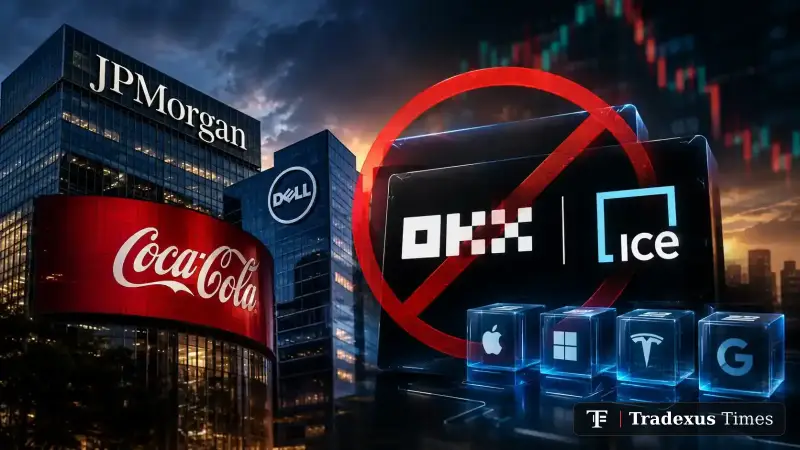
JPMorgan Chase, Coca-Cola and Dell Technologies are among the latest companies to object to their inclusion in a proposed tokenized stock trading venue developed by OKX and Intercontinental Exchange, bringing the total number of disclosed objections to 33. The latest notice, dated October 27, adds seven companies to the list, highlighting the challenges facing efforts to bring traditional equities onto blockchain-based trading infrastructure.
All seven newly disclosed objectors were among the 62 companies initially proposed for trading through the joint venture, OKXICE. That brings the number of objections from the original roster to 30, or approximately 48%. The broader list of 33 also includes companies that were not part of the original 62-stock selection, indicating that resistance extends beyond the initial group.
In this story
2 assets

The objections underscore a key challenge for tokenized securities: building the technology and regulatory framework for blockchain-based trading does not automatically secure the participation of the companies whose shares are involved. Issuers may need greater clarity about how their shares are represented, how trading operates and what benefits participation could offer before accepting a new market structure.
OKXICE outlined its proposal on October 4, describing a system designed to support round-the-clock trading through Uniswap v4 liquidity pools on OKX’s XLayer blockchain, with transactions settled in stablecoins. The model aims to combine blockchain infrastructure with automated market-making mechanisms, potentially allowing tokenized stock trading to operate beyond the conventional schedules of traditional equity markets.
The proposed venue would operate under the U.S. Securities and Exchange Commission’s five-year Innovation Exemption, which allows qualifying platforms to test tokenized stock trading using automated market makers. Under the stated process, companies have 30 days after notification to object to their inclusion. The framework provides room to experiment, but the growing number of objections shows that issuer participation remains a separate hurdle.
For the tokenization sector, the distinction matters. A trading venue may establish the infrastructure to facilitate transactions, but broad adoption also depends on the willingness of companies to participate and on the market structure gaining acceptance. If objections continue to grow, the venture may face a narrower pool of participating issuers than its original selection suggested. Conversely, companies that eventually agree to participate could help demonstrate whether blockchain-based equity trading can attract meaningful engagement from traditional financial markets.
OKXICE co-chairman Andrew Cuomo previously characterized the SEC initiative as a limited experiment, suggesting that some companies may prefer to observe how the market develops before making a decision. That wait-and-see approach reflects the uncertainty surrounding an emerging trading model. The next important developments will be the number of companies that ultimately remain eligible for the venue, how the regulatory experiment progresses and whether the proposed infrastructure can attract issuer participation at scale.