
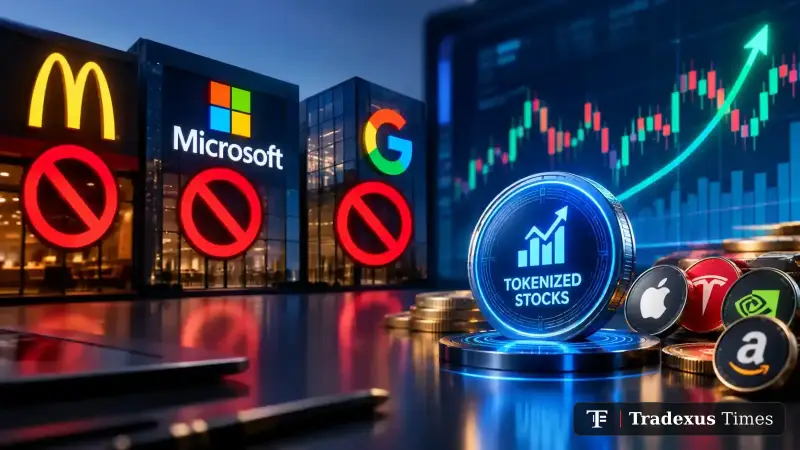
The expansion of tokenized stock trading is encountering an early challenge as 22 publicly traded companies have objected to plans to offer tokenized versions of their shares through a venue being developed by OKX and Intercontinental Exchange (ICE), the parent company of the New York Stock Exchange. The objecting companies include Microsoft, Alphabet, McDonald’s, Goldman Sachs, Wells Fargo and Cisco, highlighting the legal and operational questions that remain around bringing traditional equities onto blockchain-based trading infrastructure.
The objections come as the U.S. Securities and Exchange Commission’s Innovation Exemption framework creates a pathway for eligible tokenized securities trading. Under the process described in the source material, a trading venue must notify a company before offering tokenized versions of its shares, giving the issuer 30 days to object. If no objection is submitted within that period, trading can proceed.

That structure places public companies in a time-sensitive position. For issuers unfamiliar with a third party’s tokenization model, objecting may be the most cautious response while legal, compliance and investor-relations teams assess the implications. Law firm Latham & Watkins has warned that the process carries lasting consequences: the SEC order reportedly provides no mechanism to object after the initial 30-day window or withdraw a prior non-objection once trading begins.
The central issue extends beyond whether shares can be represented as digital tokens. Companies must also understand how the underlying shares are held, how dividends and voting rights reach token holders, and how token transfers interact with existing transfer-agent records. Without clear answers, issuers may be reluctant to allow their equity to trade through a structure they do not control.
The growing number of objections should not automatically be interpreted as a rejection of tokenization itself. The OKX-ICE venue is among the first to send issuer notices under the framework, meaning companies are confronting these questions in a new regulatory and operational context. Their responses may reflect uncertainty about the specific model rather than opposition to blockchain-based securities infrastructure as a whole.
For tokenization platforms, the immediate challenge is to demonstrate that their systems can accommodate shareholder rights, ownership records and issuer oversight while meeting applicable regulatory requirements. Greater clarity on those issues could help reduce uncertainty for companies considering similar proposals.
The next phase will depend on how the framework operates in practice and whether tokenization venues can address issuer concerns without undermining the efficiency and accessibility they seek to provide. The objections represent a meaningful early test for tokenized equities, but they do not establish that the broader market is unworkable. Instead, they show that technical infrastructure alone may not be enough to persuade established companies to participate.


 Algorand


 Dogecoin




