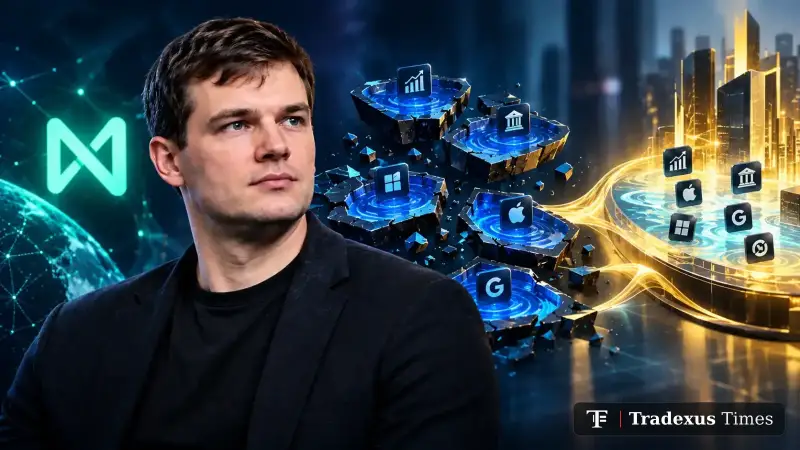
NEAR co-founder Illia Polosukhin said liquidity remains one of the primary obstacles to the broader adoption of tokenized equities, arguing that fragmented markets across multiple blockchains make larger transactions significantly harder to execute onchain.
Polosukhin said NEAR is seeking to address the issue through NEAR Intents, which is designed to aggregate liquidity across onchain markets, centralized exchanges and traditional financial venues. The approach would allow users to specify the asset and amount they want without having to manually navigate individual networks, bridges and liquidity pools.

The liquidity challenge becomes more pronounced as transaction sizes increase. Polosukhin pointed to a $10 million Nvidia purchase as an example: executing that trade through Nasdaq is relatively straightforward, while finding sufficient onchain liquidity for an equivalent tokenized transaction can be considerably more difficult because available markets remain thinner and distributed across different platforms.
Under the model described by Polosukhin, a user could submit an intent to acquire $10 million of tokenized Nvidia, with a solver sourcing or minting the required assets through providers such as Ondo. Rather than requiring liquidity to be concentrated on a single blockchain, NEAR Intents would attempt to route demand across multiple sources.
The strategy reflects a broader structural issue in tokenized real-world assets. Tokenized stocks and funds are increasingly available across networks including Ethereum, Solana and BNB Chain, but the expansion of available venues can also divide liquidity rather than deepen it within a single market. For smaller transactions, that fragmentation may be manageable; for larger orders, however, limited depth across individual venues can become a more significant execution constraint.
The integration of Ondo Stocks with near.com and NEAR Intents in September marked an initial step toward this aggregation model. The rollout introduced 20 tokenized U.S. stocks, ETFs and commodity-linked products, including Nvidia, Tesla, Apple, Microsoft and Amazon.
Ondo said at the time of the integration that its tokenized securities platform had exceeded $1 billion in total value locked and $26 billion in cumulative trading volume. The availability of those products across several blockchain networks further illustrates the fragmented market structure that NEAR Intents is attempting to address.
Polosukhin's broader proposition is that tokenized assets may require access to the liquidity of traditional financial markets rather than relying exclusively on liquidity generated within individual blockchain ecosystems. In that model, blockchain networks become access points to a wider liquidity pool instead of isolated markets competing for the same activity.
If the aggregation approach can effectively connect onchain demand with deeper traditional-market liquidity, it could reduce one of the practical limitations facing larger tokenized-equity transactions. The key issue will be whether this infrastructure can translate fragmented availability across multiple venues into reliable execution for increasingly large onchain orders.

 XRP
XRP
 Avalanche