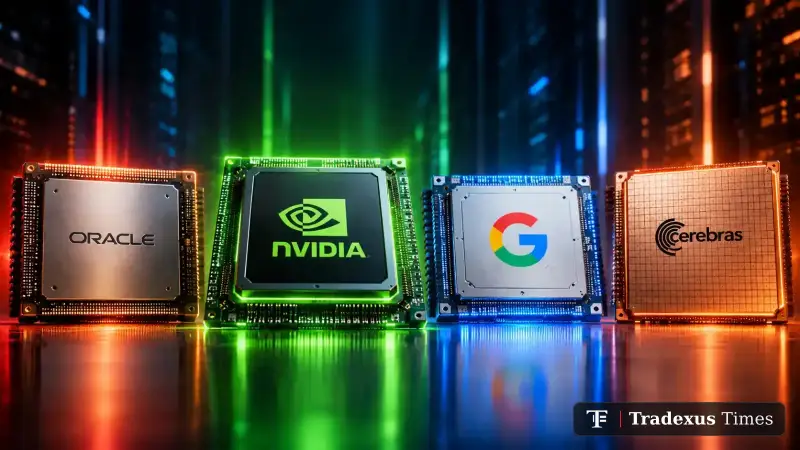
Oracle is expanding its partnership with Nvidia while broadening its cloud infrastructure offerings to include chips from Google, Cerebras Systems and SambaNova Systems. The strategy reflects a growing need to provide customers with different types of computing power as demand for artificial intelligence infrastructure increases and competition intensifies beyond the market for training AI models.
Under the expanded agreement, Oracle Cloud Infrastructure will scale its deployment of Nvidia’s next-generation Vera Rubin AI servers to a multi-gigawatt level. The companies did not disclose the financial terms of the deal. However, Nvidia CEO Jensen Huang has previously said that Vera Rubin systems could generate up to $40 billion in revenue per gigawatt for Nvidia, highlighting the potential commercial scale of deployments using the technology.
In this story
4 assets
Oracle is also seeking greater control over the components that power its infrastructure. Even its Nvidia-based systems will use Oracle’s in-house Acceleron networking chips instead of some Nvidia networking products. This approach could help Oracle differentiate its cloud services while reducing its reliance on a single supplier for every part of the computing stack.
The company’s diversification extends to the chips customers can access through its cloud platform. Oracle plans to offer Google’s tensor processing units for the first time, alongside products from Cerebras and SambaNova. Both Cerebras and SambaNova focus on inference workloads, in which AI systems generate responses to user requests. While Nvidia has established a strong position in AI training, inference offers a more diverse competitive landscape with opportunities for alternative chipmakers.
Oracle Cloud Infrastructure President Mahesh Thiagarajan said different AI workloads have different computing requirements, making flexibility in hardware selection important for performance, throughput and cost. For customers, the expanded range of options could make it easier to match infrastructure to specific applications rather than relying on a single chip architecture.
For Cerebras, the agreement could also expand access to large enterprise customers. CEO Andrew Feldman described the Oracle deal as a major expansion of the company’s customer base, with its systems being deployed at scale in other companies’ data centers.
The financial implications for Oracle remain an important question. The company has maintained a capital spending target of approximately $90 billion to $95 billion for fiscal 2027, while saying that customers are increasingly funding chip purchases. Oracle has not disclosed how it intends to finance the expanded hardware commitments. Its upcoming investor day could provide further insight into how it plans to balance infrastructure expansion, customer demand and the cost of building out AI capacity.
Oracle’s strategy is therefore about more than securing additional Nvidia systems. By combining Nvidia’s latest technology with alternative processors and its own networking chips, the company is positioning its cloud business to serve a wider range of AI workloads. The commercial test will be whether this flexibility attracts enough customer demand and revenue to justify the substantial investment required.