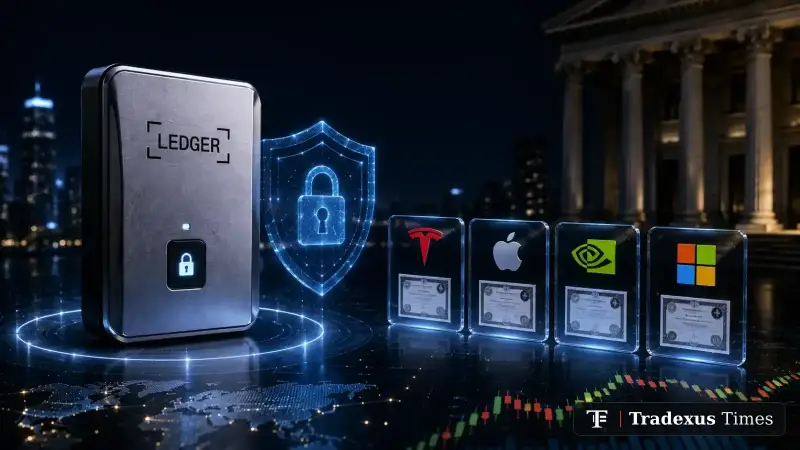
Ledger and Payward, the parent company of Kraken, have partnered to let investors store supported tokenized stocks on Ledger hardware wallets, extending the concept of crypto-style cold storage into tokenized equity markets.
The integration connects Payward’s xStocks platform with Ledger devices, including its Stax hardware wallet. Investors can route xStocks transactions through Ledger hardware and confirm transactions directly on the physical device before they are completed, adding an offline authorization step to tokenized stock trading.

The partnership applies a security model that has long been associated with cryptocurrency self-custody to digital representations of traditional equities. Instead of keeping tokenized shares solely on an exchange or internet-connected platform, users can move supported assets to a hardware device they physically control.
Transaction signing is central to the integration. A Payward customer using xStocks can require a signature on a Ledger device before a transaction is finalized. This creates an additional physical checkpoint, meaning compromised account credentials alone would not be sufficient to complete a transaction when hardware confirmation is required.
The agreement comes as tokenized stocks receive greater regulatory attention. The source says the SEC recently granted tokenized stocks an “innovation exemption,” providing a clearer framework for the development of tokenized securities while leaving broader questions around their long-term regulatory treatment unresolved.
Ledger expects potential demand from both its existing customer base and traditional investors interested in self-custody. The company has roughly 8 million customers, according to the source, while Ledger executive Sebastien Badault said the company is also discussing potential integrations with Coinbase, Binance and Robinhood. No agreements with those platforms have been finalized.
The model also introduces a different security trade-off. Hardware-based self-custody adds physical control and transaction verification, but it also places greater responsibility on users to protect their devices and manage access securely. The source notes that questions around the reliability and risks of self-custody remain active within the crypto industry.
For the broader market, the partnership represents another connection between traditional securities and crypto infrastructure. If tokenized stocks expand beyond a relatively small segment of the equity market, custody, transaction signing and interoperability could become increasingly important components of the emerging market structure.
The next focus will be the adoption of xStocks through hardware wallets and whether similar custody integrations emerge across other platforms offering tokenized equities.

 ONDO
ONDO
 Solana