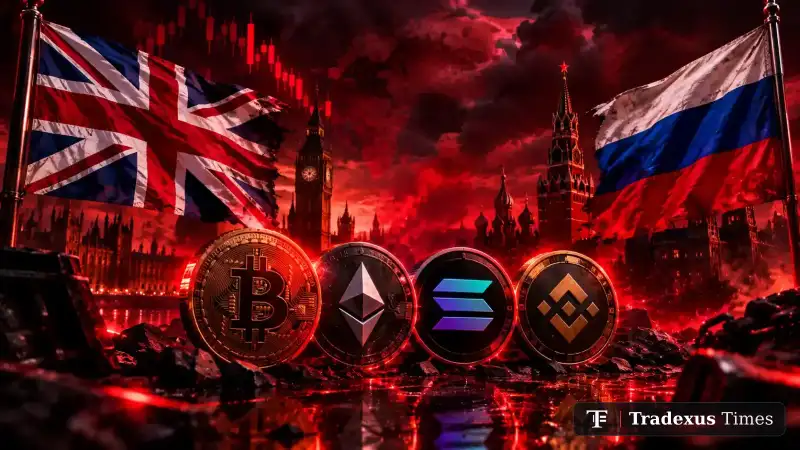
The United Kingdom has imposed sanctions on cryptocurrency exchanges and payment platforms it believes are supporting Russia-linked financial networks and helping entities circumvent international financial restrictions.
The October 8 package included 38 designations targeting Russian oil revenues, shadow-fleet vessels, military suppliers and financial infrastructure. Among the cryptocurrency-related targets were the corporate owner associated with Cryptomus and Heleket, as well as Kyrgyzstan-based exchange TokenSpot.

The measures highlight how Russia-linked financial networks can adapt to enforcement by shifting activity between related platforms and brands. Blockchain intelligence analysis identified shared infrastructure, personnel, branding and liquidity sources connecting Cryptomus and Heleket, while both services appeared to increase or decrease activity at different points as regulatory requirements changed.
Cryptomus was also linked to significant transactions involving sanctioned counterparties. The analysis identified more than $204 million received from Garantex and approximately $101 million sent back to the platform, underscoring the scale of financial activity associated with the network.
TokenSpot was separately sanctioned for supporting Russia’s financial services sector. Blockchain analysis assessed with high confidence that the exchange operates as a front company for Grinex, which has been identified as a likely successor to Garantex. Six TRON addresses were attributed to both platforms, while similarities in deposit infrastructure and transaction-fee collection further supported the connection.
TokenSpot was also found to have transferred more than $950 million in combined transactions to Grinex, Garantex and the A7 network, with A7 representing its largest external counterparty at approximately $679.5 million.
Other designated entities included Tsunami Payments, Processing KG, Russian company Planeta and Moscow-based Stolichny Kredit, while Processing KG director Ulan Bukabaev was also sanctioned.
The measures underscore a broader enforcement challenge for regulators: sanctions pressure can lead Russia-linked financial services to migrate activity to successor brands and parallel platforms rather than disappear entirely. For crypto compliance teams, monitoring shared infrastructure, liquidity sources, counterparties and customer relationships could therefore become increasingly important in identifying successor networks.