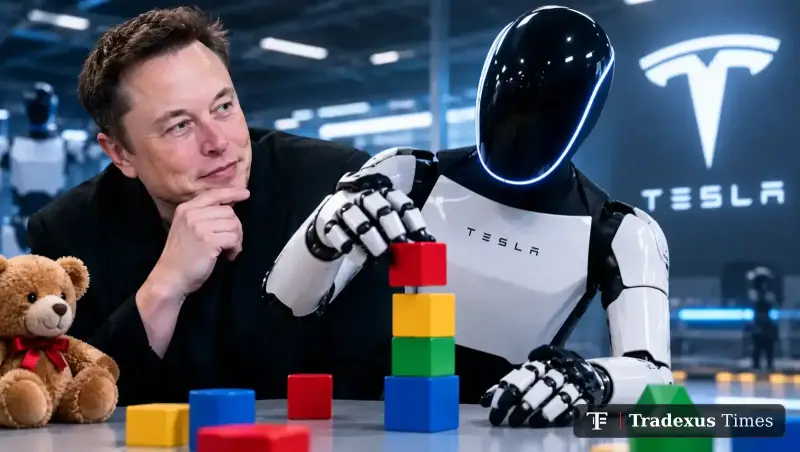
Tesla’s Optimus humanoid robot is moving closer to real-world deployment, but Elon Musk has acknowledged that teaching the machine to perform everyday tasks reliably remains a major challenge. Speaking during Tesla’s latest earnings call, Musk explained that unlike autonomous vehicles, which learn from data collected across a large fleet, Optimus must develop many of its capabilities through repeated practice and self-training.
Musk compared the process to a toddler learning to navigate the world. Robots must experiment, make mistakes and repeat tasks until they become capable of operating independently in unpredictable environments. For Tesla, this means creating a large-scale training system in which Optimus units can practice tasks and learn from their own experiences before being trusted with more complex work.
The latest Optimus V3 is designed as a human-sized robot, standing approximately five feet eight inches tall and weighing around 125 pounds. It uses Tesla’s AI5 chip, which reportedly offers roughly five times the memory bandwidth of its predecessor, while xAI’s Grok technology powers its voice interaction capabilities. These components are intended to support more advanced processing, communication and task execution as Tesla develops the robot’s capabilities.
Tesla has already begun producing Optimus units at its Fremont, California, factory, with around 1,000 third-generation robots reportedly operating on the company’s production floor. The factory’s role in Tesla’s robotics strategy became clearer after the company ended production of the Model S and Model X at the facility to make room for humanoid robot manufacturing. The move highlights how significantly Musk is shifting Tesla’s long-term ambitions beyond electric vehicles.
However, manufacturing robots at scale is only part of the challenge. The robot’s hands and fingers remain an important area of development because manipulating objects requires precision and adaptability. Musk’s comments suggest that the primary bottleneck is not simply collecting data, but giving Optimus enough real-world practice to handle open-ended tasks consistently.
The commercial timeline also remains uncertain. Tesla’s ambitions for large-scale production face a lengthy development process, with early industrial applications expected to precede household use. William Blair analyst Jed Dorsheimer has cautioned that reaching a production rate of one million units per week could take more than a year, while Musk has indicated that dangerous industrial applications could be an initial target by the end of 2027. Wider deployment in homes is expected to come later.
Tesla has also lowered its projected capital expenditure for the year from approximately $25 billion to $20 billion. Although the change comes as the company balances its investment priorities, it does not necessarily mean the reduction is directly attributable to Optimus. Tesla continues to pursue robotics alongside artificial intelligence, autonomous transportation and other major technology initiatives.
For investors, Optimus represents a potentially significant expansion of Tesla’s business, but its long-term value depends on more than ambitious production targets. The robot must demonstrate that it can perform useful tasks safely, reliably and economically. Until it proves capable of operating beyond controlled factory environments, Optimus remains a major growth opportunity with considerable technical and commercial hurdles ahead.