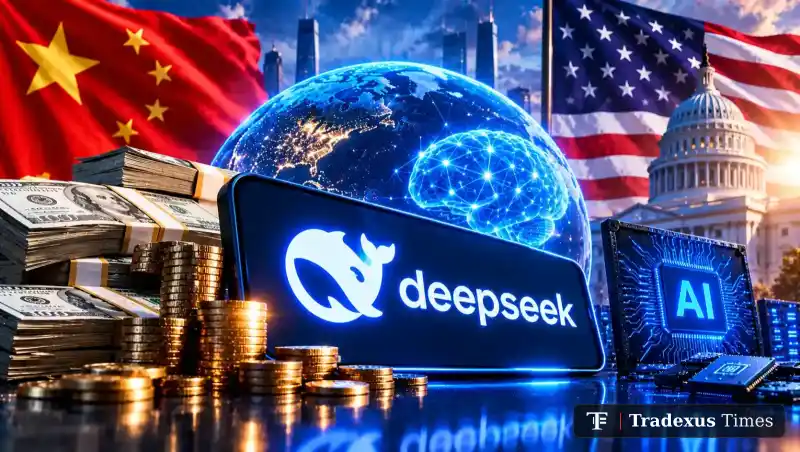
Chinese artificial intelligence startup DeepSeek is reportedly pursuing one of the country’s largest funding rounds, with an estimated $15 billion investment that could significantly expand its ability to develop AI models and infrastructure. The reported fundraising comes just days after the United States ordered federal civilian agencies to remove DeepSeek’s technology from their systems, highlighting the growing divide between the world’s two leading AI ecosystems.
Potential investors reportedly include Chinese battery manufacturer CATL and technology giant Tencent, the company behind WeChat. However, the details have not been officially confirmed by DeepSeek, and the identities of participating investors, the final funding amount and the company’s resulting valuation remain subject to verification.

The reported round follows an earlier financing effort in June, when DeepSeek was said to have raised more than $7 billion at a valuation of approximately $50 billion. Subsequent reports suggested the company was considering additional capital at a higher valuation, alongside the possibility of a Chinese initial public offering as early as next year. If the latest fundraising proceeds as reported, it would mark a substantial increase in the resources available to the Hangzhou-based AI developer.
DeepSeek’s ambitions extend beyond raising capital. The company is reportedly increasing investment in AI computing infrastructure and open-weight models for both domestic and international markets. Its approach could strengthen its ability to compete with major U.S. AI developers while intensifying competition with China’s own rapidly growing AI sector.
The startup gained international attention in early 2025 after its reasoning models challenged assumptions about the cost and resources required to build competitive AI systems. Its open-weight approach also helped developers experiment with and adapt its technology, creating a broader route to adoption than a model available only through a closed commercial service. The next challenge is to sustain that momentum while meeting the growing costs of computing, research and deployment.
The reported investment would place DeepSeek within a wider wave of capital flowing into Chinese AI companies. Moonshot AI, the developer of Kimi, has attracted multibillion-dollar investment, while Manus AI has also reportedly secured substantial funding. Zhipu AI and MiniMax, both listed in Hong Kong, further illustrate how investors are seeking exposure to China’s AI industry through private funding and public markets.
The geopolitical backdrop makes DeepSeek’s fundraising particularly significant. U.S. restrictions on the company’s use in federal systems reflect security concerns, but they do not by themselves establish that the startup’s reported fundraising has been affected. More broadly, restrictions on technology, access to advanced chips and international markets could shape how Chinese AI developers expand and compete globally.
DeepSeek was founded in 2023 by Liang Wenfeng, who previously co-founded quantitative hedge fund High-Flyer, which helped finance the startup’s early development. Liang has retained a substantial ownership interest in the company’s Chinese operating entity, according to reported ownership analysis. That structure has helped distinguish DeepSeek from some AI firms that have relied more heavily on external financing from the outset.
If confirmed, a $15 billion round would give DeepSeek additional resources to scale its computing capacity, improve its models and strengthen its position in a fiercely competitive industry. But capital alone will not guarantee success. The company will still need to demonstrate technical progress, commercial sustainability and the ability to operate under increasingly complex international restrictions.
For now, the reported fundraising underscores a central theme in the global AI race: competition is increasingly determined not only by model performance, but also by access to capital, computing infrastructure, talent and markets. DeepSeek’s next moves could help reveal how far Chinese AI companies can expand as geopolitical barriers grow.