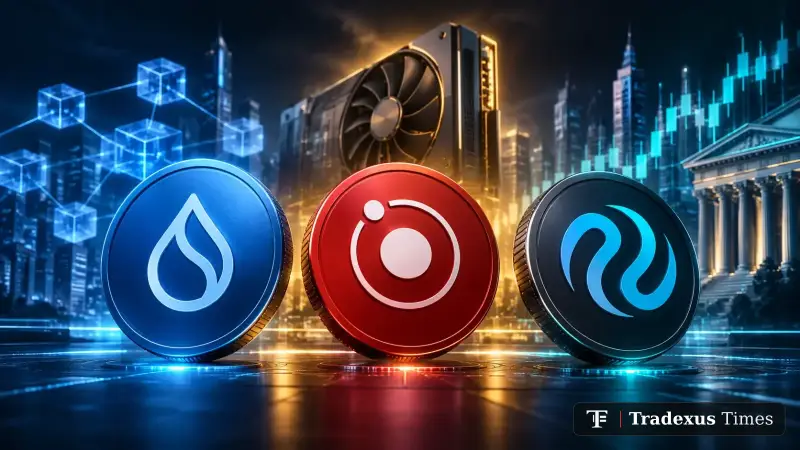
Sui, Render and Injective are positioning themselves across three distinct areas of the digital-asset industry: high-performance blockchain infrastructure, decentralized GPU computing and advanced decentralized finance. Each project addresses a different technological demand, with its long-term potential tied to network adoption, practical utility and the expansion of its respective ecosystem.
Rather than competing within the same market segment, the three networks target complementary areas of blockchain development. Sui focuses on application execution and asset management, Render connects distributed computing resources with developers, while Injective provides infrastructure for sophisticated financial applications.
In this story
3 assets


Sui's development strategy centers on its object-based execution model and the Move programming language. Originally shaped by developers with experience in Meta's Diem project, the network is designed to support efficient transaction processing while emphasizing asset security and smart contract control.
These characteristics position Sui for applications that require responsive execution and reliable infrastructure, particularly gaming, digital commerce and decentralized finance. Its ability to attract developers and sustain applications with meaningful user activity will be important in determining whether its technological advantages translate into broader ecosystem growth.
The competitive environment remains a key consideration. Performance and developer-oriented architecture can provide a foundation for adoption, but they do not independently guarantee sustained network demand. Sui's longer-term position will depend on whether applications built on the network generate consistent activity and establish reasons for users to remain within its ecosystem.
Render addresses a different infrastructure requirement: access to GPU computing capacity. Its decentralized marketplace connects individuals and organizations requiring processing resources with providers offering available GPU power.
The model targets demand from 3D artists, artificial intelligence developers and digital creators. These applications require substantial computing resources, creating an opportunity for distributed infrastructure to serve workloads that might otherwise depend on centralized providers.
Render's relevance extends beyond conventional graphics rendering. Its positioning within AI-related computing and emerging visual technologies broadens the potential applications of its infrastructure. Its reported compatibility with Apple's Vision Pro ecosystem also connects the project to spatial computing, although the commercial significance of that relationship depends on actual adoption and service demand.
The RNDR token supports payments within the network, linking token utility to the marketplace's economic activity. Consequently, increased interest in decentralized computing would be more meaningful if it translated into greater demand for rendering services and sustained participation from GPU providers.
The distinction between broader AI-sector growth and Render-specific adoption is particularly important. Rising demand for computing power does not automatically translate into increased network usage. Render's ability to attract customers, maintain available computing capacity and compete with alternative infrastructure providers will determine how effectively it captures that demand.
Injective focuses on financial infrastructure, offering tools for decentralized applications built around on-chain order books, derivatives and cross-chain transactions.
Its specialized architecture is intended to support more advanced financial products than basic token transfers and conventional decentralized exchange functionality. On-chain order books provide a framework for trading applications, while derivatives infrastructure expands the range of financial instruments developers can build.
Its connections to the Cosmos ecosystem also provide an interoperability dimension. Cross-chain functionality can help applications interact with different blockchain environments, potentially expanding the reach of financial services developed on Injective.
For the INJ token, the central consideration is the relationship between ecosystem expansion and actual network activity. More developers and applications could strengthen demand for the infrastructure, but sustained adoption will depend on whether those applications attract users and generate meaningful financial activity.
The three projects therefore represent different approaches to capturing growth within the digital-asset economy. Sui is focused on application infrastructure, Render on decentralized computing resources and Injective on specialized financial services.
Their investment cases also depend on different adoption metrics. For Sui, developer participation and application activity are important indicators. For Render, the relationship between GPU supply and demand for computing services is central. For Injective, the expansion of financial applications and cross-chain usage will help determine the strength of its ecosystem.
This distinction matters because technological relevance and token performance are not interchangeable. A project can address a growing industry without necessarily capturing a proportional share of its economic activity. Token demand ultimately depends on the way its ecosystem uses the network and the economic role assigned to the asset.
The next important development for all three projects will be evidence that their respective infrastructure is translating into sustained adoption. Growing application activity on Sui, greater utilization of Render's distributed GPU marketplace and expanding financial activity on Injective would strengthen their respective growth narratives.
Until that adoption becomes more established, all three remain exposed to execution risks, competition and broader digital-asset market conditions. Their technological positioning provides distinct growth opportunities, but the durability of their market relevance will depend on measurable ecosystem development rather than sector narratives alone
 Chainlink
 Solana