Solana

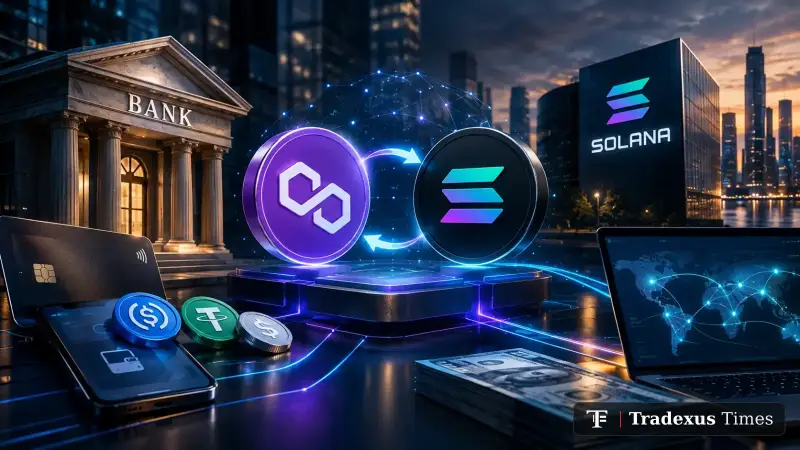
Polygon has expanded its Open Money Stack to support Solana, extending its banking and stablecoin payment infrastructure to one of the largest blockchain networks by transaction activity. The integration enables businesses to connect traditional bank accounts, stablecoin wallets and cross-chain payment services through a unified platform while retaining Solana as the underlying settlement network.
Announced on October 29, the expansion targets a blockchain processing more than $2 trillion in stablecoin transfer volume per quarter, according to Polygon. The development represents a strategic shift in Polygon's approach to payment infrastructure, extending its services beyond its native ecosystem and positioning the company as an intermediary between traditional financial systems and multiple blockchain networks.
In this story
2 assets
The integration allows businesses operating on Solana to accept bank transfers, card payments, cash deposits and cryptocurrency through Polygon's Open Money Stack. Companies can convert traditional currencies into stablecoins, hold funds in embedded blockchain wallets and transfer assets across supported networks.
Recipients can subsequently convert stablecoins into local currencies and withdraw funds through bank accounts or payment cards.
This structure addresses a fragmented payment process in which businesses often require separate providers for banking access, currency conversion, wallet infrastructure and blockchain settlement. By combining these functions, Polygon aims to reduce operational complexity while allowing businesses to select the blockchain most appropriate for their payment requirements.
Importantly, the integration does not require Solana-based businesses to migrate their operations to Polygon. Instead, Polygon provides the financial infrastructure connecting traditional payment methods with Solana's existing blockchain environment.
The expansion follows Polygon's earlier integration with TRON, which connected more than $94 billion in circulating TRON-based USDT to conventional payment infrastructure. Together, the integrations indicate that Polygon is increasingly pursuing an infrastructure strategy centered on connecting established stablecoin ecosystems rather than relying exclusively on transaction activity generated by its own network.
Solana's stablecoin activity provides the commercial foundation for this strategy. Polygon cites quarterly transfer volume exceeding $2 trillion, highlighting the scale of financial activity that could potentially be connected to traditional banking services.
However, transfer volume should not be interpreted as equivalent to payment adoption, stablecoin supply or revenue generation. On-chain transaction activity can include trading-related movements, transfers between wallets and other transactions that do not represent purchases, payroll payments or international remittances.
The distinction is important when evaluating the commercial opportunity. Polygon's objective is not simply to connect its infrastructure to a high-volume blockchain, but to convert existing on-chain activity into usable financial services for businesses and their customers.
Its recently completed acquisition of Coinme strengthens that proposition. The acquisition provides regulated money transmission coverage across 48 US states through 37 licenses and 11 exemptions, giving eligible businesses access to traditional payment infrastructure without independently assembling every component.
Polygon's embedded wallets also support assets including USDC, USDT, PYUSD, SOL and wrapped SOL across participating networks. This creates additional flexibility for companies that need to accept one digital asset while delivering another to a recipient.
For example, a business could receive USDC from an Ethereum wallet, route the payment through Polygon's infrastructure and settle in SOL for a recipient operating on Solana. Such functionality could reduce the need for businesses to maintain separate payment arrangements for each blockchain ecosystem.
For Solana, the integration provides access to additional banking and fiat payment infrastructure without requiring changes to its underlying settlement network. This could make Solana-based stablecoin services more accessible to fintech companies, international marketplaces, payroll providers and remittance businesses seeking connections between traditional currencies and blockchain-based payments.
Polygon, meanwhile, gains an opportunity to generate infrastructure activity from businesses operating outside its native network. This distinction could become increasingly important as competition in blockchain payments shifts toward the quality of financial connectivity, compliance infrastructure and ease of integration.
The implications for SOL and POL, however, require a more cautious assessment.
Additional payment infrastructure could strengthen Solana's commercial utility, but greater stablecoin activity does not automatically translate into proportional demand for SOL. The same applies to Polygon: expanding the reach of its payment services does not necessarily establish an immediate increase in demand for POL.
The commercial value of the integration will depend on how businesses use the infrastructure, the transaction activity it generates and the economic model through which Polygon captures revenue. Polygon has not disclosed customer adoption, transaction volumes or fee revenue specifically attributable to the Solana expansion.
The development also fits into Polygon's broader institutional payment strategy, which includes private stablecoin transfers designed for businesses requiring greater transaction confidentiality. Together, these initiatives suggest an effort to build financial infrastructure that accommodates different blockchain networks and business requirements.
The next important measure will be actual adoption rather than the headline stablecoin transfer volume of the connected network. Evidence of recurring business payments, cross-chain settlement activity and measurable fee generation would provide a clearer indication of whether Polygon can turn its infrastructure expansion into a sustainable commercial opportunity.
For Solana, the key question is whether improved banking connectivity translates into greater use of stablecoins for real-world payments. For Polygon, the challenge is demonstrating that connecting competing blockchain ecosystems can produce meaningful infrastructure demand without depending exclusively on activity within its own network.
The integration marks a further step toward a payment environment in which businesses can move funds between traditional financial accounts and different blockchain networks without having to manage each system independently. Its long-term significance will depend on whether that technical connectivity develops into consistent commercial usage.