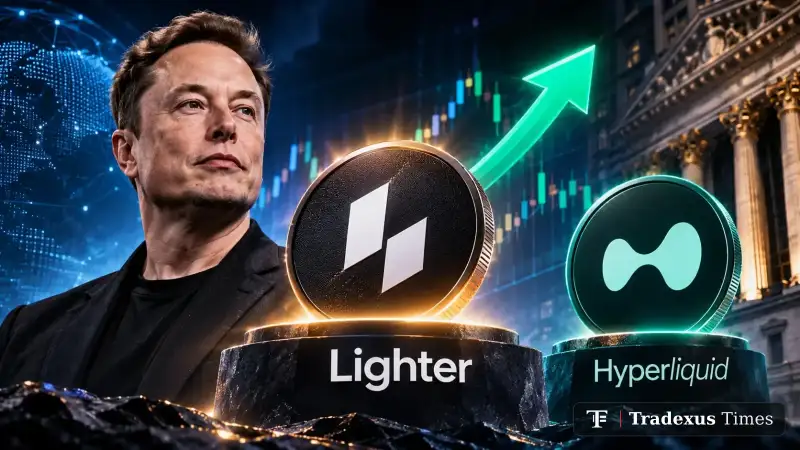
Grok AI has outlined a highly speculative scenario in which Lighter’s native token, LIT, could emerge as a major competitor to Hyperliquid, potentially challenging its position as the leading decentralized perpetual futures platform by the start of 2027. The scenario depends on a combination of regulatory progress, institutional adoption and sustained expansion of Lighter’s trading ecosystem.
The central catalyst in Grok’s projection is a potential regulatory breakthrough. Lighter could gain a significant competitive advantage if it secures clearer licensing pathways or regulatory approvals for on-chain derivatives in key jurisdictions. Such progress could help position the platform to attract professional trading activity alongside its existing retail-focused model.
In this story
2 assets

The proposed expansion also involves bringing Lighter’s zero-fee retail offering and zero-knowledge verifiable matching infrastructure into institutional and multi-asset markets. This combination could strengthen its appeal to traders seeking lower transaction costs and greater transparency in trade execution and liquidation processes.
However, the competitive gap between Lighter and Hyperliquid remains substantial. DefiLlama figures cited in the supplied data place Hyperliquid's total value locked at approximately $8.2 billion, compared with roughly $794 million for Lighter. This difference highlights the scale of adoption and capital growth Lighter would need to achieve before it could credibly challenge Hyperliquid's broader market position.
Lighter's competitive proposition centers on several structural differences. Standard retail accounts benefit from zero trading fees, while its matching and liquidation processes use zero-knowledge verification, with settlement taking place on Ethereum. The protocol also operates a revenue-sharing and buyback mechanism linked to platform activity.
These features could support user acquisition if demand for transparent, non-custodial derivatives trading increases. Nevertheless, lower fees alone do not guarantee sustained market-share growth. Lighter would also need to demonstrate that its infrastructure can accommodate larger trading activity, expand its available markets and attract participants beyond its retail user base.
Recent relative token performance has provided a more immediate indication of changing market interest. LIT gained approximately 10% over the previous three days, while HYPE declined around 4%. Although this divergence suggests stronger short-term momentum for LIT, it does not establish a lasting shift in platform dominance or market positioning.
From a technical perspective, LIT has been consolidating between $3.10 and $3.30 following a period of volatility. The token remains significantly below its previous peak near $7.86, indicating that the broader recovery has yet to reverse the full extent of its earlier decline.
The $3.50–$4.00 region represents the next important resistance area. A sustained move above this zone, followed by a breakout through $4.50–$5.00, would strengthen the intermediate bullish structure and potentially create conditions for a retest of previous highs.
On the downside, support around $2.90–$3.00 remains important for maintaining the current recovery pattern. A move below this region could weaken the near-term technical outlook, with the $2.60–$2.70 area representing the next relevant support zone.
Momentum indicators remain in neutral-to-corrective territory, suggesting that the market has not yet entered the type of sustained momentum expansion typically associated with stronger speculative advances. Consequently, a technical recovery would need confirmation through sustained price strength rather than isolated upward movements.
The regulatory dimension could prove more consequential than short-term token performance. A credible pathway for operating perpetual derivatives within established regulatory frameworks could improve Lighter's ability to attract professional participants. It could also differentiate the platform from competitors whose growth strategies rely primarily on decentralized infrastructure and retail trading activity.
However, regulatory progress would not automatically translate into institutional adoption. The platform would still need to demonstrate operational reliability, competitive execution and sufficient market depth to support larger participants.
Grok's more aggressive projection places LIT between $45 and $75 under an exceptionally bullish scenario, with a speculative extension toward $120 or higher. These figures represent hypothetical outcomes rather than evidence-based price targets. Achieving such valuations would require extraordinary growth in platform adoption, market demand and token valuation, alongside the regulatory and institutional catalysts described in the scenario.
For now, the more relevant question is whether Lighter can translate its technological differentiation and retail pricing model into measurable competitive gains. Hyperliquid's substantial advantage in total value locked illustrates how difficult that challenge remains.
The next developments to watch are regulatory progress, expansion into institutional and multi-asset trading, sustained growth in platform activity and LIT's ability to establish a confirmed breakout above its immediate resistance zones. Without progress across these areas, the prospect of overtaking Hyperliquid remains a highly speculative scenario rather than an established market trajectory.