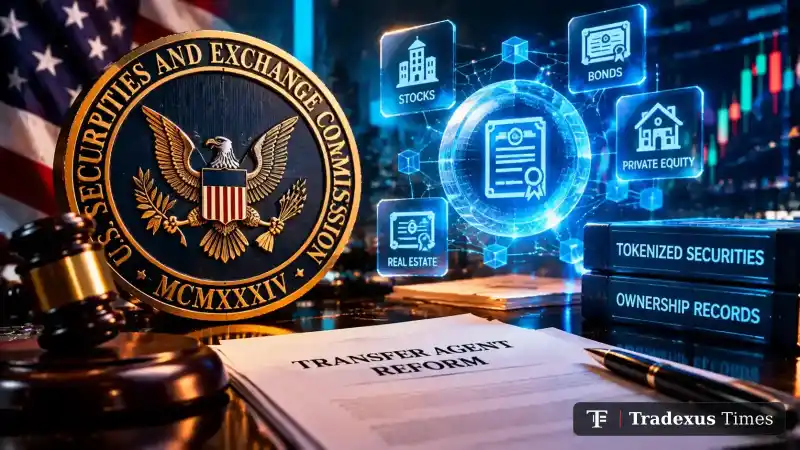
The U.S. Securities and Exchange Commission (SEC) has proposed its first major update to transfer-agent rules since the late 1970s, aiming to modernize regulations for today’s securities markets while accounting for the growing use of blockchain technology in securities issuance and share transfers. The proposal, announced on September 1, highlights the need to ensure that existing rules can accommodate evolving digital infrastructure.
SEC Chair Paul Atkins said the rules should reflect how transfer agents operate today and how they may function in the future, including the use of blockchain technology in securities offerings and share transfers. The proposal does not represent a blanket endorsement of tokenization, but it recognizes blockchain’s potential role in securities recordkeeping.

Transfer agents perform a fundamental function in financial markets. They maintain official records of securities ownership, process transfers, manage restrictive legends and work within the broader clearance and settlement infrastructure, including systems connected to the Depository Trust & Clearing Corporation (DTCC). Their records help establish who legally owns a particular security.
Blockchain technology could improve parts of this process by enabling faster settlement, continuous trading and broader distribution of tokenized securities. However, these benefits depend on how tokenized assets connect to the underlying securities and their official ownership records. If a token merely represents a claim on an asset recorded elsewhere, rather than serving as part of an authoritative ownership system, additional layers of recordkeeping may create complexity instead of eliminating it.
The risks echo Wall Street’s historical Paperwork Crisis of the late 1960s. A surge in trading overwhelmed the manual, paper-based processes used to clear and settle stock transactions. Back offices struggled to keep pace, forcing the New York Stock Exchange to introduce temporary Wednesday trading closures while firms worked through the backlog.
A central problem was the absence of a single, reliable system for tracking securities ownership. The industry responded by moving away from decentralized physical certificate handling toward centralized electronic recordkeeping. The Depository Trust Company, established in 1973, helped transform the system by immobilizing physical certificates in a central vault and allowing ownership transfers to be recorded electronically.
The proposed SEC changes raise a similar question for tokenized securities: where does the definitive record of ownership reside? If ownership information is fragmented among blockchain tokens, special-purpose vehicles, broker ledgers and transfer agents’ off-chain databases, discrepancies could emerge over which record establishes the holder’s rights.
For tokenization to deliver more efficient markets, the relationship between digital tokens and legally recognized securities ownership must remain clear. Faster transactions alone will not resolve the underlying challenge if multiple systems maintain competing records of the same asset.
The SEC’s proposal is therefore an important regulatory development for the tokenization industry, although its final impact will depend on the rules ultimately adopted and how market participants implement them. The central issue is whether modernization can support blockchain-based securities while preserving reliable ownership records and coordination across the financial system.