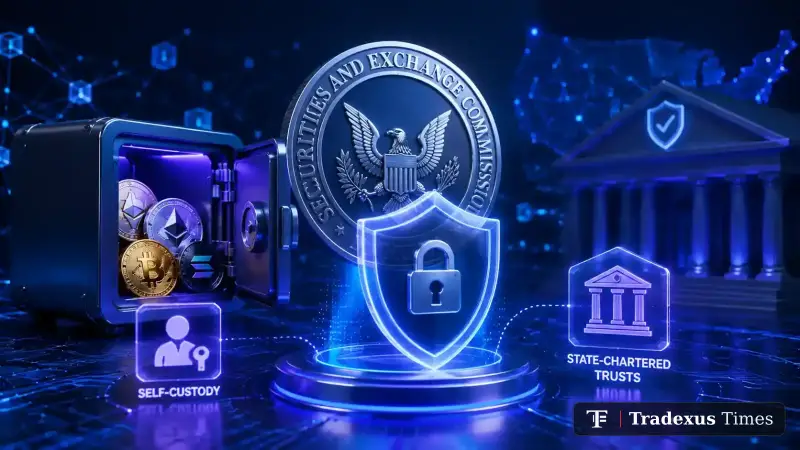
The U.S. Securities and Exchange Commission (SEC) has proposed a new rule designed to clarify how investment advisers and regulated funds can custody crypto assets, outlining requirements for asset safekeeping, recordkeeping, disclosures and audits. The proposal would establish a more explicit regulatory framework for firms handling digital assets and is open to a 60-day public comment period.
SEC Chairman Paul Atkins said the proposal aims to address uncertainty arising from custody rules originally designed for traditional financial assets. He argued that existing requirements were developed to protect advisory clients and regulated funds against loss, theft, misuse and misappropriation, but did not adequately account for the characteristics of digital assets.

A central element of the proposal is greater clarity over which types of entities may qualify as custodians for crypto assets. It would also specify how investment advisers and regulated funds must maintain records and meet federal disclosure requirements, while providing additional guidance on industry practices and auditing standards.
The proposal includes provisions that would permit self-custody of crypto assets under certain circumstances and allow state-chartered trusts to serve as custodians. These provisions could broaden the range of custody arrangements available to eligible market participants, although the precise conditions and compliance obligations will determine how widely the options can be used.
For institutional investors and asset managers, clearer custody requirements could help reduce uncertainty when designing digital-asset investment products and operational arrangements. Defined standards for safeguarding assets, documenting holdings and conducting audits may also help firms assess their regulatory responsibilities. However, the proposal does not automatically authorize every institution to custody crypto assets, nor does it remove the need to comply with applicable securities laws.
The distinction between self-custody and third-party custody will remain important. Self-custody gives an eligible entity direct control over its assets, while using an external custodian introduces a separate party responsible for safekeeping under the relevant arrangement. The proposed framework would establish circumstances in which self-custody could be permitted, but the available announcement does not specify every condition or explain how the final requirements will be applied in individual cases.
The proposal also marks a development in the SEC’s broader digital-asset regulatory agenda under Atkins. It was announced shortly before Commissioner Hester Peirce’s scheduled departure on Friday. Peirce had led the agency’s Crypto Task Force since its establishment and was set to take up a professorship in Virginia. Her departure represents a personnel change at the agency as the custody proposal enters the public consultation process.
The immediate next step is the 60-day comment period, during which industry participants and other interested parties can provide feedback. The SEC’s subsequent decisions on the final rule, including the eligibility criteria for custodians, self-custody conditions, recordkeeping obligations and audit requirements, will determine how the proposal translates into practical compliance standards.
For the crypto market, the significance lies less in an immediate change to token prices than in the potential effect on institutional infrastructure. Greater regulatory clarity could influence how funds and investment advisers structure custody arrangements and manage digital-asset exposure. The final rule’s scope and implementation will be key to assessing whether those changes lead to broader institutional participation.