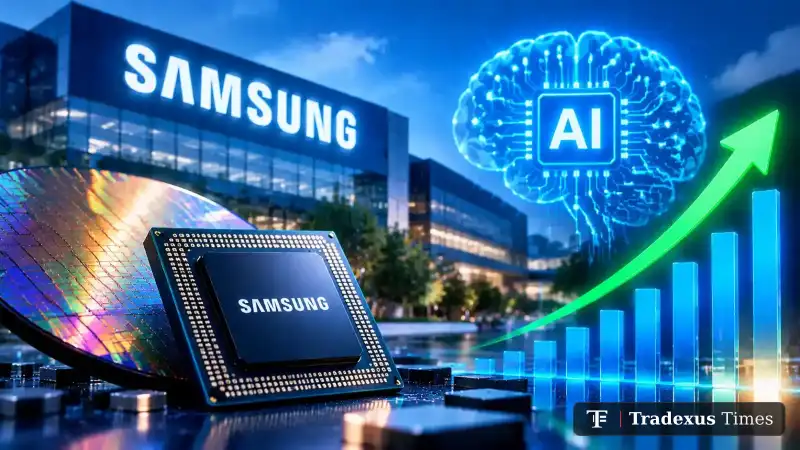
Samsung Electronics has reported record quarterly financial results, as surging demand for memory chips used in artificial intelligence systems continues to strengthen the global semiconductor industry. The South Korean technology giant recorded operating profit of 107.4 trillion won, approximately $80.5 billion, for the July–September quarter, while revenue reached an all-time high of 195.3 trillion won, or around $146 billion.
The results mark Samsung’s fourth consecutive quarter of record profit and revenue, highlighting the growing importance of AI infrastructure to the company’s business. Demand for advanced memory products is increasing as technology companies expand data centers, develop larger AI models, and invest in computing systems capable of handling increasingly complex workloads.

Samsung’s strong performance follows similarly record-breaking quarterly results from domestic rival SK Hynix. Together, the two companies control approximately two-thirds of the global memory chip market, placing them at the center of the supply chain supporting the AI industry.
Samsung expects demand for AI-related chips to continue accelerating through 2027, potentially outpacing available supply as customers race to expand their infrastructure. The company plans to prioritize advanced memory and storage products, including high-bandwidth memory (HBM), server DRAM, and solid-state drives used in AI servers.
High-bandwidth memory has become particularly important because advanced AI processors require rapid access to large amounts of data. As demand for AI computing increases, semiconductor manufacturers are under pressure to expand production capacity and deliver more sophisticated memory solutions. This trend could create further growth opportunities for established chipmakers, although the extent of future gains will depend on customer investment, production capacity, and broader market conditions.
South Korea is also increasing its investment in semiconductor manufacturing and data center infrastructure to strengthen its position in the global AI market. Samsung and SK Hynix have announced plans for a combined investment of 800 trillion won, approximately $599 billion, in a new semiconductor manufacturing hub in the country’s southwest. The project reflects expectations that AI-related demand will remain a major driver of technology investment in the coming years.
However, the industry’s rapid expansion also carries risks. Some analysts have questioned whether the enormous investments planned for semiconductor facilities and AI infrastructure will generate sufficient long-term returns. If demand slows, technology companies reduce spending, or new capacity exceeds market needs, manufacturers could face pricing pressure and weaker profitability.
South Korea’s reliance on semiconductor exports presents an additional economic concern. The country’s central bank has warned that an excessive dependence on the chip industry could leave the broader economy more vulnerable to a downturn in AI-related investment. Because semiconductors play such a significant role in South Korea’s exports and economic activity, any prolonged decline in demand could affect manufacturers, suppliers, employment, and overall growth.
For now, Samsung’s latest results demonstrate the financial strength of the AI-driven semiconductor cycle. The company is benefiting from rising demand for advanced memory and data storage, but sustaining record performance will require continued investment, disciplined capacity expansion, and durable demand from AI developers and data center operators.