XRP

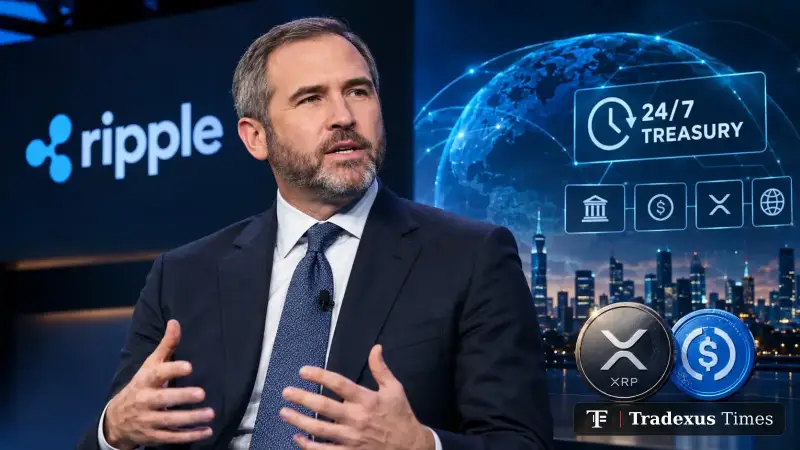
Ripple CEO Brad Garlinghouse announced the launch of 24/7 Returns by Ripple Treasury, a service designed to help corporate clients manage idle cash and move funds outside traditional banking hours. The announcement came during the tenth edition of the Ripple Swell conference in New York, highlighting Ripple’s push to expand blockchain-based infrastructure into corporate treasury management and global financial operations.
The new service is designed to enable businesses to deploy funds around the clock, including weekends, when conventional banking processes may limit access to liquidity and settlement services. By combining treasury automation with digital-asset infrastructure, Ripple aims to give corporate finance teams greater flexibility in managing cash positions, forecasting liquidity and settling transactions.
The launch reflects a broader shift toward financial systems that operate continuously rather than within fixed banking schedules. For multinational businesses, the ability to move funds and settle obligations outside conventional operating hours could reduce administrative delays and improve the efficiency of working-capital management. However, the practical benefits will depend on how the service integrates with existing financial systems, corporate investment policies and applicable regulatory requirements.
Ripple’s treasury platform already serves companies including American Airlines, Trax, Subway, Adecco, Kingfisher and Christian Louboutin, according to Garlinghouse. Its capabilities include position management, liquidity forecasting, reconciliation and automated financial workflows. These functions are central to corporate treasury operations, where businesses must coordinate cash across accounts, entities and jurisdictions while maintaining visibility over available funds.
The new service integrates Ripple USD (RLUSD), Ripple’s US dollar-pegged stablecoin, to support settlement and is built on the XRP Ledger. XRP also plays a role in the network’s liquidity and transaction-fee structure. This creates a distinction between the stablecoin’s intended role as a dollar-denominated settlement asset and XRP’s role within the underlying network.
For corporate users, RLUSD could help facilitate transactions without requiring the transferred value to fluctuate directly with XRP’s market price. Yet using stablecoins does not eliminate every operational or financial risk. Adoption will still depend on the reliability of settlement infrastructure, liquidity availability, compliance requirements and whether businesses are permitted to use these instruments under their internal treasury policies.
Ripple is also expanding its relationships across the financial services sector. Garlinghouse highlighted the company’s work with Robinhood, a retail-focused digital-asset trading platform, as well as an expanded relationship with BNY. The developments indicate that Ripple is seeking to position its technology across both customer-facing digital-asset services and institutional financial operations, extending its reach beyond payments alone.
The commercial opportunity is supported by demand for faster access to cash-management products. Garlinghouse cited the 2026 AFP Liquidity Survey, stating that 86% of treasury professionals would choose real-time money market funds if the products met their companies’ investment policies and regulatory standards. The finding points to interest in more responsive treasury tools, although demand for real-time money market funds does not automatically translate into demand for blockchain-based products or stablecoin settlement.
Regulation remains another factor in the potential expansion of digital-asset infrastructure. US Treasury Secretary Scott Bessent attended the conference and discussed developments in the regulatory environment surrounding digital assets. Clearer rules could help financial institutions and corporations assess how blockchain-based settlement fits within their existing compliance frameworks. The conference remarks, however, do not by themselves establish a specific regulatory approval for Ripple’s new service.
Garlinghouse also noted that corporate-linked payments amounted to $13 trillion last year, while crypto assets accounted for little of that activity. The contrast highlights the scale of the traditional financial market Ripple is seeking to address. Even limited adoption within such a large payment ecosystem could create opportunities for blockchain infrastructure, but the size of the market alone does not demonstrate that businesses will shift to digital-asset settlement.
For XRP, the launch provides a potential use-case development rather than proof of an immediate increase in token demand. Activity on the XRP Ledger requires transaction fees paid in drops, the smallest unit of XRP, creating a direct operational connection between network usage and the token. The broader effect on XRP demand would depend on transaction volumes, liquidity requirements and how extensively the service is adopted. Transaction fees alone do not establish the scale of any resulting effect on the token’s circulating supply or market price.
The next indicators to watch are the pace of corporate adoption, the volume of transactions settled through RLUSD and the XRP Ledger, and the extent to which Ripple’s treasury tools become embedded in established financial workflows. Progress in these areas would provide stronger evidence of commercial traction than the announcement alone. For now, Ripple’s launch signals an effort to bring continuous digital-asset settlement into corporate cash management, with the ultimate market significance dependent on real-world usage.