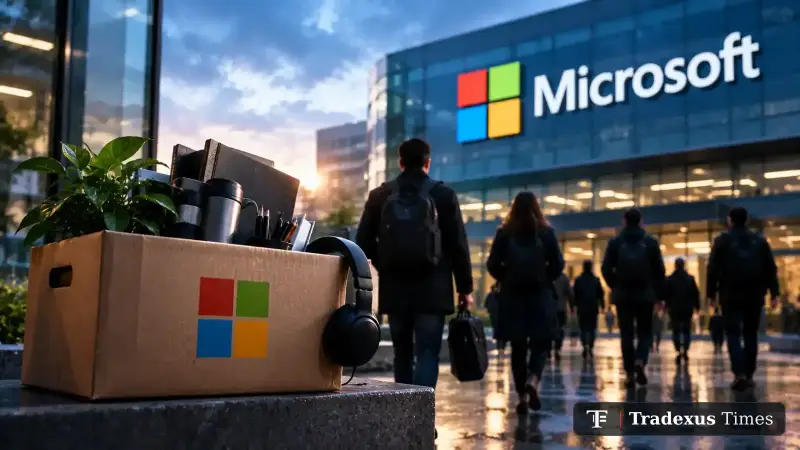
Microsoft is offering voluntary buyouts to approximately 60,000 employees as the technology giant looks to control operating costs while continuing to invest heavily in artificial intelligence infrastructure. The program could affect more than a quarter of the company’s global workforce, marking another significant step in its efforts to reshape staffing and manage the financial demands of its expanding AI strategy.
The offer is available to eligible employees across several parts of the business, including AI experiences, Copilot, finance, human resources, Xbox, and Windows + Devices. However, the program does not cover every division. Marketing, commercial business and security teams are excluded, according to information provided about the initiative. Microsoft said eligible employees in participating teams across Canada, India, the United Kingdom and the United States can take part, subject to the program’s conditions.

Chief People Officer Amy Coleman described the initiative as a voluntary option for employees considering a future outside the company. She said the program would give eligible staff an opportunity to make that transition with support while allowing participating organizations to adapt their workforces to changing business needs. Microsoft has characterized the offer as time-limited and said it builds on lessons from an earlier voluntary retirement program.
The scale of the initiative comes as Microsoft faces growing scrutiny over the cost of its AI expansion. The company is investing heavily in data centers, advanced chips and the infrastructure required to develop and operate AI services. Although these investments are intended to strengthen its position in a rapidly evolving technology market, they also create substantial near-term spending commitments. Microsoft has forecast $175 billion in capital expenditures for calendar year 2026, underscoring the financial scale of its infrastructure plans.
The company had 223,000 full-time employees worldwide as of June 30, 2026. A buyout program covering approximately 60,000 employees would therefore represent a substantial portion of its workforce, although the figure refers to the employees potentially eligible for the offer, not the number expected to leave. Because participation is voluntary, the final reduction in headcount will depend on how many eligible employees accept the terms.
Microsoft has already used workforce reductions and voluntary departures as part of its broader cost-management efforts. Earlier in the year, it offered voluntary buyouts to approximately 9,000 US employees, equivalent to around 7% of its US workforce. In July, the company also announced 4,800 job cuts connected to changes in its Xbox gaming business, alongside plans to divest up to five studios as it sought to improve returns from the division.
The latest initiative highlights the challenge facing major technology companies as they attempt to balance ambitious AI investments with demands for stronger financial discipline. Building AI infrastructure requires significant capital, but maintaining a large workforce also carries ongoing costs. Voluntary buyouts can give companies a way to adjust staffing without relying entirely on compulsory layoffs, while offering employees financial support as they leave. The actual savings, however, will depend on the terms of the offers, participation levels and whether Microsoft needs to recruit or redeploy workers with different skills.
The timing is also important for investors. Microsoft is scheduled to report its first-quarter financial results after markets close on Wednesday, giving investors an opportunity to assess revenue growth, operating costs and the returns emerging from its AI investments. The buyout announcement may sharpen attention on whether the company can continue funding infrastructure expansion while maintaining profitability and demonstrating that AI-related spending will generate sustainable returns.
Microsoft shares were up approximately 1% on Monday, according to the figures provided in the report, after having gained around 10% during the year. The immediate share-price response does not establish how investors will ultimately judge the program. The more important questions are whether workforce adjustments translate into meaningful cost savings, whether AI demand continues to grow and how quickly the company can convert its infrastructure spending into revenue.
For the broader technology sector, Microsoft’s move illustrates a growing tension between expanding AI capacity and managing the costs of that expansion. Companies are competing to secure computing power, develop new services and integrate AI into existing products, while investors increasingly demand evidence that large capital commitments can produce adequate returns. Workforce restructuring does not necessarily indicate weakening AI demand, but it does show how companies may seek efficiencies elsewhere as spending on infrastructure rises.
Microsoft’s voluntary buyout program is therefore more than a staffing initiative. It reflects a broader effort to align the company’s workforce and cost structure with its changing investment priorities. The results due later this week may provide further insight into whether its AI strategy is generating the financial momentum needed to support continued expansion, making the balance between investment, efficiency and returns a central issue for investors.