
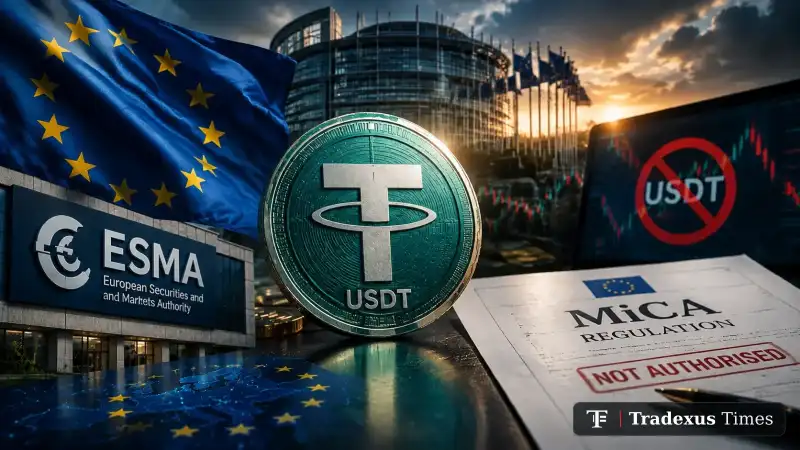
Tether’s USDT faces a regulatory deadline in the European Union on January 8, 2027, as authorised crypto-asset service providers prepare to discontinue services involving stablecoins that do not comply with the Markets in Crypto-Assets Regulation (MiCA). The European Securities and Markets Authority (ESMA) issued its formal opinion on October 8, 2026, establishing a transition period for providers to wind down remaining holdings. Tether has not obtained the EU authorisation required for USDT to be offered as an e-money token, placing the world’s largest stablecoin under increasing regulatory pressure in the European Economic Area.
The deadline carries particular weight because of USDT’s central role in global cryptocurrency trading. According to CoinGecko figures for October 22, 2026, approximately 182.8 billion USDT were in circulation, representing a market value of about $182.7 billion. Its reported 24-hour trading volume reached $60.2 billion, compared with approximately $89.4 billion across the entire crypto market. That means USDT accounted for roughly 67% of reported market-wide trading volume, underscoring its importance as a settlement asset and trading pair across digital-asset markets.

The regulatory change does not amount to a blanket prohibition on owning USDT in the EU. Instead, it restricts the services authorised providers can offer around non-compliant stablecoins. Under the described transition arrangements, buying additional USDT and continuing to trade it on affected EU platforms will no longer be available once the relevant services are discontinued. Selling, swapping and withdrawing existing holdings to a self-custody wallet remain possible.
This distinction is important for German investors. The immediate issue is not whether USDT can continue to exist or circulate globally, but whether customers can access it through their existing regulated trading venues. Individual providers may implement restrictions before the January deadline, meaning the practical transition could occur earlier than the formal cut-off.
MiCA classifies stablecoins pegged to a single official currency as e-money tokens. Issuers and providers must meet applicable authorisation requirements to offer the tokens in the EU, alongside obligations concerning reserves and other aspects of regulatory compliance. Tether has not secured the relevant authorisation for USDT, while Circle has obtained EU authorisation for its dollar-linked USDC and euro-linked EURC tokens.
The difference highlights a growing separation between global market dominance and regulatory accessibility. USDT’s trading activity gives it substantial utility across crypto markets, but its scale does not override EU requirements. Conversely, the availability of authorised alternatives does not guarantee that they can immediately replicate USDT’s trading reach or liquidity across every platform. The supplied figures establish USDT’s dominant position, although they do not quantify how much trading activity could migrate to other stablecoins following the restrictions.
For exchanges, the transition requires changes to product availability and the handling of existing customer positions. For users, the consequences depend on when their provider implements the restrictions and which alternatives it supports. Investors who rely on USDT as an intermediate asset between trades may need to move into an authorised stablecoin or euros before their usual trading routes become unavailable.
USDT’s regulatory position also intersects with the risks inherent in its design. Tether states that its tokens are fully backed by reserves, primarily comprising short-dated US government bonds and cash equivalents, and publishes reserve information through its transparency reporting. However, reserve disclosures and independent reviews do not constitute a state guarantee or deposit protection. USDT holders remain exposed to the issuer’s ability to maintain redemption and to market confidence in the dollar peg.
That distinction matters when assessing the broader implications of the EU restrictions. The immediate regulatory issue concerns whether authorised platforms can offer USDT, rather than evidence of a failure in its reserve backing. Nevertheless, access restrictions could make holding and converting the token less convenient for European customers, particularly if individual exchanges discontinue trading pairs at different times.
The token’s price provides a separate indicator of market confidence. USDT traded at approximately $0.999256 on October 22, 2026, a small deviation from its intended $1 peg. Such a difference is not, by itself, evidence of a loss of confidence or a redemption problem. The stability mechanism relies on the ability of eligible customers to redeem tokens and on market participants responding to price discrepancies. Sustained deviations would be more consequential because they could indicate doubts about redemption or reserve confidence, although the reported price alone does not establish such concerns.
USDT’s infrastructure introduces further considerations. The token operates across multiple blockchains, including Ethereum, Tron, Solana, Avalanche and The Open Network. Although these tokens represent claims against the same issuer, transactions occur on separate networks, with different transfer costs and compatibility requirements. Moving USDT to a self-custody wallet therefore preserves access to the token but does not eliminate issuer risk, nor does it guarantee that the asset can be traded through a regulated EU platform.
The comparison with euro-denominated stablecoins also has a practical dimension. USDT is designed to maintain parity with the US dollar, so its euro value remains exposed to fluctuations in the EUR/USD exchange rate. EURC may reduce that currency mismatch for users whose liabilities and spending are denominated in euros, although it remains an issuer-dependent digital asset rather than a bank deposit. The choice of alternative therefore involves both regulatory access and the currency in which an investor measures purchasing power.
German tax treatment adds another consideration when investors reposition their holdings. Under the treatment described in the supplied material, exchanging Bitcoin for USDT constitutes a disposal of Bitcoin for German tax purposes, potentially triggering tax on gains when the applicable holding-period conditions are met. Investors should therefore account for the tax consequences of a conversion rather than treating a stablecoin swap as an administrative change with no financial effect.
The next key date is January 8, 2027, but the more immediate focus is how individual authorised providers implement the transition. Notices detailing the suspension of USDT trading, the continued availability of withdrawals and the supported replacement assets will determine the practical impact on customers. The extent to which trading activity shifts toward authorised stablecoins or euro balances will also matter for assessing the effect on European crypto-market access.
For the broader market, USDT’s position presents a clear distinction between liquidity utility and regulatory eligibility. Its reported trading share demonstrates how deeply embedded the token is in crypto-market infrastructure, while the EU deadline shows that this importance does not guarantee continued access through regulated European venues. Whether the transition produces a meaningful redistribution of trading activity will depend on the alternatives available, the timing of provider restrictions and the ability of users to move existing positions without disrupting their trading activity.