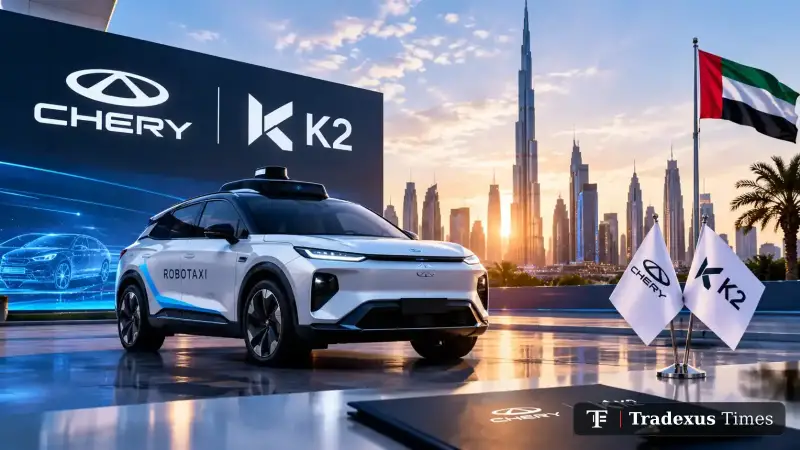
Chery Auto has unveiled a purpose-built Level 4 autonomous Robotaxi and signed a strategic cooperation agreement with UAE-based K2, marking a new step in its ambition to commercialize driverless mobility beyond China. The vehicle was presented at Chery's 2026 Global User Summit in Wuhu, where the company highlighted a design built specifically for autonomous operation rather than adapted from a conventional passenger car.
The Robotaxi integrates autonomous-driving technology into a vehicle platform designed for factory production, with passengers accessing the service through an app and no human driver required during the intended operating experience. Chery's approach emphasizes safety systems, adaptability to different markets, cost efficiency, and the potential to scale commercial operations. However, the announcement does not establish that the vehicle has already secured deployment approvals or entered commercial service across international markets.

The agreement with K2 provides a potential route for expanding the Robotaxi's commercial reach internationally. The partnership's significance will depend on how the companies translate their strategic cooperation into operational deployments, including market-specific regulatory approvals, fleet management, infrastructure requirements, and reliable driverless performance. Level 4 autonomy is designed to enable driving without human intervention within defined operational conditions, meaning deployment capabilities and restrictions can differ across jurisdictions and operating environments.
The announcement comes against a challenging backdrop for publicly traded consumer cyclical stocks referenced in the accompanying market data. As of the supplied October 18 snapshot, 94 of 134 priced US stocks in the sector were lower, while 38 advanced. XPeng shares traded at $9.23, down 4.15%, despite order activity on Pluang being heavily skewed toward buying, at 97%. Other notable declines included NEGG, down 4.05%, and Sea Limited, down 3.83%. These figures provide broader market context but do not establish a direct relationship between Chery's announcement and the share-price movements of those companies. The reported buying activity in XPeng likewise reflects platform order activity, not necessarily institutional demand or a confirmed change in investor sentiment across the wider market.
For Chery, the central challenge is moving from a technological demonstration and strategic agreement to a commercially viable international service. The next meaningful developments will be evidence of deployment timelines, the markets selected for launch, regulatory clearance, and the operational economics of running driverless fleets. Until those details emerge, the announcement signals an expansion strategy rather than proof that large-scale global commercialization has already begun.


 Chainlink

 BNB
BNB