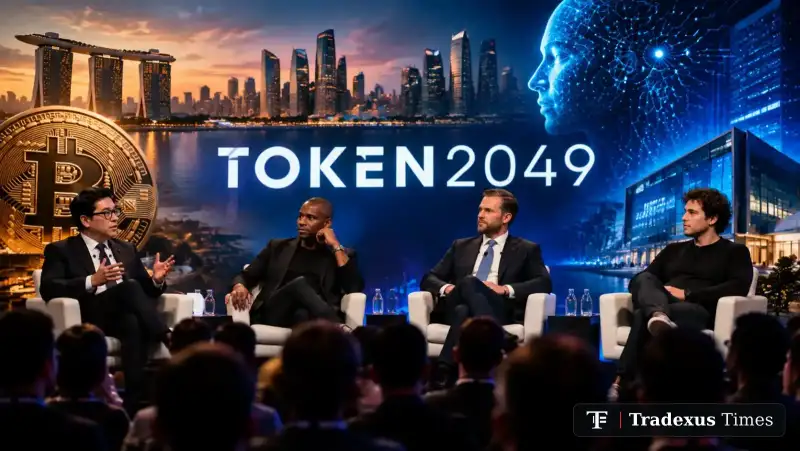
TOKEN2049 Singapore brought together some of the crypto industry’s most influential figures to discuss the next phase of digital assets, with Tom Lee, Eric Trump, Arthur Hayes, Jeff Yan, and Shayne Coplan sharing their views on institutional adoption, artificial intelligence, market accessibility, and the transition from speculation toward practical utility.
The discussions focused on a central question facing the crypto industry: where will the next sustainable wave of growth come from, and what applications can transform blockchain technology into a lasting part of the global financial system?

Tom Lee, chairman of BitMine, presented a bullish outlook on the future of crypto, arguing that the next market cycle could become larger than previous expansions. His view was based on several potential growth drivers, including asset tokenization, institutional participation, crypto treasury strategies, and the emergence of AI-related financial activity.
Lee emphasized that traditional financial institutions could increasingly use blockchain infrastructure to manage and trade existing assets. However, the long-term impact of this trend will depend on whether tokenization creates meaningful improvements in ownership, settlement, and financial efficiency rather than simply changing the format of existing products.
A major focus of Lee’s comments was BitMine’s Ethereum accumulation strategy. The company’s holdings were approaching a target of controlling 5% of Ethereum’s total supply, highlighting the scale of institutional interest in digital assets while also showing that large accumulation strategies can have defined objectives rather than unlimited buying intentions.
Eric Trump focused on the relationship between artificial intelligence and digital assets, suggesting that AI development could become a major driver for future crypto growth. His perspective connected the expansion of AI technology with increasing demand for blockchain-based infrastructure and financial applications.
However, the market impact of AI-related crypto adoption will depend on whether these technologies create real economic demand. Increased attention around AI does not automatically guarantee that every blockchain project connected to the sector will achieve long-term success.
Arthur Hayes presented one of the most ambitious ideas at TOKEN2049 through the FLOP project, which aims to create a system where AI agents can pay for computational resources using a dedicated token.
The concept focuses on a future where artificial intelligence systems require constant access to computing power and can participate in automated economic activity. The success of such a model will depend on practical demand, network efficiency, and whether blockchain-based payments offer advantages over existing alternatives.
Jeff Yan, CEO of Hyperliquid, approached the future of crypto from the perspective of access and opportunity. He argued that many financial opportunities are often captured by a small group of early participants before broader users gain access.
According to Yan’s perspective, building more accessible financial markets is essential for creating a system where a wider range of participants can benefit from emerging technologies. His comments also highlighted the role of market design and efficient trading structures in improving user participation.
Shayne Coplan, founder of Polymarket, challenged the culture of chasing speculative assets based only on expectations of extreme returns. He criticized the mindset of buying tokens purely because they might deliver massive gains, arguing that sustainable markets require stronger connections between assets and real-world utility.
Coplan’s comments reflected a broader shift in the industry toward evaluating projects based on practical applications rather than short-term price expectations. The future of crypto, according to this perspective, will depend on whether platforms can provide meaningful services that users continue to rely on.
Together, the views of Lee, Trump, Hayes, Yan, and Coplan represent different perspectives on the next stage of crypto development. Institutional adoption, AI infrastructure, market accessibility, and real utility emerged as key themes, but each faces the same challenge: proving value beyond market narratives.
The next phase of the industry will likely be determined by execution. Tokenization must demonstrate clear financial advantages, AI-focused crypto projects must prove genuine demand, and new platforms must show that they can create sustainable user adoption.
TOKEN2049 highlighted that the future of crypto may not be defined by speculation alone, but by the ability of blockchain technology to solve practical problems and become integrated into broader financial and technological systems.