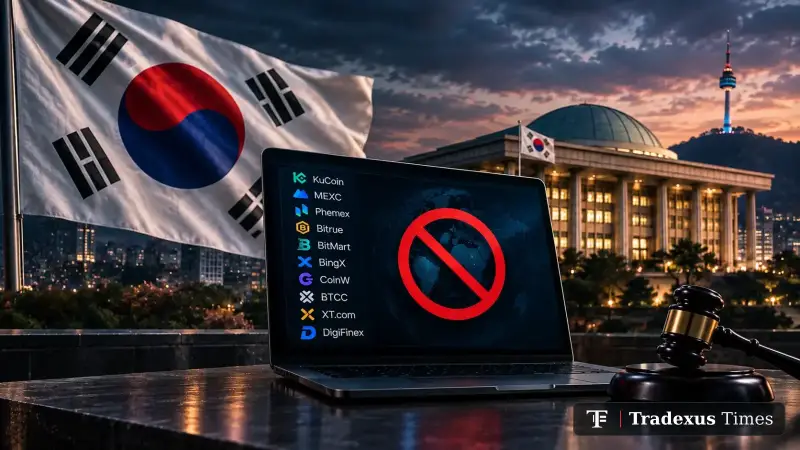
South Korea is moving to block domestic access to the websites of 27 foreign cryptocurrency platforms identified as operating without the required local registration. The country's Financial Intelligence Unit (FIU) announced the restrictions following reviews by the Korea Media and Communications Standards Commission on October 6 and 7, extending regulatory enforcement against unregistered virtual asset service providers.
The affected platforms include major international cryptocurrency exchanges such as KuCoin, MEXC, Phemex, Bitrue, BitMart, BingX, CoinW, BTCC, XT.com, and DigiFinex. The restrictions target access from within South Korea rather than the exchanges' global operations, meaning the decision does not amount to an international shutdown of the affected businesses.

Under South Korean law, foreign virtual asset service providers must register with the FIU if they offer cryptocurrency services to investors in the country. Regulators may consider several indicators when determining whether an overseas platform is targeting the domestic market, including Korean-language websites, promotional activity directed at South Korean users, and services involving the Korean won. These criteria allow authorities to assess whether foreign exchanges are effectively serving local customers even without a physical presence in the country.
The website restrictions represent an expansion of South Korea's existing enforcement measures against unregistered cryptocurrency platforms. In April 2025, Apple's App Store restricted downloads and updates for 14 unregistered cryptocurrency applications, while Google Play introduced similar measures affecting 17 applications. By extending restrictions from mobile applications to websites, authorities are addressing another channel through which overseas exchanges can reach South Korean customers.
The immediate concern for affected investors is continued access to their accounts and digital assets. Website blocking does not automatically freeze customer balances or prevent platforms from processing withdrawals, but it may create practical obstacles for users attempting to access trading accounts or transfer funds. Investors experiencing difficulties have been directed toward the Digital Asset Exchanges Association, an organization representing major South Korean cryptocurrency exchanges, for assistance.
From a market structure perspective, the decision reinforces the distinction between international exchange availability and authorization to serve a specific jurisdiction. Platforms operating across multiple markets may remain accessible elsewhere while facing restrictions in countries where they have not satisfied local registration requirements. For South Korean users, this creates an additional operational consideration beyond trading fees, asset availability, and platform functionality: whether an exchange can legally maintain access to its services in the domestic market.
The enforcement action could also strengthen the competitive position of locally registered cryptocurrency service providers by limiting access to unregistered overseas alternatives. However, the extent of any shift in trading activity cannot be established without data on the affected platforms' South Korean customer bases, trading volumes, or subsequent account transfers. The restrictions alone do not demonstrate that users have moved assets to domestic exchanges.
The next key issue is how effectively the website blocks are implemented and whether affected platforms take steps to meet South Korea's registration requirements. The ability of existing customers to access accounts and withdraw assets will also be an important measure of the restrictions' practical impact. For international cryptocurrency exchanges, the decision underscores the operational consequences of serving regulated markets without obtaining the necessary local authorization.