The Reserve Bank of Australia faces a difficult policy decision ahead of its November meeting, with Deputy Governor Andrew Hauser warning that the inflation outlook has deteriorated even as tighter monetary policy begins to slow economic activity. Rising oil prices and persistent underlying inflation pressures have strengthened the case for caution, leaving policymakers weighing the risk of further price increases against growing signs of weakness in the labour market and household demand.
Speaking at a Citi investment conference on Wednesday, Hauser said the RBA’s economists were still finalising their quarterly forecasts but that the inflation outlook appeared “materially worse,” partly because of elevated energy costs. Brent crude was trading above $110 a barrel, up from around $102 when the central bank last met three weeks earlier. The latest level was also more than 35% above the price the RBA had forecast in August.

Hauser said monetary tightening was working, with the labour market easing and consumption growth remaining subdued. However, pockets of economic strength and a deteriorating inflation outlook have made the policy balance increasingly difficult. The central bank must decide whether further tightening is necessary to contain inflation or whether holding rates steady would better protect employment and economic activity.
He also cautioned that monetary policy cannot directly reverse an oil-price shock. Instead, the RBA must ensure that higher energy and other costs do not become embedded in broader prices or push inflation expectations higher. Hauser noted that some members of the public had begun questioning whether the central bank could return inflation to its 2%–3% target range.
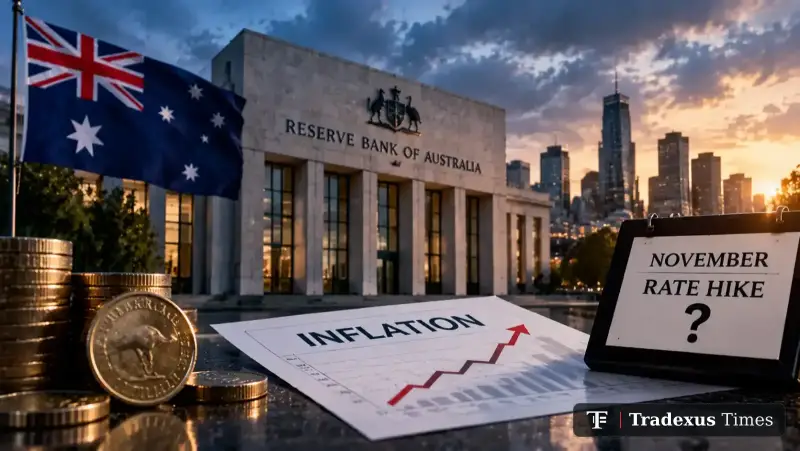
The RBA’s next policy meeting is scheduled for November 2–3, when its board will consider whether to raise the cash rate from 4.60% for a fifth time this year. Market pricing has shifted toward a greater probability of another increase, with the implied chance of a move to 4.85% reaching approximately 50%, compared with 30% at the start of the week. Markets are also fully pricing in another rate increase by March next year.
Goldman Sachs interpreted Hauser’s remarks as strengthening the case for a November hike. The bank said the RBA continued to see inflation and inflation-expectations risks tilted to the upside despite having delivered 100 basis points of tightening during the year. In its assessment, another increase was more likely than not unless the upcoming third-quarter consumer price index report delivered a downside surprise.
The inflation figures, due next week, are expected to be particularly important for the board’s decision. Headline inflation could rise to 4.0% in the third quarter as conflict in the Gulf pushes up fuel costs. Core inflation is forecast to remain around 3.5%, still above the RBA’s target range and potentially indicating that price pressures remain persistent beyond energy markets.
Hauser said the eventual inflation result was likely to exceed the central bank’s previous forecast. The figures would also help policymakers assess whether the Australian economy had less spare capacity than previously estimated, a factor that could influence how much restraint is needed to bring inflation under control.
Minutes from the RBA’s previous meeting showed that policymakers remained concerned about upside inflation risks after raising rates for the fourth time this year. Since then, however, economic data have presented a more mixed picture. Australia’s unemployment rate unexpectedly reached a five-year high of 4.7% in September, while house prices declined faster than policymakers had anticipated.
Hauser acknowledged that labour-market conditions had softened more than expected and that household demand and the housing market had weakened. Nevertheless, unemployment remained among the lowest in the Group of 20 economies, leaving the board with limited room to assume that economic weakness alone would quickly ease inflation.
The November decision will therefore depend heavily on incoming inflation data and the RBA’s assessment of how energy costs are feeding through the wider economy. A stronger-than-expected inflation reading could reinforce the argument for another hike, while evidence of easing underlying pressures may give policymakers reason to hold rates steady. For now, Hauser’s comments underline that the central bank remains concerned about inflation but has not committed to a further increase.