Bitcoin
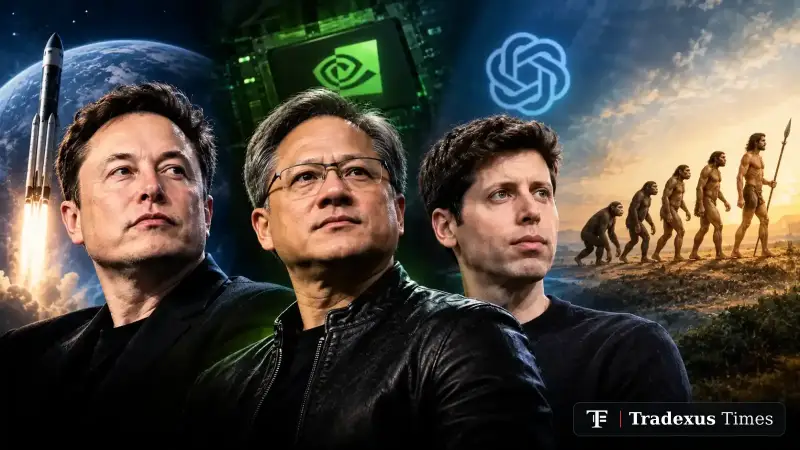
Humanity advances when individuals dare to challenge what the world considers impossible. Today, three technology leaders are helping redefine the boundaries of innovation: Elon Musk, Jensen Huang and Sam Altman. Their fields are different, their approaches are distinct, but their ambitions share a common thread: transforming technologies that could fundamentally change how humanity lives, works and understands its own potential.
Elon Musk is pursuing some of the most ambitious technological goals of our time. Through Tesla, he has helped accelerate the transition toward electric vehicles; through SpaceX, he has advanced reusable rockets and reduced the cost of reaching space; and through Starlink, he has expanded satellite internet connectivity across the globe. His ambitions extend even further through Neuralink, which is developing brain-computer interface technology with the long-term goal of helping people with certain neurological conditions. From transportation and global connectivity to the possibility of connecting the human brain with computers, Musk's projects explore multiple frontiers that once seemed far beyond practical reach.
In this story
3 assets
Jensen Huang is helping build another foundation of the future: the computing power behind artificial intelligence. Under his leadership, NVIDIA has become a central force in accelerated computing, supplying hardware and platforms that power many of today's advanced AI systems. These technologies are supporting progress in scientific research, medicine, robotics and industrial automation. While Musk's innovations often produce visible changes in the physical world, Huang's contribution lies in the computational infrastructure that may enable countless breakthroughs across industries.
Sam Altman, meanwhile, has helped bring artificial intelligence into everyday life through OpenAI. The widespread adoption of ChatGPT made advanced conversational AI accessible to millions of people, giving students, developers, researchers and businesses new ways to learn, create and solve problems. As AI capabilities continue to develop, they could help accelerate scientific discovery, improve productivity and expand access to knowledge. Realizing that potential, however, will require responsible deployment, stronger safeguards and attention to the risks that accompany increasingly powerful systems.
What makes these three figures particularly significant is that they are not simply competing within the same industry. They are advancing different parts of a much larger technological transformation. Musk is pushing the boundaries of transportation, space exploration, connectivity and brain-computer interfaces. Huang is helping provide the computing infrastructure behind the AI revolution. Altman is working to bring AI capabilities into the hands of individuals and organizations around the world. Their fields increasingly intersect, creating the possibility that progress in one area could accelerate breakthroughs in another.
None of this means their work is beyond criticism. Their companies face questions involving safety, competition, privacy, employment and the distribution of economic benefits. Technologies such as brain-computer interfaces and advanced AI also demand careful oversight. Recognizing these challenges does not diminish the importance of innovation; it highlights the responsibility that comes with developing technologies capable of changing society.
Perhaps the most important lesson is that humanity needs people willing to think beyond the limits of the present. Progress rarely comes from accepting that existing systems are as good as they can ever become. It requires vision, persistence, technical talent and the willingness to invest in ideas whose full potential may take years to emerge. People who turn ambitious ideas into real technologies can expand the possibilities available to entire generations.
Musk, Huang and Altman are each helping drive a revolution in their own field, and history will ultimately judge their legacies by the lasting effects of their work. But their stories also remind us that technological progress is a collective achievement, built by engineers, scientists, researchers and teams whose contributions often receive far less public attention. The world needs more ambitious innovators, more scientific curiosity and more people willing to tackle humanity's hardest problems. And when their work genuinely improves lives, expands opportunity and opens new frontiers, we should recognize the value of those contributions while continuing to hold them accountable.