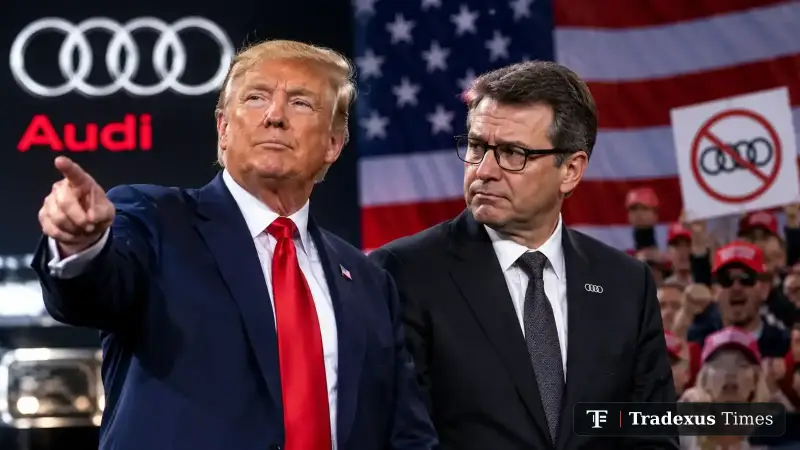
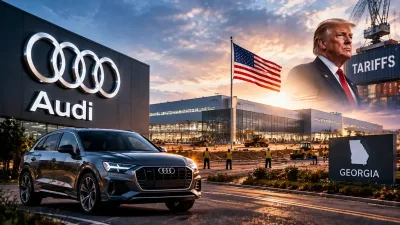
Audi CEO Gernot Döllner is facing criticism from German labor representatives and political leaders after appearing alongside US President Donald Trump at a campaign rally in Georgia, where the automaker announced plans for a proposed $4 billion manufacturing plant. The project would mark Audi’s first US production facility and is expected to have the capacity to produce 200,000 SUVs annually. However, the announcement has triggered controversy over political neutrality, corporate governance and the growing tension between expanding US manufacturing and protecting jobs in Germany.
The proposed investment still requires approval from Volkswagen’s supervisory board, which includes German labor representatives. The plan follows lengthy discussions about establishing local US production to reduce the impact of import tariffs, which cost Audi approximately €1.2 billion, or $1.3 billion, last year. Georgia is reportedly prepared to support the project with $1.4 billion, although the investment package and its final terms remain subject to the necessary approvals.

The controversy centers on Döllner’s decision to appear at a political campaign event just days before the US midterm elections scheduled for November 3. Christiane Benner, head of Germany’s IG Metall union and deputy chair of Volkswagen’s supervisory board, accused the Audi chief of violating the company’s political-neutrality guidelines. Audi’s code of conduct states that public appearances at events involving political parties or politicians standing for election, as well as sponsorship of such events, are prohibited during the three months preceding an election.
Audi defended the appearance, saying its delegation had traveled to Georgia to advance negotiations over the planned factory and had accepted an invitation to present the project alongside Trump. The company said the decision was made solely in Audi’s business interests and acknowledged that it took seriously concerns that the appearance could be interpreted as political support. A person familiar with the matter said Audi’s management board had approved an exception to the code of conduct before Döllner attended the rally.
The response within Volkswagen’s leadership has been more complicated. Daniela Cavallo, head of Volkswagen’s works council, acknowledged that localizing Audi production in the United States could make commercial sense, particularly in light of tariffs. However, she criticized the way the investment was presented, arguing that Döllner had allowed the company’s announcement to become part of Trump’s political messaging. Volkswagen’s supervisory board committee has also discussed the matter, according to people familiar with the discussions, against a backdrop of existing tensions over the group’s restructuring plans.
For Trump, the announcement supports a central message of his economic agenda: that tariffs can encourage manufacturers to invest in US production and create domestic jobs. By presenting Audi’s proposed factory at a campaign rally in the battleground state of Georgia, the administration gained a prominent example of a foreign automaker considering a major American investment. For Audi, however, the same setting has created a reputational challenge, with labor representatives concerned that the company’s commercial strategy could be interpreted as an endorsement of a political campaign.
The investment also highlights the difficult choices facing global automakers as they respond to tariffs, changing consumer demand and the high cost of transitioning toward electric vehicles. Producing vehicles closer to US customers could reduce Audi’s exposure to import duties and strengthen its competitiveness in the American market. Yet the benefits depend on whether the factory receives final approval, how quickly it can be built, the costs of local production and whether demand is sufficient to support the planned output.
The timing has intensified concerns among German employees. Volkswagen is pursuing plans to reduce costs, cut excess production capacity and eliminate around 100,000 jobs across its German operations as it confronts pressure from losses in China, tariffs and the expensive transition to electric vehicles. Audi’s Neckarsulm factory is among four German production sites reportedly facing the prospect of closure from the beginning of the next decade. Against that background, announcing a major US plant while German operations face restructuring has raised questions about how the group will distribute future investment and employment opportunities.
Lower Saxony’s state premier, Olaf Lies, whose state is Volkswagen’s second-largest shareholder, also criticized the presentation of the project at a campaign rally. He argued that an event of this kind was not an appropriate setting for announcing an investment of such magnitude and said the appearance had caused concern among employees worried about their jobs. The criticism reflects a broader concern that decisions made to protect the company’s competitiveness in the United States could deepen uncertainty for workers in Germany.
Financial analysts have nevertheless argued that local US production could be commercially rational. Avoiding tariffs and building vehicles closer to the American market may improve Audi’s cost position over time, even if the announcement’s political optics have created difficulties. The distinction is important: criticism of the event does not necessarily mean the proposed factory lacks a business case. The investment’s ultimate value will depend on its economics, regulatory and board approvals, and its contribution to Audi’s long-term strategy.
The episode illustrates how international business decisions can become entangled with domestic politics when governments use tariffs and investment announcements to demonstrate economic results. Audi must weigh the advantages of local production against the consequences of appearing alongside a political candidate, while Volkswagen’s leadership must consider both shareholder interests and the concerns of employees whose jobs are already under pressure.
The next major question is whether Volkswagen’s supervisory board will approve the proposed $4 billion investment and under what conditions. If the project proceeds, it could help Audi strengthen its position in the United States and reduce tariff exposure. At the same time, the company will face continued scrutiny over how it manages political neutrality, communicates strategic decisions and balances new investment in America with restructuring across its German manufacturing network.

 Dogecoin

 Polkadot