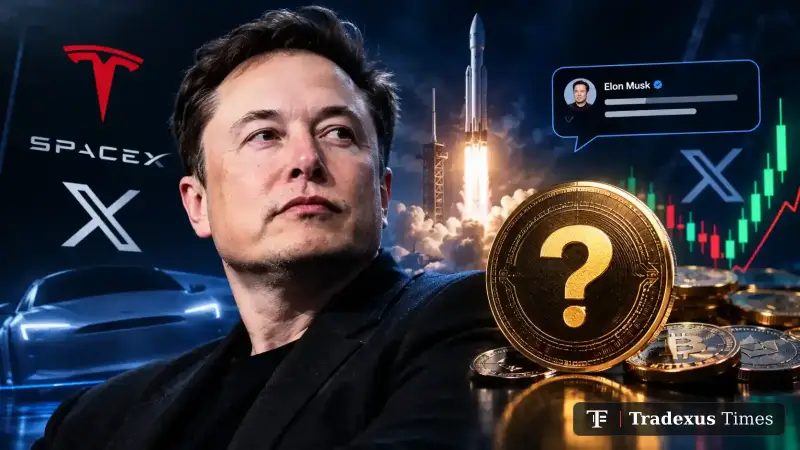
Elon Musk has spent years influencing the cryptocurrency market through his public comments, his support for Dogecoin and his companies’ exposure to digital assets. Yet despite speculation that Tesla, SpaceX, Starlink or X could eventually introduce a cryptocurrency of their own, no official company-issued token has been announced. The question is not simply why Musk has never launched his own coin, but whether he has any intention of changing a position he has publicly stated.
There is direct evidence that Musk has rejected the idea of his companies issuing proprietary crypto tokens. On November 3, 2023, he posted on X: “To be super clear, none of my companies will ever create a crypto token.” His statement followed speculation surrounding tokens using the name of xAI, his artificial intelligence company. The comment was reported by CryptoSlate and TheStreet. It was a clear public declaration, although it does not guarantee that business decisions can never change in the future.
In this story
2 assets

Musk had made a similar statement about X several months earlier. In August 2023, after a user warned people about fake tokens claiming to be associated with X, Musk replied, “And we never will.” The Block and Decrypt reported the exchange. These statements support the conclusion that Musk publicly rejected plans for his companies to issue their own cryptocurrency tokens at that time. They do not mean that his companies would never support payments involving existing cryptocurrencies.
Musk’s personal cryptocurrency holdings are a separate issue. During The B Word conference in July 2021, he said that his meaningful personal assets outside his company stock included Bitcoin, Ether and Dogecoin, with Bitcoin representing the largest of the three. He also confirmed that Tesla and SpaceX held Bitcoin. These disclosures show that he has owned established cryptocurrencies, but they do not establish that he created or owns a proprietary cryptocurrency bearing his name.
Dogecoin is the digital asset most closely associated with Musk in the public imagination, but it is not his personal coin. Dogecoin was created in 2013, before Musk became a prominent supporter. In a June 2022 interview at the Qatar Economic Forum, Musk said he had bought Dogecoin, explained that Tesla accepted it for some merchandise and said SpaceX would do the same. Tesla’s acceptance of Dogecoin for selected merchandise does not make the cryptocurrency a Tesla-issued asset, nor does it mean that customers can generally purchase Tesla vehicles with Dogecoin.
The distinction matters because the crypto market frequently produces tokens that use the names of famous entrepreneurs and major companies. A token named after Elon Musk, Tesla, SpaceX, Starlink or X is not automatically authorized by any of those parties. In July 2022, fact-checking organization Full Fact found no evidence supporting claims that Tesla had invented its own electronic currency. It also noted that the company’s acceptance of Dogecoin for some merchandise did not prove that Tesla had launched a separate cryptocurrency. Such claims should be verified through official company announcements rather than token names, social media posts or promotional videos.
So why might Musk avoid creating a proprietary coin for his business ecosystem? One possible explanation is that a new token would introduce complexity without necessarily solving a problem that existing payment systems cannot already handle. Tesla can collect payments for vehicles and products through established channels, while Starlink can charge recurring subscription fees. X can develop wallets and money transfers without issuing a cryptocurrency. A new token would need to offer a clear advantage in settlement speed, transaction costs, international payments or customer experience to justify the additional operational burden. Musk has not publicly confirmed that this is his reasoning, so it should be treated as analysis rather than an established motive.
Regulatory requirements could also complicate any potential launch. A token used across several businesses and countries might raise questions involving financial regulation, consumer protection, anti-money-laundering obligations and tax treatment. If the token were designed to maintain a stable value, its structure could also raise questions about reserves and redemption. If its market price fluctuated, customers and businesses could face volatility when making or receiving payments. These are potential challenges for a hypothetical token, not confirmed reasons Musk has given for rejecting one.
X Money adds another dimension to the discussion. X has pursued financial services and payment functionality, including a partnership announced with Visa in January 2025 that outlined plans for wallet funding, transfers between users and transfers to bank accounts. A payments platform, however, does not automatically require a native cryptocurrency. X could potentially support certain crypto-related services in the future without creating a new token of its own. No official announcement cited here establishes that X Money will launch an independent cryptocurrency.
A unified digital currency connecting Tesla, SpaceX, Starlink and X remains a hypothetical scenario that could attract attention from crypto investors. In theory, one asset might be used for eligible purchases, subscriptions or transfers across participating services. But such a system would require a clear economic purpose, a workable legal structure and a reason for customers to use it instead of conventional money or existing digital assets. There is currently no verified basis for presenting this concept as an active Musk business plan.
The evidence therefore supports a careful conclusion: Musk has publicly rejected the creation of crypto tokens by his companies, has disclosed personal holdings in existing cryptocurrencies, and has been associated with corporate Bitcoin holdings and limited Dogecoin payment options. Those facts do not establish the existence of an official personal cryptocurrency. Based on the public information reviewed, no official Musk-branded coin has been confirmed as a cryptocurrency issued by him or his companies. That conclusion concerns publicly verified information, not the unknowable details of every private asset or activity.
For investors, the key distinction is between an official announcement and market speculation. Until Musk or a relevant company announces a proprietary token through a verifiable official channel, claims that a coin is the official cryptocurrency of Elon Musk, Tesla, SpaceX, Starlink or X should be treated with caution.