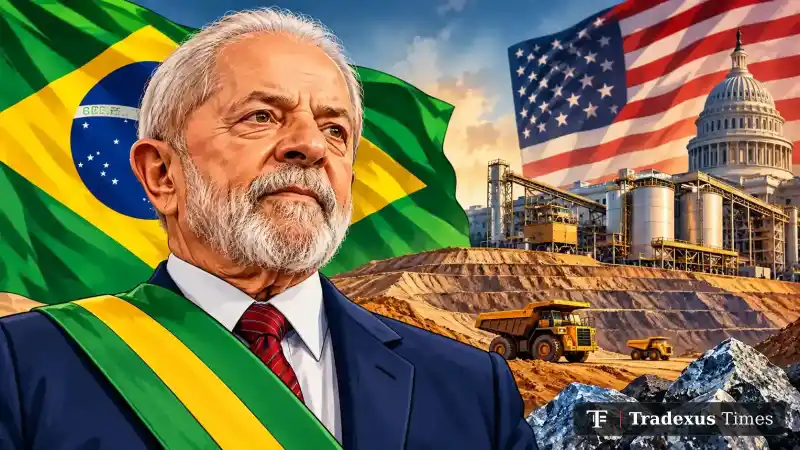
Brazil’s rare earth resources are becoming an increasingly important factor in the global competition for critical minerals, following the re-election of President Luiz Inácio Lula da Silva.
According to a Reuters report published on November 5, 2026, Lula’s victory is expected to complicate US efforts to secure rapid and preferential access to Brazil’s vast rare earth reserves, which are considered the second-largest in the world.

The Brazilian government plans to prioritize domestic processing, refining, and manufacturing rather than simply exporting unprocessed minerals. Foreign investors will still be welcome, including companies from the United States and China, but they are expected to contribute technology, research, and industrial development within Brazil.
The policy will be coordinated through Brazil’s National Council for the Industrialization of Critical and Strategic Minerals (CIMCE). The council is preparing regulations covering investment incentives, priority projects, and international agreements, with a regulatory framework expected to take shape in early 2027.
The issue carries significant strategic importance for Washington. Rare earth elements are essential to the production of electric vehicles, advanced electronics, renewable energy systems, and other high-tech products. The United States has been seeking alternative sources of supply to reduce its dependence on China, which dominates the global rare earth industry.
Lula’s approach signals that Brazil wants to capture more economic value from its natural resources instead of remaining primarily a supplier of raw materials. However, building a domestic processing industry will require investment, infrastructure, and technology. Brazil currently has limited rare earth processing capacity, and only one commercially operating mine.
The policy does not shut the door on US investment. Instead, it changes the conditions under which foreign companies can participate, potentially making access to Brazil’s mineral wealth more dependent on long-term industrial partnerships and technology transfer.
As competition between Washington and Beijing over critical minerals intensifies, Brazil is seeking to strengthen its position as a strategic supplier while maintaining greater control over the development of its own resources.