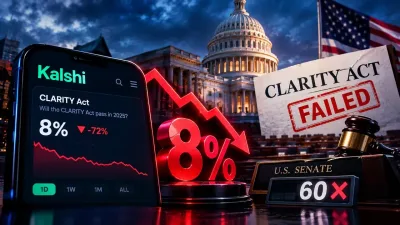
The cryptocurrency industry spent approximately $8 million lobbying for the Digital Asset Market Clarity Act during the first half of 2026, but the legislation has yet to pass the U.S. Senate. The spending, identified in federal lobbying disclosures reviewed by CoinDesk, highlights the industry's effort to secure a federal framework for digital asset markets and the difficulty of translating financial influence into legislative results.
Crypto-related interests spent more than $13 million on direct lobbying between January and June, according to the analysis. Roughly $8 million was associated with the Clarity Act, although disclosure filings do not establish how much of that spending was devoted exclusively to the bill. The remaining expenditures covered a broader range of issues, including taxation, digital asset mining and regulatory policy.

The Clarity Act lobbying campaign involved three main groups: outside lobbying firms, trade association employees and lobbyists working directly for cryptocurrency companies. Third-party firms received approximately $2.4 million, while another $2.1 million supported lobbyists employed by industry trade associations. The remaining portion of the identified $8 million was attributed to crypto companies' in-house lobbying operations.
These figures represent a separate category of political spending from campaign contributions and broader advocacy funding. The industry's election-related spending and support for organizations such as the Digital Chamber, Blockchain Association and Crypto Council for Innovation operate through different channels, even though their activities may advance overlapping policy objectives.
The distinction matters because direct lobbying focuses on influencing the lawmakers and officials involved in drafting legislation. In the Clarity Act's case, the objective was to establish clearer rules governing U.S. digital asset markets and the regulatory responsibilities associated with them. Despite the resources deployed, the industry has not secured the Senate approval it sought.
The reported $8 million figure also does not necessarily capture the full cost of efforts connected to the bill. Some disclosures describing lobbying on cryptocurrency or financial services did not explicitly mention the Clarity Act, making it difficult to determine whether those activities also supported the legislative push. Consequently, the identified spending should be treated as the amount linked to the legislation in the analysis, rather than a definitive total for every related lobbying activity.
The Senate setback leaves the industry's immediate legislative objective unresolved. According to the report, even supporters were uncertain whether the bill could receive another opportunity during the limited year-end lame-duck session. That uncertainty complicates planning for companies seeking a predictable federal framework for digital asset businesses.
However, the stalled legislation does not necessarily mean that all the industry's efforts have been lost. The bill advanced further than previous attempts to establish a comprehensive crypto market-structure framework, and negotiations helped lawmakers engage with technical questions surrounding digital assets. Areas of bipartisan agreement could provide a foundation for future negotiations, although they do not guarantee that a revised bill will advance.
The industry's regulatory strategy is also continuing beyond Capitol Hill. The Securities and Exchange Commission and the Commodity Futures Trading Commission remain important points of engagement as federal agencies develop rules affecting crypto markets. Blockchain Association's Fraser said the organization was reassessing its priorities following the Senate vote, with deeper engagement with the SEC and CFTC among its planned areas of focus.
For the crypto sector, the next key developments are whether lawmakers revisit the Clarity Act, whether unresolved disagreements can be addressed and how regulators shape market rules in the meantime. The $8 million lobbying effort demonstrates the scale of the industry's commitment, but the bill's stalled progress illustrates that spending alone cannot secure legislative approval.