
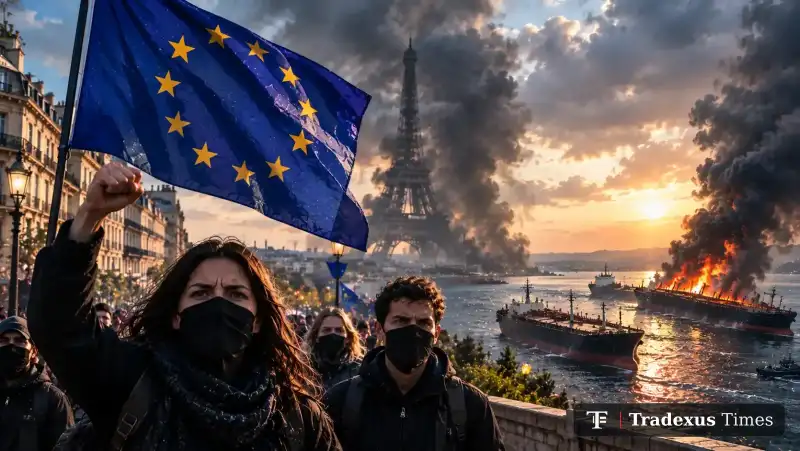
Protests and violent unrest across parts of Europe are exposing growing economic and political pressures as the conflict involving Iran and the United States continues to disrupt energy markets. France has experienced particularly severe disturbances, with demonstrations over the cost of living and deteriorating public services escalating into clashes, arson and widespread looting. Similar unrest has been reported in Italy, Belgium, Portugal and Albania, although the causes and scale differ across countries.
France has emerged as a major flashpoint. Demonstrations initially driven by dissatisfaction with education and public services have expanded into a broader expression of frustration over living costs and government policy. The violence has added another challenge for President Emmanuel Macron's government, which must balance demands for economic relief with pressure to restore public order. Donald Trump has also called on France to close its borders, linking the unrest to immigration, a claim that should be distinguished from the economic and public-service grievances driving the demonstrations.

The economic backdrop is becoming more complicated because of the disruption around the Strait of Hormuz, a critical route for global energy shipments. Restrictions on commercial shipping and continuing attacks on vessels have constrained normal traffic through the waterway. Brent crude has recently traded around $110 per barrel, highlighting the continuing geopolitical risk premium in energy markets. Although oil prices can fluctuate as traders respond to diplomacy, supply expectations and policy decisions, a prolonged disruption could keep fuel and transportation costs elevated.
Higher energy prices can feed into inflation by increasing the cost of transport, manufacturing and essential goods. For households already struggling with living expenses, another rise in fuel prices could intensify public frustration and increase pressure on governments to provide subsidies or other forms of relief. However, the connection between the unrest in different countries should not be overstated: protests may share economic pressures without forming a single coordinated international movement. Reports of unrest in Colombia, Mexico and Argentina also require separate country-specific verification before those countries can be presented as part of the same fuel-protest wave.
The implications extend beyond energy markets. Persistent inflation could complicate central-bank decisions, particularly if policymakers face a combination of rising prices and weakening economic activity. The Federal Reserve's October meeting is therefore an important event for markets. Investors will be watching the policy decision and the accompanying assessment of inflation, employment and economic risks. If energy-driven inflation proves persistent, expectations for monetary easing could weaken; if economic conditions deteriorate more sharply, concerns about growth could become equally important.
Cryptocurrency markets could feel these pressures through several channels. Higher energy costs and renewed geopolitical uncertainty may encourage investors to reduce exposure to volatile assets, including Bitcoin and altcoins, particularly if expectations for interest-rate cuts decline. A stronger US dollar or tighter financial conditions could add further pressure. Conversely, a change in the geopolitical outlook or a more supportive monetary-policy signal could improve risk appetite. These are conditional possibilities, not confirmed market outcomes, and crypto prices will also depend on asset-specific developments and broader liquidity conditions.
The central question is whether the current combination of geopolitical conflict, energy disruption and social unrest will remain a series of connected regional crises or develop into a broader global economic shock. The risk of further escalation is real, but the available evidence does not establish that the world has entered a third world war. That conclusion would require a much broader assessment of direct military involvement, alliances and the expansion of armed conflict between major powers.
For markets, the next developments to watch are the status of commercial shipping through Hormuz, changes in oil prices, the response of European governments to public unrest and the Federal Reserve's October decision. A sustained improvement in shipping conditions could ease pressure on energy costs, while further disruption could reinforce inflation concerns and volatility across traditional and digital-asset markets. The immediate danger is not simply one event, but the possibility that geopolitical and economic pressures begin reinforcing one another.

 SUI




 Ethereum

 Chainlink


