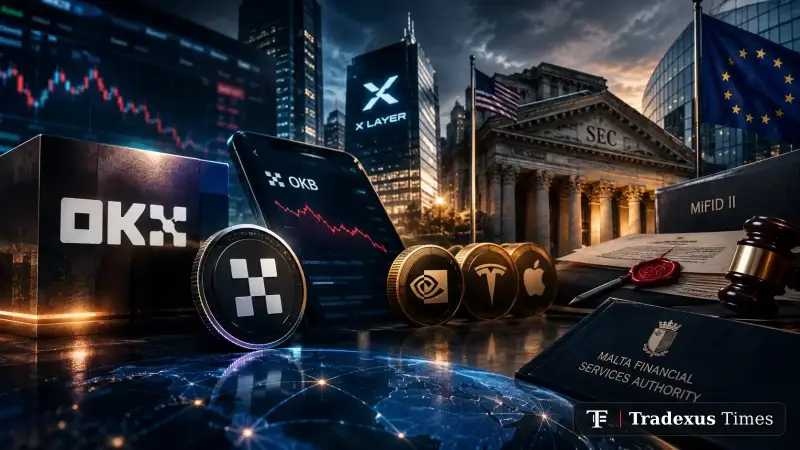
X Layer added $32 million in market capitalisation for tokenised stocks over seven days, marking the third-largest weekly gain among blockchains supporting these instruments. The expansion highlights growing activity on the blockchain operated by OKX, but the development has yet to translate into positive price performance for OKB, the token used to pay transaction fees on the network.
OKB traded at $111.35 on Wednesday evening, down 4.19% over the preceding seven days despite a daily gain of 1.82%. The divergence highlights an important distinction between growth in blockchain-based financial products and demand for the native token used to facilitate their transactions. Rising tokenised stock activity may increase network usage, but its effect on OKB depends on transaction volumes, fee generation and the economic mechanisms through which those fees accrue.

X Layer began supporting tokenised stocks on June 15, 2026, with market capitalisation starting from zero. By September 12, that figure had reached approximately $91.5 million. Reported assets under management approached $200 million by October 16, while estimates for the end of October ranged from $259 million to $304 million, depending on the data provider and its measurement methodology.
The variation between estimates underscores a challenge in assessing tokenised securities markets: different data services may classify assets and calculate market capitalisation differently. Nevertheless, the overall trajectory points to rapid expansion within X Layer's tokenised stock segment.
The broader xStocks ecosystem, which includes X Layer and other connected blockchains, reached approximately $1 billion in market capitalisation at the end of October, with cumulative trading volume of roughly $2 billion through partners such as Uniswap. X Layer's weekly gain therefore represents a contribution to a wider market for blockchain-based exposure to traditional equities rather than an isolated development.
Tokenised stocks provide price exposure to underlying shares through blockchain-based instruments issued by a provider. In the case of xStocks, the issuer describes the products as tracker certificates backed one-to-one by the corresponding shares. However, that backing does not make the token equivalent to direct share ownership. The products described in the OKX offering provide price exposure without dividend or voting rights, leaving holders dependent on the contractual structure and performance of the issuer rather than granting them the full rights associated with the underlying equity.
The distinction matters because the growth of tokenised stocks does not necessarily translate into the same investor protections or economic benefits as holding shares through a conventional brokerage account. Investors are exposed not only to movements in the underlying equity but also to the structure of the product, the issuer's obligations and the arrangements governing custody and redemption.
X Layer is a zkEVM-based network built using Polygon technology, with OKB serving as its transaction-fee token. Following the discontinuation of the older OKTChain and the OKB version on Ethereum's main network, OKB assumed the fee-payment role on X Layer. The blockchain's growing activity therefore creates a potential channel through which tokenised stock adoption could affect demand for OKB.
That relationship remains indirect. Additional transactions can increase the use of OKB for fees, but the $32 million increase in tokenised stock market capitalisation is not revenue generated by the network and does not establish how much additional demand for OKB has resulted. Transaction costs on layer-two networks are designed to remain relatively low, and the effect on the token depends on actual activity and the treatment of fees.
OKB's supply structure provides a separate consideration. Both its circulating supply and maximum supply are reported at 21 million tokens, indicating that the token's supply is fully issued and capped. A fixed supply can constrain future issuance, but it does not guarantee price appreciation. Market demand, trading liquidity and the economic value captured by the token remain decisive factors.
Price action also points to risks that are distinct from network growth. According to CoinPaprika data, OKB's market capitalisation stood at approximately $2.3 billion on Wednesday evening. Daily data from Kraken showed a high of $136.18 and a low of $110.62 on October 23, while the weekly low reached $101 on October 22. The highest daily close cited for the week was $116.58 on October 21.
These observations illustrate substantial short-term volatility, although price fluctuations alone cannot establish that thin liquidity was the cause. The source data indicate that prices can differ across trading venues, making execution conditions important for investors placing larger orders. Market orders can expose traders to slippage when available liquidity is insufficient at the quoted price, while limit orders offer greater control over execution price at the cost of potentially remaining unfilled.
The market structure surrounding tokenised stocks also faces a separate regulatory test in the United States. OKX and Intercontinental Exchange, the operator of the New York Stock Exchange, submitted an application through a joint venture to the US Securities and Exchange Commission in early October 2026, seeking to enable around-the-clock trading in 63 tokenised US stocks, including Nvidia, Tesla and Apple.
The application remains pending, with no decision date published. Several companies whose shares are involved, including Coca-Cola, JPMorgan and Dell, have reportedly opposed the proposal. Their resistance is significant because it comes from issuers of the underlying equities rather than solely from competing financial platforms.
The outcome could influence how tokenised equities are distributed and traded, particularly if regulatory approval or objections determine the scope of products that can reach investors. Until the application is resolved, however, it should be treated as a separate regulatory development rather than evidence that the existing tokenised stock market will automatically expand under the proposed framework.
For European investors, the regulatory classification of these products is particularly important. Tokenised stocks that qualify as financial instruments fall under the Markets in Financial Instruments Directive II, or MiFID II, rather than the EU's Markets in Crypto-Assets Regulation, known as MiCA. The distinction affects the authorisation framework governing distribution and means that a crypto exchange's authorisation under one regime should not be assumed to cover every financial product it offers.
OKX identifies OKX Europe Markets Limited as the distributor of its stock tokens, operating under an investment-firm licence from Malta's financial regulator, the Malta Financial Services Authority, pursuant to the Investment Services Act and MiFID II. The platform also identifies regional restrictions that may affect product availability. Kraken's offering, meanwhile, is described as operating through a Cypriot investment firm.
Investors therefore need to verify the legal entity providing the service, the scope of its authorisation and the terms applicable to their own accounts. The brand name of an exchange alone does not establish that a particular tokenised security is available or appropriately authorised in every jurisdiction.
Tax treatment adds another layer of uncertainty for German investors. Traditional crypto assets such as Bitcoin and OKB may fall under the private disposal rules that provide a one-year holding period under certain circumstances. Shares, by contrast, are generally subject to investment-income taxation, including capital gains taxation irrespective of how long they are held.
For tokenised stocks, the classification of the underlying product as a financial instrument suggests that investment-income rules may be more relevant than the private crypto-asset holding-period regime. However, this is not the same as a definitive tax ruling. Without published administrative guidance specifically addressing the treatment of these tokenised shares in Germany, investors should not assume that the tax treatment of a token automatically follows the rules applied to Bitcoin or other conventional crypto assets.
The practical consequence is that portfolios containing both crypto assets and tokenised equities may require separate transaction records and tax assessments. Investors should establish the appropriate treatment with a qualified tax adviser before disposing of the instruments rather than relying on the assumption that all blockchain-based assets are taxed alike.
Custody and counterparty risk also distinguish tokenised stock certificates from direct equity ownership. The one-to-one backing described by the issuer is relevant, but investors still depend on the contractual arrangements, the issuer's ability to meet its obligations and the effectiveness of the custody structure. Moving a token into a personal wallet transfers responsibility for private-key security to the holder without eliminating the underlying issuer-related risk.
Around-the-clock trading introduces an additional complication. The token may remain tradable outside the opening hours of the underlying US equity market, but the reference share does not continuously generate a live exchange price. During those periods, pricing depends more heavily on the token market's own order book and the mechanisms used to determine its value. That can complicate price discovery and execution, particularly when the underlying market is closed.
For OKB, the next important question is whether expanding tokenised stock activity produces measurable, sustained network usage and fee demand. For tokenised stock investors, the more immediate priorities are the issuer's obligations, the applicable regulatory framework, tax classification and the conditions under which tokens can be traded, transferred or redeemed.
The increase in X Layer's tokenised stock market capitalisation is evidence of product growth, but it is not sufficient on its own to establish a stronger valuation case for OKB. The distinction between adoption, fee generation and token demand remains central to assessing whether network expansion can eventually translate into economic value for holders.