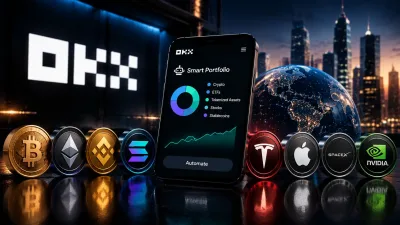
OKX has secured new investment from Circle, Ripple, Qube Research & Technologies and SC Ventures, the venture arm of Standard Chartered, as the cryptocurrency exchange accelerates its transition toward a broader financial technology platform spanning digital assets, payments and blockchain-based traditional financial products.
The company did not disclose the size of the latest investment. The financing follows an investment from Intercontinental Exchange, the owner of the New York Stock Exchange, completed in March. Like that transaction, the latest financing values OKX at $25 billion on a pre-money basis.

OKX founder and CEO Star Xu said the exchange business was the company's starting point but that its longer-term strategy is to operate as a broader financial technology platform where customers can hold, spend, invest and grow their assets through a single environment.
The expansion reflects a wider strategic shift among major crypto exchanges, which are increasingly moving beyond spot cryptocurrency trading into payments, stablecoins, traditional securities, derivatives and tokenized real-world assets. For OKX, the involvement of established financial and digital-asset firms in its latest financing provides an additional link between its existing crypto infrastructure and the traditional financial system.
That transition is also becoming visible through OKX's relationship with ICE. An OKX-ICE joint venture has filed to introduce tokenized stock trading under a U.S. Securities and Exchange Commission framework, placing the company closer to a market traditionally served by brokerages and securities exchanges.
OKXICE plans to offer 24-hour trading in tokenized shares of 63 U.S. companies through OKX's X Layer blockchain, with stablecoins including USDC, USDT and USDG used within the platform. Under the proposed structure, tokenized shares would retain dividend and voting rights, making the initiative more closely aligned with traditional equity ownership than purely synthetic crypto-based exposure.
The model nevertheless faces an important adoption test. Macquarie has said that the platform will need sufficient participation from companies, investors and liquidity providers to maintain reliable pricing around the clock. The temporary nature of the SEC exemption could also complicate institutional adoption, as financial firms may be reluctant to invest heavily in technical connections before the regulatory framework's longer-term status becomes clearer.
TD Securities has raised similar concerns, reinforcing the uncertainty surrounding the institutional case for the platform. Existing institutions already have established access to U.S.-listed equities, meaning a new tokenized venue must provide a meaningful advantage in liquidity, settlement, accessibility or operating efficiency to justify additional regulatory and technology costs.
As a result, early adoption could skew toward retail investors, who may have fewer structural barriers to accessing a new trading venue. Institutional participation could depend more heavily on the platform's ability to establish durable liquidity and regulatory certainty.
The broader significance for OKX extends beyond tokenized stocks. If the platform can combine crypto infrastructure, stablecoin settlement and regulated access to traditional assets, it could demonstrate how exchange infrastructure is evolving into a broader financial distribution layer.
Stablecoins could become particularly important in that model. Their use as a settlement mechanism for tokenized equities would provide another test of whether blockchain-based dollar instruments can move beyond crypto-native markets and support regulated financial activity.
For OKX, the key challenge now is converting its expanding financial infrastructure into sustained usage. The scale of institutional participation, the depth of available liquidity and the durability of the regulatory framework will be critical indicators of whether the company's broader financial-platform strategy can move beyond the crypto exchange model.