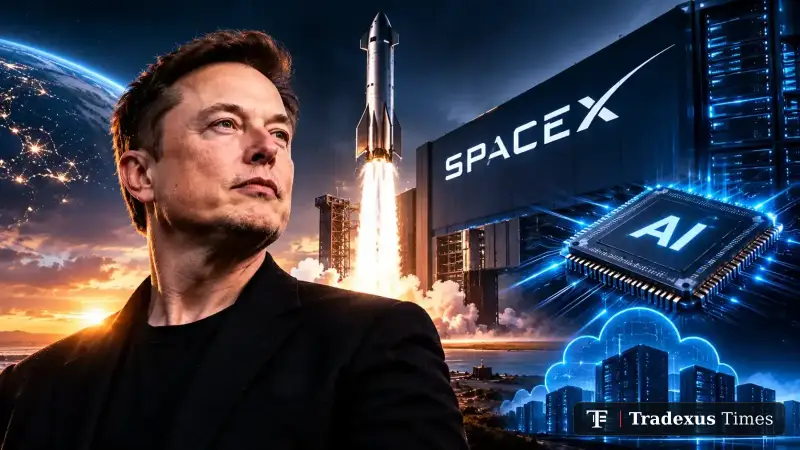
Elon Musk has confirmed that SpaceX has secured a $40 billion debt deal to finance purchases of artificial intelligence chips, highlighting the growing financial divide between technology companies with diversified revenue and businesses dependent almost entirely on AI infrastructure. The financing comes as the race to build computing capacity becomes increasingly expensive and lenders grow more selective about which companies they are willing to fund.
Musk announced the deal on X, explaining that SpaceX can access substantial financing because of its strong credit profile and established revenue streams from Starlink satellite internet and rocket launches. Unlike companies whose earnings depend almost entirely on renting computing power, SpaceX has businesses that generate revenue independently of AI data centers, giving it a stronger foundation for borrowing.
In this story
2 assets

The deal is mainly structured as callable debt, allowing SpaceX to repay the financing early. The capital could help fund deliveries of graphics processing units expected in the first half of 2027, although Musk did not explicitly confirm that purpose. The chips are essential for training and operating advanced AI systems, but acquiring them at scale requires enormous upfront investment in addition to the cost of building and powering data centers.
Musk also warned that financing conditions for AI infrastructure companies have deteriorated sharply. According to his comments, debt markets have largely closed off access to funding for businesses that lack substantial revenue outside AI data centers. If this financing environment persists, companies that expanded aggressively on the assumption of continued access to cheap capital could face increasing pressure to restructure, sell assets or exit the market.
He predicted that more than 200 neocloud companies could eventually consolidate, leaving only a small number of survivors. Neoclouds specialize in providing AI computing capacity, often competing to secure advanced chips and rent computing power to developers and businesses. Their business models can generate significant revenue when demand and utilization are strong, but they are also exposed to substantial equipment costs, financing obligations and the risk that computing capacity becomes outdated before investments are fully recovered.
The financing challenge extends beyond purchasing GPUs. Companies must also secure data center space, electricity, cooling systems and the infrastructure needed to operate large computing clusters. If construction is delayed or customer demand falls short of expectations, expensive chips may remain underused while interest and operating costs continue to accumulate. That creates a difficult equation for businesses that borrowed heavily to expand capacity ahead of anticipated demand.
Chamath Palihapitiya has separately raised concerns about the financial strength and management of some neocloud companies. He has argued that major cloud providers, including Amazon, Microsoft and Google, may be cautious about committing to certain external computing arrangements as they prioritize their own infrastructure requirements. Delays in data center construction could leave some projects unable to generate sufficient revenue to cover their costs, particularly as the industry moves into 2027.
The broader issue is whether the enormous investment flowing into AI infrastructure will produce returns quickly enough to justify its cost. Demand for AI computing remains a major driver of technology investment, but rapid expansion can create financial vulnerabilities when borrowing costs rise, funding becomes harder to secure or capacity grows faster than customer demand. Companies with reliable cash flow and diversified operations may be better positioned to withstand those pressures than businesses relying on a single source of revenue.
Financial markets have become increasingly sensitive to questions about the profitability of AI spending. Concerns over valuations, capital expenditure and the eventual return on infrastructure investment have weighed on AI-linked stocks and contributed to broader market uncertainty. The figures provided in the original report placed Nasdaq futures near 29,080, down from levels above 30,000 earlier in the month, while Bitcoin was trading near $79,400. These figures reflect the report’s stated snapshot rather than independently verified live prices.
For cryptocurrency markets, the implications are indirect but potentially important. If investors become less willing to finance high-growth technology businesses or reduce exposure to risk-sensitive assets, digital currencies could face additional pressure alongside technology stocks. Conversely, a continued expansion in AI demand could support investment in the sector, provided companies can demonstrate that their spending is translating into sustainable revenue and profits.
SpaceX’s financing highlights a central distinction in the AI boom: access to capital may increasingly depend not only on the technology a company builds, but also on the strength and diversity of its existing business. The coming years could bring further consolidation among AI infrastructure providers as lenders and investors demand clearer paths to profitability. Musk’s warning does not establish how many companies will ultimately survive, but it underscores the growing financial risks facing businesses that have built their strategies around an expensive and rapidly evolving market.