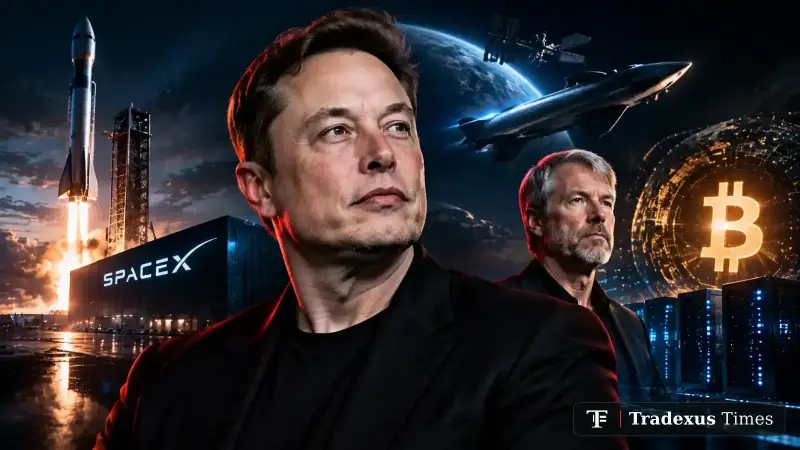
Elon Musk said SpaceX could eventually reach a valuation far beyond the current global economy, arguing that the company has a potential path toward becoming one of the most valuable entities in history. The SpaceX CEO and chairman shared the view on X on Oct. 8, describing a future scenario in which the company’s value could grow by several orders of magnitude.
Musk later provided a numerical reference for that vision, stating that a valuation above $1 quadrillion could become a possible outcome. He emphasized that this represented a potential path rather than a high-confidence prediction, noting that such an outcome was previously considered unrealistic in his own view.

The comparison between SpaceX’s potential valuation and the global economy depends on how economic value is measured. Global gross domestic product represents annual economic production, while company valuations represent the total market value assigned to ownership stakes. These measures reflect different concepts and cannot be directly compared on a one-to-one basis.
Musk’s long-term thesis is built around expanding space-based infrastructure, particularly the combination of reusable launch technology, solar-powered computing, and artificial intelligence. His vision includes deploying computing systems in orbit using solar energy to support larger AI workloads beyond Earth.
The plan depends heavily on reducing the cost of transporting equipment into space. Musk has identified launch capacity, solar power generation, and computing hardware as three essential components of this strategy. SpaceX’s Starship program represents a key element of that approach, with the goal of creating a reusable transportation system capable of supporting large-scale orbital operations.
Beyond orbital computing, Musk has also discussed potential lunar manufacturing as part of a broader space infrastructure strategy. Producing materials such as solar panels and radiators on the Moon could reduce reliance on launches from Earth, while lower gravity and the absence of an atmosphere could support alternative methods for moving equipment into space.
The valuation discussion also attracted attention from Michael Saylor, executive chairman of Strategy Inc., who responded to Musk’s comments with “₿ullish,” using the Bitcoin symbol as part of the word. The response connected Saylor’s long-standing interest in Bitcoin with Musk’s outlook on SpaceX’s future.
Saylor has previously linked SpaceX with major technology companies holding Bitcoin, placing the company alongside Tesla in his broader view of corporate Bitcoin adoption. SpaceX’s disclosed holdings include 18,712 Bitcoin as of June 30, with a reported acquisition cost of $661 million and a fair value of approximately $1.098 billion at that date.
For markets, Musk’s comments highlight the growing intersection between space infrastructure, artificial intelligence, and digital assets. While the proposed valuation remains highly dependent on SpaceX achieving ambitious technological milestones, the discussion reflects a broader investment narrative around companies building future-oriented infrastructure.
The key factors to watch will include SpaceX’s progress in reusable launch technology, the development of space-based computing systems, and how emerging technologies influence valuations across sectors connected to AI, energy, and digital assets.