
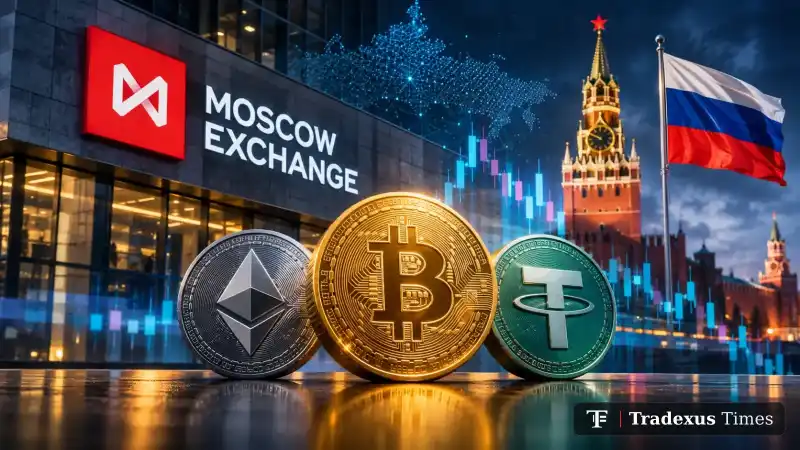
Moscow Exchange plans to launch organized trading in Bitcoin, Ether and Tether’s USDT on December 1, 2026, marking what the exchange describes as Russia’s first organized digital currency market. The plan, outlined in a notice dated November 2, establishes an initial framework for cryptocurrency trading through the exchange’s existing infrastructure, while imposing strict purchase limits on non-qualified investors.
The initial offering will cover three digital currencies: Bitcoin (BTC), Ethereum (ETH) and USDT. All three instruments will be available through anonymous and addressed trading modes, providing two execution formats within the new market. Moscow Exchange also indicated that the instrument list could expand to include international and Russian digital currencies and other digital assets, although it has not identified additional candidates or provided a timetable for further listings.
In this story
3 assets


Trading will support two settlement windows. TOD transactions will settle on the same day, while TOM transactions will settle on the following day. The exchange will also introduce swap transactions, giving participants an additional instrument for liquidity management.
The market will operate through Moscow Exchange’s existing stock market infrastructure, with clearing handled by the National Clearing Center (NCC). Trading hours will follow the stock market schedule, running from early morning until late evening Moscow time. Using established exchange and clearing infrastructure provides an operational foundation for the new market without requiring an entirely separate trading and settlement system.
However, the December launch should not be interpreted as an immediate full-scale opening. Moscow Exchange expects to begin with pilot transactions, while market participants connect to the platform progressively as they complete their preparations. Consequently, the initial availability of trading will depend partly on broker readiness and the pace at which participants integrate with the new infrastructure.
The number of brokers operational at launch will therefore be an important indicator of the market’s initial reach. Although the exchange has established a launch date and outlined the available instruments and settlement mechanisms, it has not disclosed how many brokers are preparing to participate or what transaction fees will apply. The absence of published limits for qualified investors also leaves an important part of the market-access framework unresolved.
Retail participation will face more explicit restrictions. Non-qualified investors must first pass an assessment before purchasing digital currencies, with annual purchases capped at 300,000 rubles through a single broker. This restriction creates a defined entry threshold for retail exposure and limits the potential scale of individual participation through regulated domestic channels.
The cap is particularly relevant to the market’s initial development. Even if the exchange successfully establishes its trading infrastructure, the combination of mandatory testing and purchase restrictions could constrain retail activity during the early stages. Broker onboarding procedures and the accessibility of the required assessment will therefore influence how quickly non-qualified investors can begin participating.
The regulatory foundation is Law No. 282-FZ, titled "On Digital Currencies and Digital Rights." Its principal provisions took effect on September 1, 2026, providing the legal basis for the exchange’s planned market. However, the framework is not yet fully implemented. Additional provisions are scheduled to enter into force in July and September 2027, meaning the regulatory environment will continue developing after the initial trading launch.
This phased legal implementation adds another dimension to the market's development. The December opening establishes an initial regulated trading structure, but subsequent regulatory provisions could shape how digital currency trading evolves within Russia. The distinction between the initial operational framework and the later stages of legal implementation will be important when assessing the market's longer-term structure.
The inclusion of USDT alongside Bitcoin and Ether is also notable because the initial market is not limited to major investment-oriented cryptocurrencies. It includes a dollar-pegged digital asset, giving the exchange a broader starting instrument mix. Nevertheless, the available information does not establish how trading demand will be distributed among the three assets or how liquidity will develop after launch.
For the broader Russian digital asset market, Moscow Exchange's initiative represents an attempt to bring cryptocurrency trading into established domestic exchange and clearing infrastructure. Its practical significance will depend less on the announced launch date alone and more on whether brokers, clients and clearing participants can support consistent trading activity.
The immediate focus will be on December 1 and the first pilot transactions. The number of brokers connected to the market, the pace of client onboarding and the initial availability of BTC, ETH and USDT trading will provide the first indications of how effectively the framework translates into an operational marketplace.
Further announcements concerning transaction fees, qualified-investor restrictions and additional digital asset listings will also help clarify the market's eventual scope. Until those details emerge, Moscow Exchange's planned launch represents an important structural development, but its actual market reach remains dependent on implementation and participant readiness.