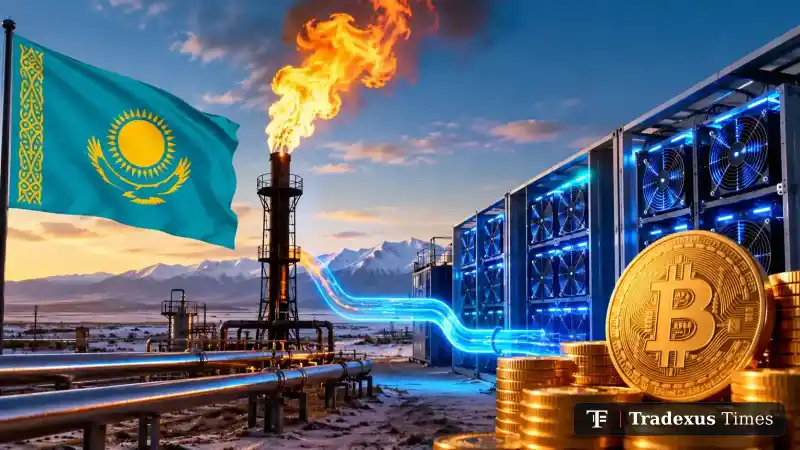
Kazakhstan is developing a framework to connect crypto mining operations with flare gas from oil fields, as the government seeks to expand the digital-asset industry while addressing energy and environmental pressures.
The move follows President Kassym-Jomart Tokayev’s July decree on measures to stimulate and develop Kazakhstan’s digital-asset industry. The decree called for legislation establishing a mechanism for companies to use gas opportunities in digital mining, increasing miners’ interest in flare gas as a potential power source.

Kazakhstan became a major crypto mining hub during the 2021 boom, but the industry’s electricity consumption placed additional pressure on the country’s aging power infrastructure. Authorities subsequently tightened controls and introduced an auction system to regulate the amount of electricity available for digital-asset mining, contributing to the departure of much of the industry.
The proposed flare-gas model could provide miners with an alternative energy source outside conventional grid-based power. Daniyar Mubarakov, head of the Blockchain and Digital Mining Association, said miners were prepared to purchase and install equipment capable of converting flare gas into usable electricity. He estimated that Kazakhstan’s total flared-gas production could potentially generate between 1.2 and 1.3 TWh.
The scale of the available resource could allow individual oil fields to support medium or large digital centers or Bitcoin mining farms, depending on their location. For miners, access to flare gas could provide a lower-cost source of energy, while oil companies could generate additional revenue from gas that would otherwise require disposal, creating an economic incentive for both sides.
The model could also change how mining companies manage their power costs. Batyr Bauyrzhan, technical director of power-solution integrator WES LLP, said the approach could allow miners to secure electricity prices for several years rather than rely entirely on grid-based power, where tariffs can fluctuate.
The potential supply base is also relatively broad. Kazakhstan’s Ministry of Energy estimates that up to 60 oil fields produce flare gas, indicating that the proposed framework could support multiple mining or digital-infrastructure projects rather than being limited to a single site.
The main constraint remains regulation. Gizzat Baitursynov, Kazakhstan’s vice minister of AI and Digital Development, said a legal framework defining the rules for companies was under development. For the mining industry, the eventual structure of those rules will determine how easily flare-gas projects can move from interest and equipment investment to actual operations.
If the framework is implemented, Kazakhstan’s approach would link two existing industries through a shared economic incentive: oil producers could monetize flare gas while miners gain access to an alternative power source. The key factor to watch next is the legal mechanism governing these projects and how quickly companies can begin converting the available gas into electricity for digital-asset operations.