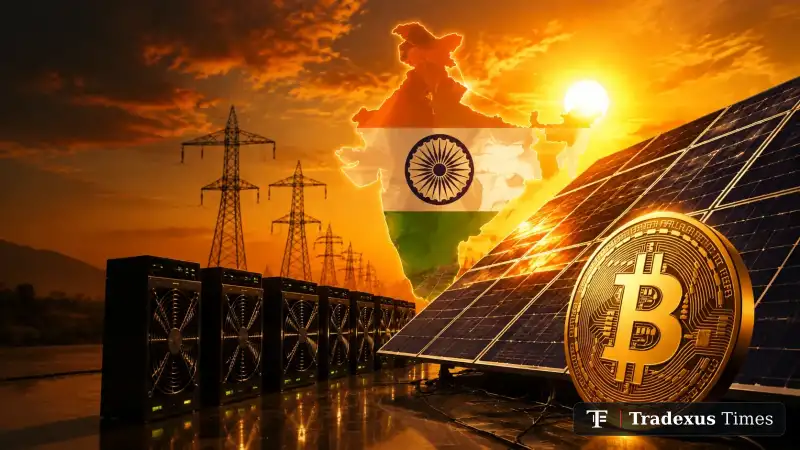
India’s expanding solar power capacity is creating a new energy management challenge, as periods of excess generation are leaving electricity unused due to limitations in grid capacity and storage infrastructure. With solar production increasing during peak sunlight hours, Bitcoin mining has emerged as a potential method to utilize a portion of the surplus energy that may otherwise be curtailed.
The core issue facing India is not a shortage of electricity production, but the ability to absorb and store additional supply. During periods of strong solar generation, the grid may receive more power than it can immediately handle, creating inefficiencies and leaving some renewable energy unused. The problem highlights the growing importance of energy storage and grid flexibility as solar capacity continues to expand.

According to the reported figures, approximately 11.5% of solar capacity can go unused because India’s infrastructure cannot absorb or store excess generation quickly enough. This suggests that future energy challenges may increasingly focus on managing availability rather than simply increasing production.
Bitcoin mining presents one possible approach for using some of this excess electricity. Mining operations require substantial energy consumption, but they also have the ability to adjust usage based on power availability. In theory, mining facilities could increase activity during periods of high solar output, creating additional demand when electricity production exceeds immediate consumption needs.
India reportedly generated around 8 terawatt-hours (TWh) of solar power that could not be fully utilized, highlighting the scale of the energy management challenge. The situation indicates that the country’s renewable energy sector is reaching a stage where efficient consumption and storage solutions are becoming as important as generation capacity.
The connection between renewable energy and Bitcoin mining has already been explored in other markets. Countries with abundant renewable resources have examined mining as a way to create additional electricity demand and improve the economic use of surplus power.
Bhutan provides one example of renewable energy being connected with Bitcoin mining activity. The country’s significant hydropower resources have supported mining operations, contributing to its accumulation of Bitcoin holdings. Similarly, renewable energy availability in regions such as Brazil has attracted interest from mining companies seeking access to lower-cost power sources.
However, Bitcoin mining alone would not resolve India’s broader renewable energy challenges. The country still requires improvements in grid infrastructure, storage capacity, and energy distribution systems to manage increasing solar generation efficiently. Mining could serve only as an additional outlet for electricity that might otherwise remain unused.
The practical implementation of large-scale Bitcoin mining using surplus solar power would also depend on regulatory conditions, taxation policies, and the broader environment surrounding digital assets in India. While mining is not banned, regulatory uncertainty remains an important factor for any future expansion.
The broader question is whether Bitcoin mining can become part of India’s strategy for managing renewable energy growth. If integrated effectively, mining could provide an additional source of flexible demand during periods of excess solar generation. However, its role would likely remain complementary to the larger requirements of grid modernization and energy storage development.