

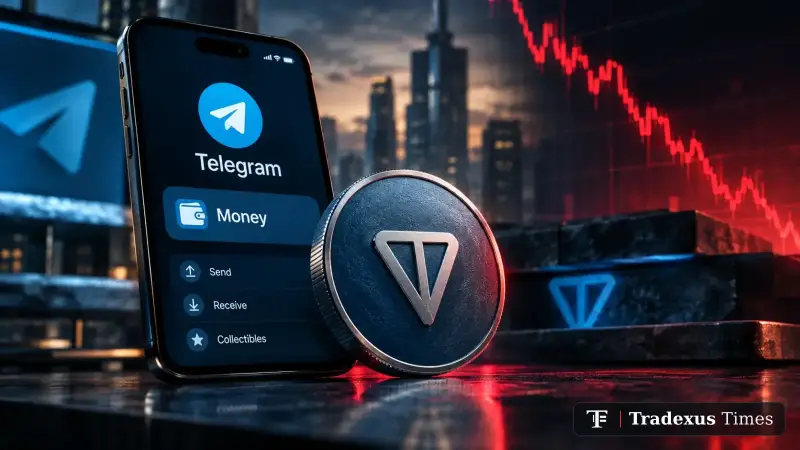
Gram has surrendered its gains following Telegram's expansion of the Money wallet on October 9, 2026, falling 7.5% from its post-announcement price of $1.4871 to $1.3761 as of October 14. The pullback comes despite broader access to the messenger's non-custodial cryptocurrency wallet, highlighting the gap between infrastructure developments and sustained demand for the underlying token.
According to CoinGecko data recorded at approximately 01:00 on October 14, Gram was trading at $1.3761, down 9.45% over seven days but still up 2.47% over the preceding 30 days. The token reached a weekly high of $1.5198 on October 7 before declining to $1.3480 on October 8. Its current price places it approximately 83.3% below the all-time high of $8.25 recorded on June 14, 2024.

Gram's market capitalization stands at approximately $3.89 billion, ranking it 32nd among cryptocurrencies, with roughly 2.83 billion tokens circulating. Trading volume over 24 hours totaled approximately $31 million, equivalent to less than 1% of market capitalization. While this ratio does not independently establish market liquidity, it underscores the importance of examining trading activity when assessing whether a price recovery has meaningful participation.
The latest volatility followed Telegram's October 9 expansion of Money, the non-custodial wallet previously known as Gram Wallet. Initially announced in July and made available to selected accounts in August, Money is now being introduced to a broader portion of Telegram's audience of more than one billion users. However, neither Telegram's announcement nor the coverage cited by FinanceFeeds and crypto.news establishes that the feature is available to every account.
Money allows users to hold and transfer Gram directly within Telegram and purchase digital collectibles, including Telegram gifts and collectible usernames. The wallet also supports transfers from existing Walt accounts, which the provider describes as immediate and free of network fees. The expansion reduces the steps required to access Gram-based services, although easier access does not necessarily translate into immediate token purchases.
The distinction between Money and Walt is significant. Money operates through a non-custodial model in which users control their private keys, while Walt remains a custodial service that manages assets on behalf of customers. With Money, Telegram cannot recover lost private keys, reverse completed blockchain transactions or restore access to a wallet whose recovery phrase has been lost.
The wallet expansion initially generated a sharp market reaction. CoinGecko hourly figures show Gram advancing from $1.3762 at approximately 01:00 on October 9 to $1.4871 at 14:00, an increase of approximately 8.1%. Crypto.news reported a move of around 9%, with the difference reflecting the observation periods used to calculate the advance.
The subsequent reversal indicates that the initial buying response was not sustained. By October 14, Gram had fallen below its price at the beginning of the October 9 advance, effectively erasing the announcement-driven rally. This price behavior suggests that expectations surrounding wallet accessibility have not yet translated into sufficient buying pressure to maintain the initial valuation increase.
A similar pattern followed the token's June 15, 2026, rebranding from Toncoin to Gram. Following approval through a community vote, the token traded at $1.7529 on the announcement date, its highest level that week. By June 29, it had declined to $1.5864, representing a loss of approximately 9.5% over two weeks.
The comparison reveals two major ecosystem developments followed by relatively rapid price reversals. The June rebranding coincided with a 9.5% decline over 14 days, while the October wallet expansion was followed by a 7.5% decline over five days.
Although the events are not sufficient to establish a recurring trading pattern, they suggest that positive infrastructure announcements alone have not generated lasting price support.
The underlying issue is the difference between expanded distribution and measurable adoption. Integrating a wallet into an established messaging platform may reduce barriers to cryptocurrency transactions, but it does not automatically create additional demand for Gram. Sustained demand would depend on users activating the feature, acquiring tokens and conducting transactions that require the asset.
Telegram's potential distribution advantage remains substantial because Money is being integrated into an application with more than one billion users. However, without verified figures for wallet availability, active users or transaction growth, the scale of actual adoption remains uncertain. Evidence of increasing payment activity would provide a stronger basis for evaluating the wallet's economic impact than the announcement alone.
The expansion also introduces operational considerations for users, particularly those moving assets from custodial exchanges into Money. Because private keys remain under individual control, losing the recovery phrase can result in permanent loss of access to the associated holdings. Users must also verify transaction details carefully, as completed blockchain transfers generally cannot be reversed.
Security risks surrounding the Gram ecosystem extend to fraudulent migration requests. The official guidance accompanying the June rename stated that existing holdings did not require swapping, claiming or transferring. Requests to migrate tokens or disclose wallet recovery phrases should therefore be treated as potential attempts to steal assets.
For European users, the expansion also intersects with the European Union's Markets in Crypto-Assets Regulation, known as MiCA. Crypto-asset service providers operating within the regulation's scope must meet applicable authorization and compliance requirements. Users purchasing Gram through trading platforms should verify the provider's regulatory status and consider execution costs, including the difference between quoted buying and selling prices.
German tax treatment is another consideration for investors transferring Gram into self-custody. Transfers between wallets belonging to the same beneficial owner generally do not constitute taxable disposals or restart the holding period under Section 23 of Germany's Income Tax Act. However, using Gram to purchase digital collectibles may constitute a taxable disposal, making acquisition records and transaction documentation important.
From a technical perspective, Gram is approaching its recent weekly low of $1.3480, recorded on October 8. At $1.3761, the token is approximately 2.1% above that reference level. A sustained move below $1.3480 would weaken the immediate price structure and bring the psychological $1.30 level into focus.
On the upside, $1.4871 represents the first important reference point because it marks the October 9 rally high. A recovery above that level would indicate that buyers have regained the territory lost after the wallet announcement. The weekly high of $1.5198 would then provide the next observable resistance reference.
The immediate market outlook therefore depends on whether Gram can stabilize above $1.3480 and eventually reclaim the October 9 rally high. Beyond price action, the more consequential development would be evidence that Money's broader distribution is producing measurable transaction activity and genuine demand for Gram. Until those figures emerge, the wallet expansion remains a potentially important infrastructure milestone whose longer-term effect on token valuation has yet to be demonstrated.

 ADA
ADA

 Bitcoin
 Aptos
Aptos


