Google is preparing to expand its artificial intelligence chip business with two specialized tensor processing units (TPUs) planned for next year, adding another competitive challenge for Nvidia as concerns surrounding its CEO, Jensen Huang, create additional uncertainty for the semiconductor giant.
The planned chips are designed for distinct computing requirements. One will target confidential computing, catering to customers processing sensitive information, while the other will support data-intensive applications such as software development and drug discovery. The expansion signals Google's ambition to strengthen its position in the AI hardware market by addressing specialized workloads beyond conventional general-purpose GPU demand.
In this story
2 assetsThe commercial opportunity could be substantial. Bloomberg Intelligence estimates that sales of Google's TPUs, including associated hardware and software, could surpass $135 billion by 2028, compared with approximately $12 billion in 2026. Its analysts estimate that Google's chips cost around 30% less than Nvidia's GPUs, potentially giving customers a meaningful economic incentive to diversify their AI infrastructure.
That pricing difference could become increasingly relevant as companies evaluate the cost of developing and operating large-scale AI systems. If Google's products deliver competitive performance at lower prices, the company could strengthen its ability to attract enterprise customers and challenge Nvidia's position in selected computing segments. However, projected sales growth does not automatically translate into equivalent market-share gains, particularly while Nvidia retains an established position in AI hardware.
The competitive pressure is emerging during a broader deterioration in sentiment toward AI infrastructure investments. Several companies associated with the neocloud and data-center ecosystem, including IREN, Cipher Digital, and CoreWeave, have fallen at least 70% from their respective all-time highs. These declines indicate that the market's enthusiasm for AI-related infrastructure exposure has weakened, creating a more demanding environment for companies whose valuations depend on continued expansion in AI computing demand.
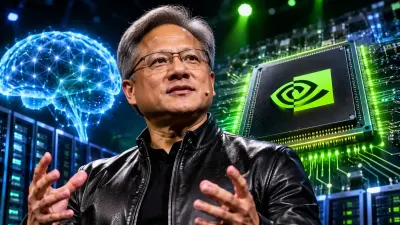
Nvidia is also confronting a separate corporate governance challenge. Its shares lost more than $250 billion in market capitalization on Monday after the company's board announced an investigation into reports concerning Huang's personal relationships and possible links to foreign intelligence. Huang acknowledged an affair with a woman whom US officials reportedly suspect was recruited by Chinese intelligence. Independent directors and external legal advisers will oversee the investigation, with Huang pledging to cooperate.
The company has stated that it has no reason to believe national security or corporate secrets were compromised, while the board has expressed confidence in its chief executive. Nevertheless, the investigation introduces an additional source of uncertainty for a company whose leadership remains closely associated with its technological strategy and market position.
Nvidia shares declined 4.3%, even as the Nasdaq advanced more than 2% and Google gained 3.4%. The divergence highlights the extent to which company-specific developments can influence investor positioning independently of broader technology-sector momentum.
The two developments confronting Nvidia operate through different channels but could reinforce pressure on its market position. Google's expanding TPU portfolio represents a structural competitive challenge, particularly if lower-cost alternatives become increasingly attractive to enterprise customers. Meanwhile, the investigation involving Huang introduces governance and reputational considerations that investors must evaluate separately from the company's underlying technology and commercial performance.
For the AI semiconductor market, the central question is whether Google's specialized chips can translate projected demand into sustained commercial adoption. For Nvidia, the immediate focus extends beyond competitive pricing to the outcome of the board investigation and the company's ability to maintain investor confidence during a period of changing market sentiment.
Together, these developments illustrate a more competitive phase for AI infrastructure, in which hardware pricing, workload specialization, corporate governance, and capital-market expectations are becoming increasingly important determinants of market leadership.