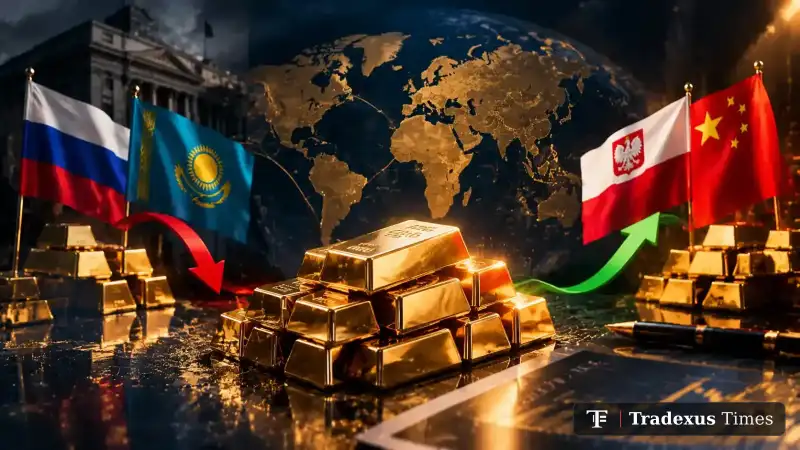
Global central-bank gold strategies are diverging, with Russia reducing its holdings, Kazakhstan preparing a partial sell-off, and Poland continuing to build its reserves. China is also emerging as a potential buyer of Russian gold, highlighting how government financing needs and long-term reserve policies are influencing the precious metals market.
Russia reduced its gold reserves by approximately 6.2 tonnes in September, bringing its reported reduction since the beginning of 2026 to around 62 tonnes. The pace of selling stands out against the country's previous reserve-management patterns and reflects mounting pressure on public finances as the government balances budget demands with defence spending.

Some Russian gold has reportedly been routed through Hong Kong, where trade data indicates that around 100 tonnes arrived between January and July, nearly three times the volume recorded over the same period last year. According to precious metals industry expert Adam Stroniawski, China's central bank is a major buyer of the gold. If these transactions are taking place outside the main London bullion market, their immediate effect on benchmark prices may be limited, although the broader implications depend on the size, timing and destination of the sales.
For Russia, reducing gold holdings provides a way to convert reserve assets into funding when fiscal pressures intensify. The decision does not necessarily signal a permanent retreat from gold. The country has previously rebuilt its reserves after periods of selling, leaving open the possibility that its current strategy could change if economic and budget conditions improve.
Kazakhstan is also preparing to reduce its gold exposure. After ranking among the larger official-sector gold buyers during the first eight months of 2026, the country has indicated that it intends to bring gold down from approximately 78% to 75% of its total reserves by the end of the year.
The planned adjustment appears relatively limited in percentage terms and may reflect profit-taking, budget requirements or a desire to rebalance reserve assets. Kazakhstan has accumulated gold over an extended period, so selling part of those holdings after a substantial rise in prices could allow it to realize gains while retaining a significant allocation to the metal.
The contrasting strategies do not necessarily point to a broad central-bank retreat from gold. Reserve managers operate under different fiscal conditions, currency priorities and geopolitical pressures. One country may sell to raise funds or adjust its portfolio, while another may continue buying to diversify reserves and reduce reliance on other assets.
Poland remains an important example of the latter approach. The National Bank of Poland has spent several years increasing its gold holdings and is approaching its stated target of 700 tonnes. Stroniawski expects purchases to continue rather than give way to a significant liquidation, arguing that substantial gold reserves can strengthen confidence in a country's financial position and support currency stability.
Reaching the 700-tonne target would therefore represent a milestone rather than necessarily the end of Poland's accumulation strategy. The country's future decisions will depend on central-bank policy and broader reserve objectives, but the current approach contrasts with the short-term financial pressures reportedly driving sales elsewhere.
For global gold prices, the combined effect of these transactions may be less significant than the headline figures suggest. Russia's sales could be absorbed by buyers such as China, while Kazakhstan's planned reduction is being spread over time. The net impact on the market will depend on the volume of gold that actually reaches the market, whether it is purchased by official institutions or private investors, and how other central banks respond.
Gold's price performance also illustrates why investors should distinguish short-term corrections from long-term trends. The metal gained 25.5% in US dollar terms in 2024 and 67.4% in 2025, according to figures cited from the World Gold Council. It then declined 4.4% during the first nine months of 2026, showing that even an asset widely viewed as a store of value can experience meaningful setbacks.
For individual investors, central-bank purchases and sales are useful indicators of changing demand, but they are not reliable stand-alone signals for when to buy or sell. Gold prices are also influenced by interest rates, currency movements, inflation expectations, geopolitical developments and investor positioning. Large official-sector purchases can provide support, but they do not guarantee that prices will continue rising.
Investors considering taking profits after a substantial rally should weigh their original investment goals, time horizon and exposure to other assets. Those buying gold as a long-term diversifier may assess it differently from traders seeking short-term price gains. Gradual purchases and a diversified portfolio can also reduce the risk of making a large investment at an unfavourable moment.
The latest reserve movements point to a market shaped by differing national priorities rather than a unified shift away from gold. Russia and Kazakhstan are adjusting holdings amid their own financial and reserve-management considerations, while Poland remains focused on accumulation and China may be absorbing some of the available supply. For private investors, the key is to follow the balance of global demand without assuming that central-bank activity alone determines the next move in prices.