
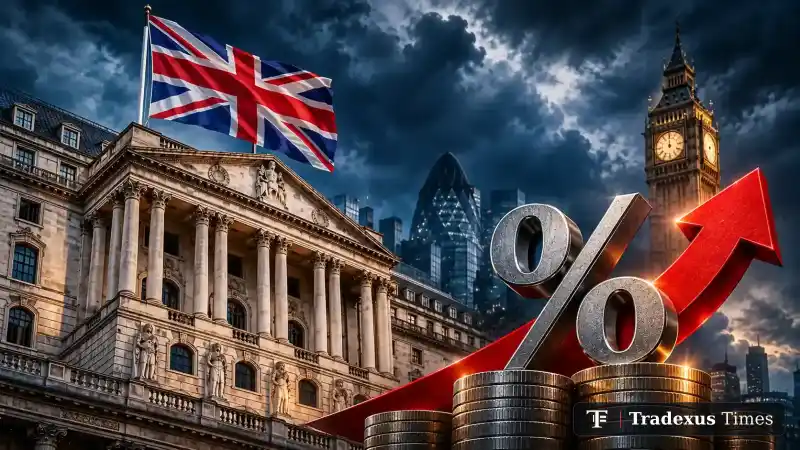
The Bank of England has raised its benchmark interest rate for the first time since the outbreak of the Iran war, increasing borrowing costs from 3.75% to 4% as surging energy prices threaten to push U.K. inflation higher through 2027.
The decision marks a shift in monetary policy after the central bank had kept rates unchanged since December. Higher oil and natural gas prices, driven by the conflict in the Middle East, have intensified concerns about inflation and increased the risk that rising household expenses could translate into stronger wage demands.

Despite the rate increase, policymakers signaled that they are unlikely to tighten monetary policy as aggressively as financial markets had anticipated. Investors had previously expected the benchmark rate to reach 5% by the end of next year. However, the Bank of England's latest guidance suggests that borrowing costs may rise only once more, potentially reaching 4.25%.
Governor Andrew Bailey emphasized that Thursday's decision should not be interpreted as the beginning of an extended series of rate increases. However, he warned that another increase remains possible if the conflict in the Middle East continues. The bank's position reflects the uncertainty surrounding energy prices and the difficulty of determining how long the inflationary pressure will persist.
The outlook is closely connected to developments following the U.S. midterm elections. Oil prices have declined in recent days as markets respond to the possibility that the election results could increase pressure for an end to the conflict. A diplomatic breakthrough before the end of the year could reduce energy costs and help bring U.K. inflation back toward the central bank's 2% target sooner than currently projected.
However, Bailey cautioned against drawing firm conclusions from the recent market reaction, noting that there is not yet sufficient evidence of a concrete peace process. Even if the conflict ends soon, the central bank may still consider another rate increase necessary to contain inflationary pressures.
The Bank of England's latest forecasts highlight the potential scale of the challenge. Based on an assumed oil price of $108 per barrel, policymakers expect annual inflation to peak at 4.9% in the second quarter of 2027. Inflation is then projected to return to the bank's 2% target only in the third quarter of 2028.
Higher borrowing costs are already affecting households and businesses. Mortgage rates have increased by approximately one percentage point since the beginning of the war, adding to financial pressure on borrowers. The central bank believes these higher costs could help slow economic activity and reduce inflation, although they also risk weighing on growth.
Despite the energy shock, the U.K. economy has shown greater resilience than previously expected, partly supported by activity related to artificial intelligence. The Bank of England has consequently upgraded its economic growth forecasts to 1.6% for this year and 1.3% for next year, compared with its previous projection of 1.1% for both periods. However, its outlook for 2028 has weakened as higher energy costs and borrowing expenses threaten to restrain economic activity.
The next major test will come from wage negotiations in early 2027. Policymakers are concerned that households facing higher heating and electricity bills may demand larger pay increases, creating second-round inflation effects that could make price pressures more persistent. There are currently limited signs of a significant wage acceleration, but the colder winter months could intensify pressure on household budgets.
For financial markets, the direction of oil prices and the future of the Middle East conflict will remain critical factors. A sustained decline in energy costs could reduce the need for further monetary tightening, while prolonged conflict could force the Bank of England to maintain higher interest rates for longer. The central bank's next decisions will therefore depend not only on inflation data but also on developments in energy markets and the strength of wage growth.