Tether’s USDT accounted for the largest share of stablecoin borrowing on four of the six decentralized finance lending protocols examined by the European Banking Authority (EBA), highlighting the token’s significant role in DeFi markets as European regulators reconsider how crypto firms provide access to decentralized lending services.
In a report published on November 25, based on lending activity recorded on July 30, the EBA found that USDT, including its bridged USDT0 version, led stablecoin borrowing on Aave, Fluid and Spark. Borrowers on JustLend also overwhelmingly favored USDT, reflecting the token’s strong position within the Tron ecosystem. By contrast, USDC represented a larger share of active loans on Compound and Morpho, demonstrating that borrowing preferences vary across DeFi platforms.

The findings compare each stablecoin's share of all active loans within its respective protocol. However, the figures do not establish the geographical distribution of borrowers. The EBA noted that participation by EU users in decentralized finance appears limited, while self-hosted wallets and gaps in available reporting make it difficult to determine where users are located.
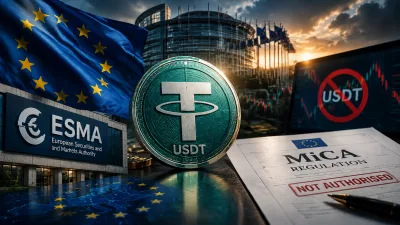
The regulatory concern centers on the European Union’s Markets in Crypto-Assets Regulation (MiCA). The framework requires authorization for covered stablecoins to be offered to the public or admitted to trading in the EU, while USDT currently lacks the required authorization. Fully decentralized services operating without an intermediary generally fall outside MiCA's scope, but the regulatory picture becomes more complicated when centralized crypto firms provide customers with access to decentralized lending.
Some platforms allow users to earn returns through DeFi lending without requiring them to manage their own self-hosted wallets. In these arrangements, customers rely on an intermediary to handle their assets and access the underlying protocols. The EBA argues that such services may warrant additional regulatory scrutiny because the intermediary plays a role in connecting customers to lending activities involving stablecoins that lack EU authorization.
The authority has renewed its recommendation for the European Commission to examine the costs and benefits of additional requirements for these intermediaries as part of the MiCA review. Potential measures include stronger disclosure obligations, assessments of whether products are appropriate for customers, leverage restrictions and possible limits on firms facilitating borrowing and lending involving unauthorized stablecoins such as USDT.
The EBA plans to continue monitoring decentralized finance throughout 2027, particularly how European consumers access stablecoins that do not have MiCA authorization. Its findings could provide the basis for further recommendations to the Commission, leaving the regulatory treatment of intermediaries operating between traditional crypto platforms and decentralized lending protocols as an important issue for the European market.