Brazilian companies sharply increased their cryptocurrency trading on election day as businesses sought to protect their treasuries against potential currency weakness and uncertainty over the country’s fiscal outlook. The unexpected victory of incumbent President Luiz Inácio Lula da Silva over Flávio Bolsonaro triggered a wave of demand for dollar-pegged stablecoins, highlighting how political developments can quickly influence corporate financial decisions.
Data from Mercado Bitcoin, one of Brazil’s major crypto exchanges, showed that corporate accounts generated 78% of Sunday’s trading volume. Turnover in Tether’s USDT stablecoin surged nearly 800% from the previous week and exceeded three times the average recorded across the four preceding Sundays. Bitcoin trading also jumped 865% compared with the previous Sunday, indicating that the rush extended beyond dollar-linked assets.

The increased activity reflected concerns about Brazil’s public finances and the future direction of economic policy. Lula’s platform of expanded social spending, alongside a proposed ban on online betting that could reduce tax revenue, raised questions among some investors about the government’s ability to manage its fiscal position. Rising public debt, additional spending commitments and limited room for tax increases could complicate efforts to reassure markets, while pressure on the Brazilian real and elevated borrowing costs added to corporate concerns.
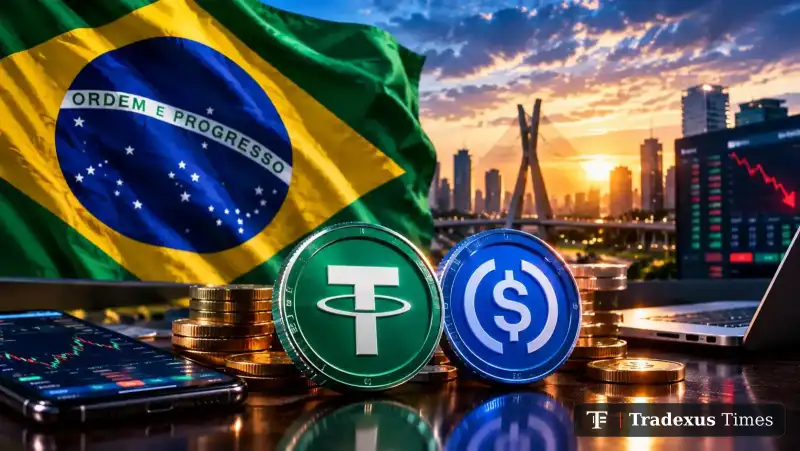
For businesses managing substantial cash reserves, stablecoins offer a way to obtain dollar-linked exposure without relying exclusively on the domestic currency. USDT and Circle’s USDC are designed to track the US dollar, making them potential tools for companies seeking to diversify part of their treasury holdings. However, they are not identical to holding insured bank deposits or physical dollars, and their use carries risks involving issuers, platforms, liquidity and regulation.
The election-related shift was especially striking because investor sentiment had moved in the opposite direction after the first round of voting three weeks earlier. When Bolsonaro finished ahead of Lula in that round, the Ibovespa stock index climbed 7.7%, while the dollar weakened more than 4% against the real. Investors had anticipated a possible change in government and tighter control over public spending. Lula’s subsequent victory reversed those expectations and prompted companies to reassess their exposure.
The market reaction continued into the following trading session. According to the figures provided, the Ibovespa plunged 14% in its worst performance since March 2020, while the dollar rose more than 8% against the real, marking its largest daily gain since 1999. Those movements underscored the extent of market volatility described in the report, although the scale of the reaction does not by itself establish that the election was the sole cause.
The corporate shift was not limited to Mercado Bitcoin. Data from Biscoint, which tracks crypto prices and trading activity across 10 venues, showed that USDT trading volume against the real increased 150% from the previous Sunday, while USDC turnover rose 318%. The figures suggest that demand for dollar-linked digital assets spread across multiple trading platforms rather than remaining confined to a single exchange.
Retail customers accounted for only 22% of Mercado Bitcoin’s Sunday trading volume, while corporate clients contributed the remaining 78%. The exchange also indicated that some corporate clients hold as much as 15% of their assets on its platform, illustrating how digital-asset exchanges can become part of treasury-management strategies for certain businesses.
The broader significance is that Brazilian firms appear to be treating stablecoins not only as speculative crypto assets but also as a potential instrument for managing currency exposure during periods of political and economic uncertainty. Still, shifting reserves into stablecoins does not eliminate risk, nor does it resolve the underlying fiscal challenges facing the country. The longer-term question is whether this surge represents a temporary response to election volatility or a more lasting change in how Brazilian companies manage their money.