Gas Fees Explained: Why Are Crypto Transactions Not Free?
Discover how crypto gas fees work, why transaction costs fluctuate, and how blockchain users can reduce fees while keeping transactions secure.

Key takeaways
- 1. Gas Measures Computing Work — It powers blockchain transactions.
- 2. Network Demand Drives Fees — Higher demand often means higher costs.
- 3. Complexity Matters — Complex transactions require more gas.
- 4. Failed Transactions Can Cost — Used gas is generally non-refundable.
- 5. Layer 2 Saves Costs — Scaling solutions can reduce transaction fees.
Introduction: The Hidden Cost of Crypto Transactions
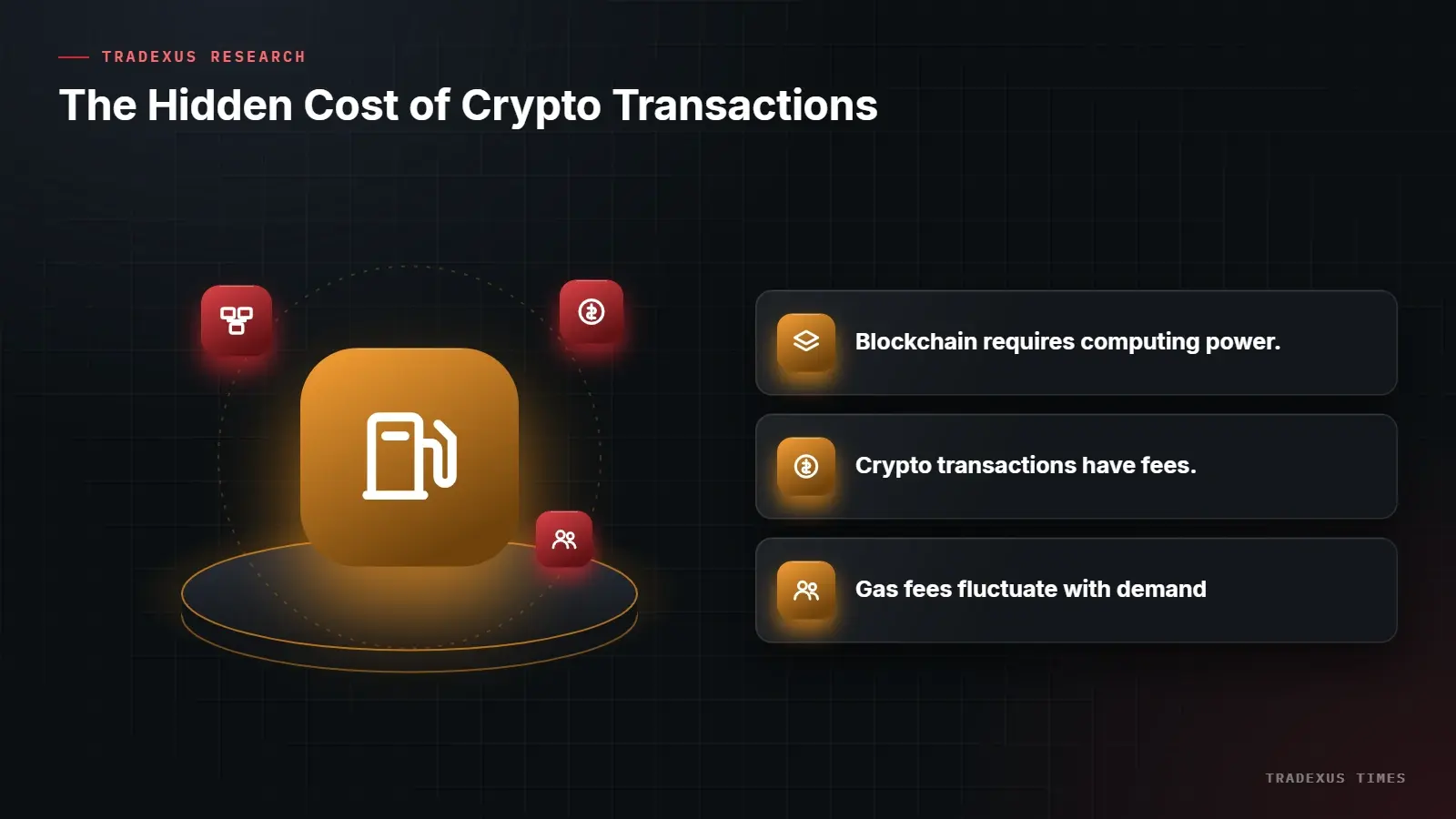
Cryptocurrencies are often described as a faster, more accessible alternative to traditional financial systems. With digital assets, people can transfer value across borders, trade tokens, interact with decentralized applications, and manage funds without relying on a traditional bank for every transaction. However, anyone who has sent cryptocurrency or used a decentralized application has probably encountered an additional cost: the transaction fee. On networks such as Ethereum, this is commonly known as a gas fee. It can sometimes be surprisingly expensive, especially when the network is busy. This raises an important question: if cryptocurrency transactions happen digitally, without a bank teller or a physical transfer of money, why should users pay anything at all? The answer lies in the computing resources, network capacity, and security required to maintain a decentralized blockchain.[1]
What Exactly Is Gas in Cryptocurrency?
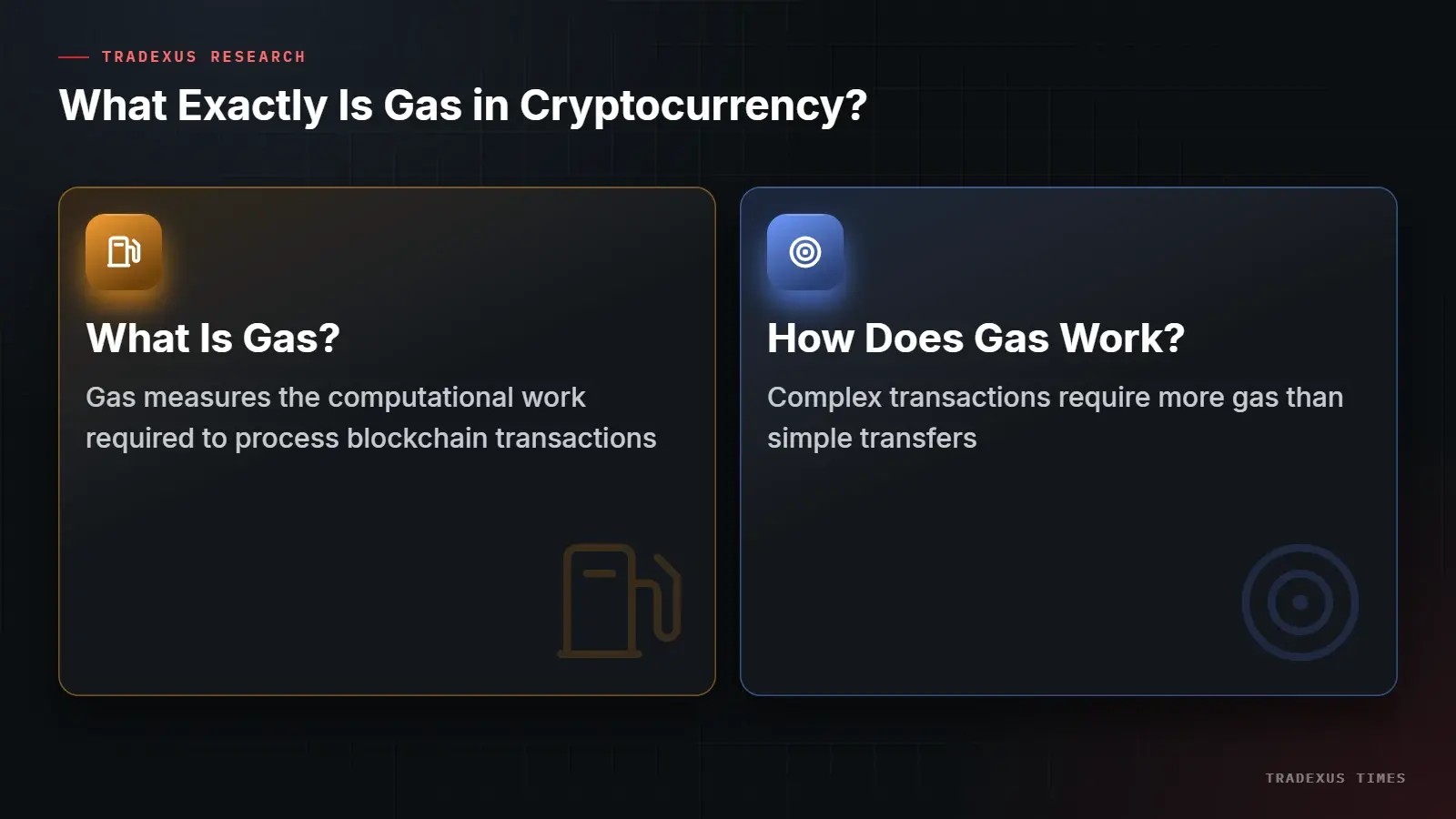
The word gas does not refer to a physical fuel, nor does it mean that cryptocurrency transactions literally consume gasoline. On Ethereum, gas is a unit of measurement used to quantify the computational work needed to perform an operation. Imagine a blockchain as a shared computer maintained by a distributed network of participants. When someone sends ETH, transfers a token, exchanges assets through a decentralized exchange, or interacts with a smart contract, the network must process and validate the requested operation. Each operation requires a certain amount of computational effort, measured in gas units. A relatively simple ETH transfer normally requires 21,000 gas units, while a complicated smart-contract interaction can require considerably more. The gas unit measures the work involved; the gas price determines how much the user pays for each unit. Keeping these two concepts separate is essential because a transaction can require a fixed amount of computational work while its monetary cost changes according to network conditions.[1]
 Watch on our channelWhat Exactly Is Gas in Cryptocurrency?
Why Can't Crypto Transactions Be Free?
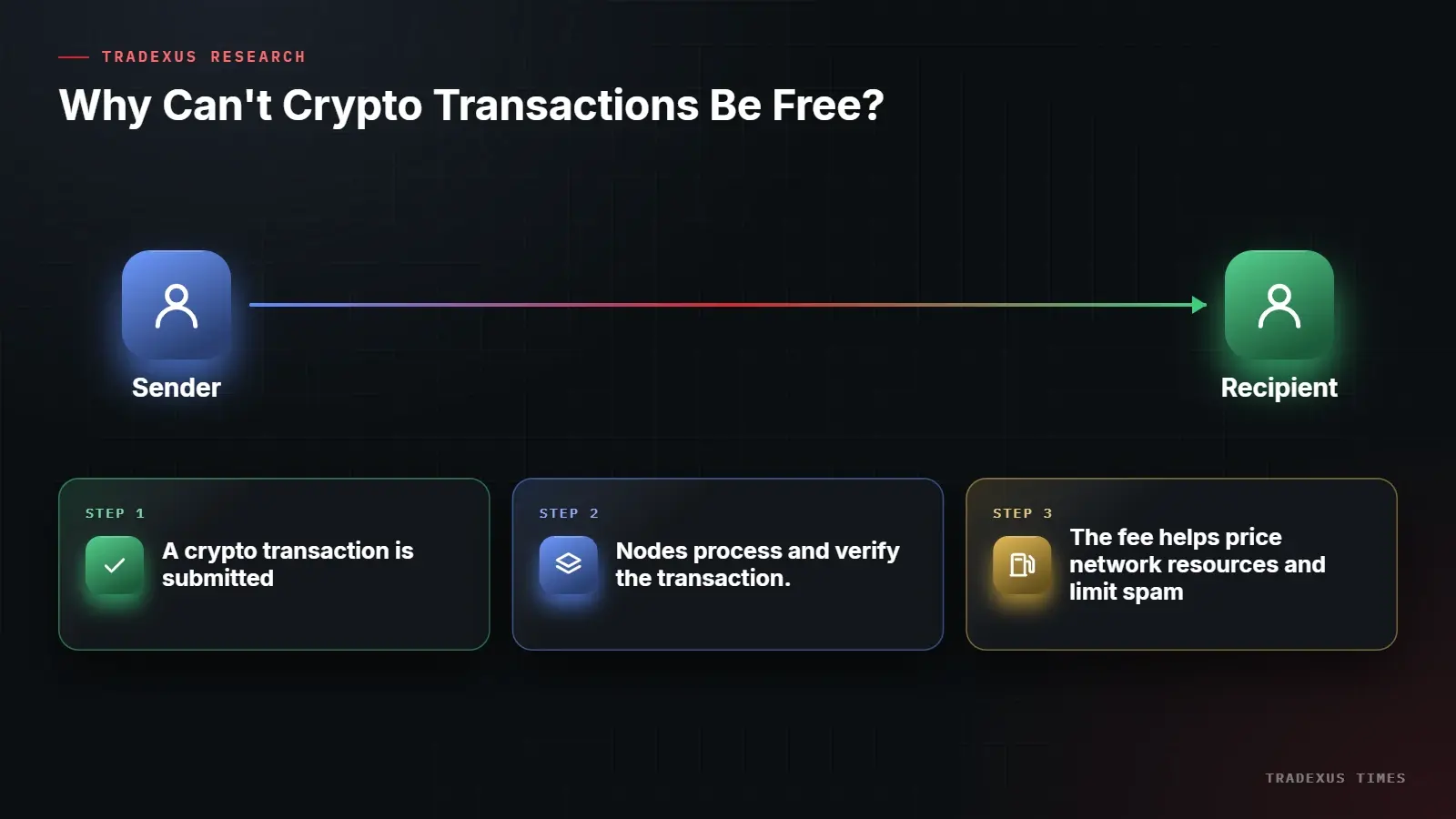
The main reason blockchain transactions are not generally free is that decentralization does not eliminate the cost of computation, verification, and network infrastructure. In a traditional payment system, banks and payment providers maintain servers, employ specialists, manage security, and process transactions. Their expenses are covered through different sources, including service charges, merchant fees, account fees, and other business revenues. A public blockchain distributes many responsibilities among independent network participants rather than placing all control in one institution. On Ethereum, validators help propose and verify blocks, while network nodes maintain and check blockchain data. These participants operate within a system that has limited computational capacity. Gas fees help price access to that capacity and discourage people from flooding the network with unnecessary or malicious requests. Without an effective cost mechanism, attackers could repeatedly submit resource-intensive operations, potentially making the network slower or less usable for everyone else. Fees therefore serve both an economic purpose and an important role in protecting network availability.[2]
How Are Gas Fees Calculated?
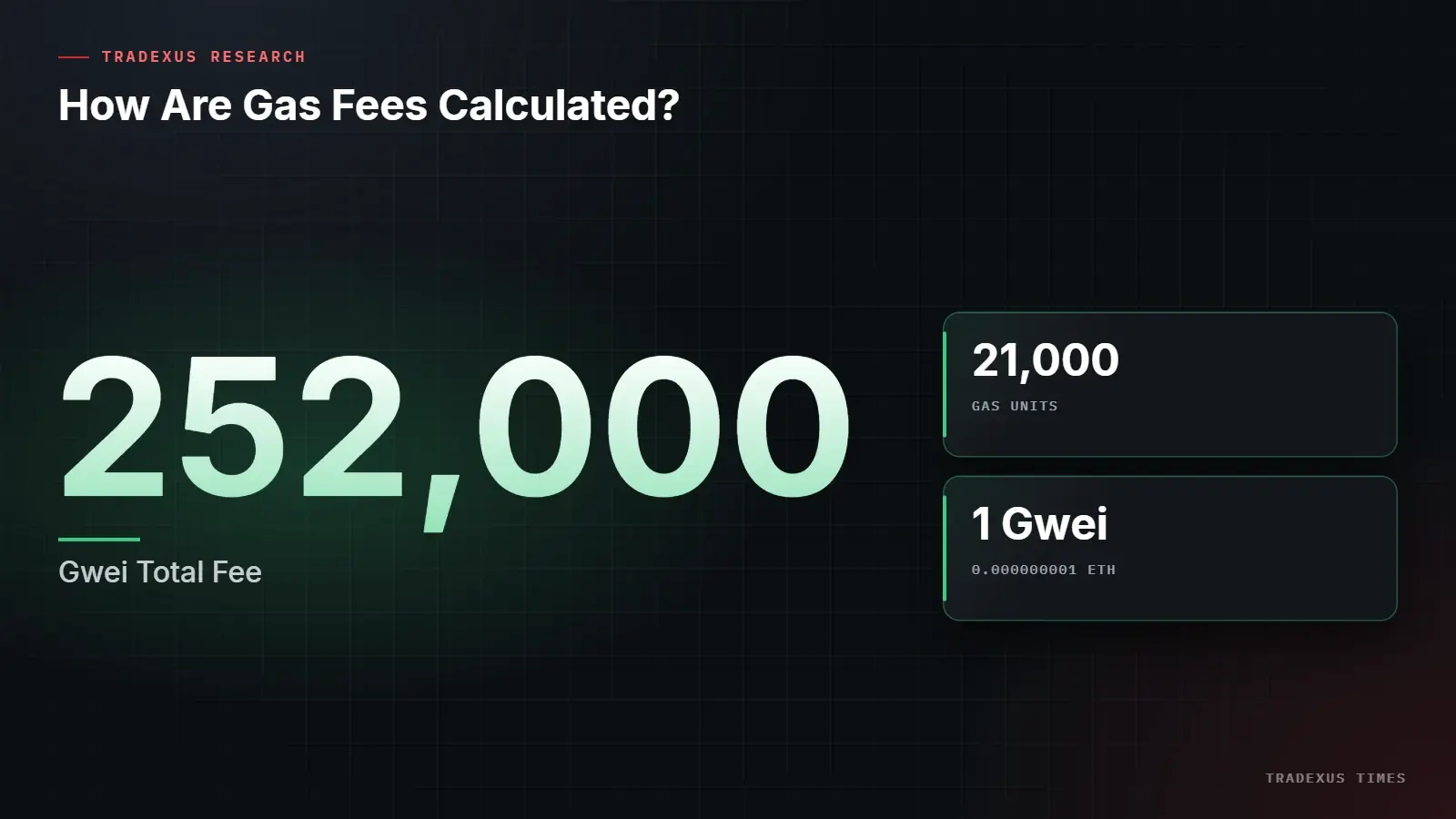
On Ethereum, the basic formula for a transaction's gas fee is straightforward: gas used × (base fee + priority fee). The base fee is the minimum per-unit fee determined by the protocol according to network demand. The priority fee, also known as a tip, is an additional amount that users can offer to encourage validators to include their transactions sooner. Gas used depends on the actual computational work required by the operation. Consider a simplified example: suppose a transaction consumes 21,000 gas units, the base fee is 10 gwei per unit, and the priority fee is 2 gwei per unit. The total fee would be 21,000 × 12 gwei, which equals 252,000 gwei, or 0.000252 ETH. Here, one gwei is one-billionth of an ETH. This is an illustrative calculation, not a live fee quote. The base fee is burned, meaning it is permanently removed from circulation, while the priority fee goes to the validator who includes the transaction. Wallets usually estimate these values automatically, although users should review the quoted cost before confirming a transaction.[1]
Why Do Gas Fees Sometimes Become Extremely Expensive?
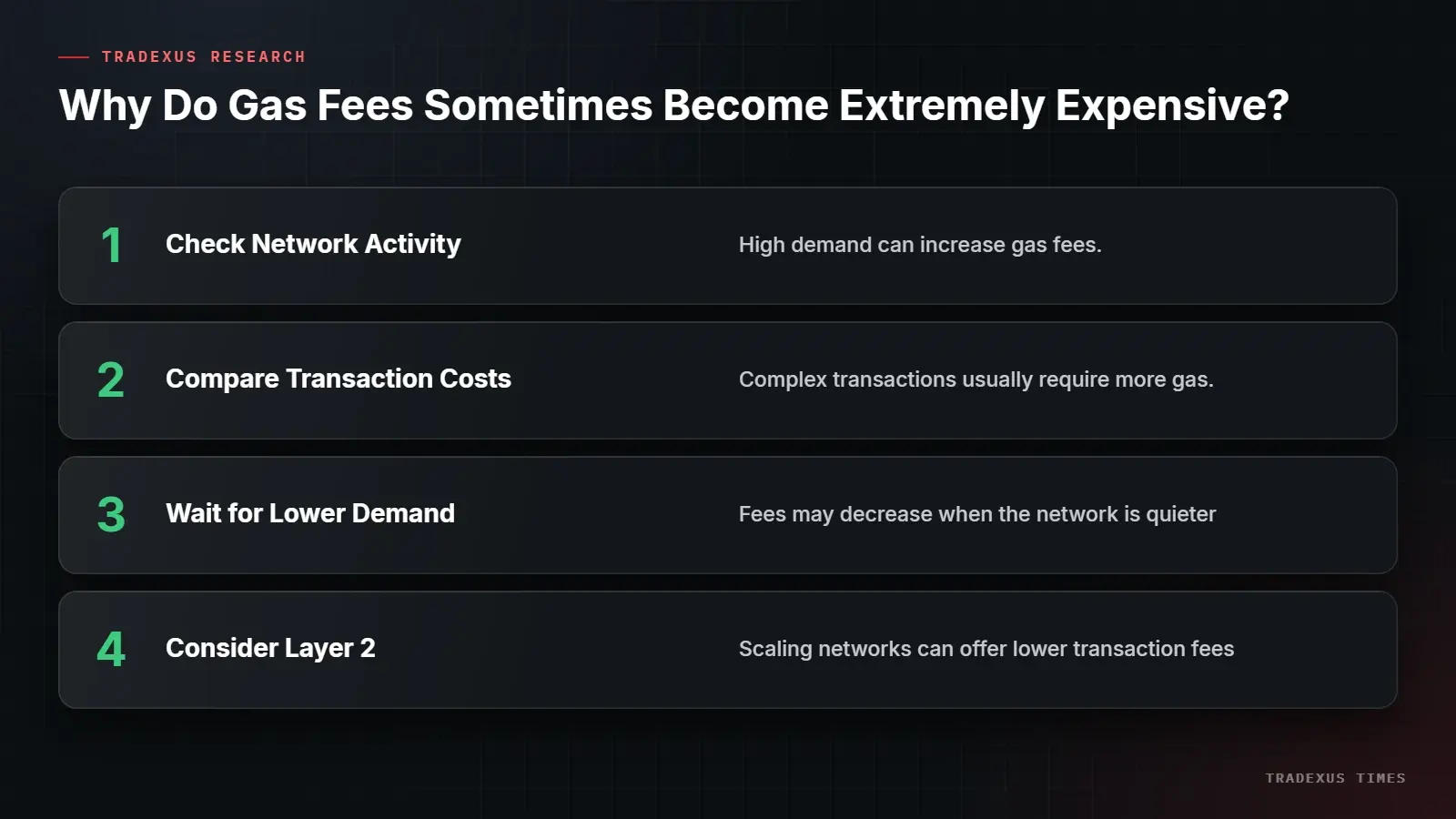
Gas fees are not fixed because demand for blockchain resources changes constantly. Ethereum blocks can include only a limited amount of computational work, so users effectively compete for space when many transactions arrive at once. During periods of intense trading, popular NFT launches, or heavy activity in decentralized finance applications, demand can rise sharply. When this happens, the protocol's base fee increases in response to high block usage, and users may also offer larger priority fees to improve their chances of prompt inclusion. By contrast, when the network is relatively quiet, fees can decrease. Transaction complexity matters, too: sending ETH generally requires less computation than executing a complicated smart contract or swapping tokens through a decentralized exchange. This explains why two users can pay very different fees even if they submit transactions only minutes apart. It also explains why the fee may seem disproportionately high for a small transfer. On Ethereum, the fee primarily reflects computational resources and network demand, not simply the dollar value of the cryptocurrency being sent.[1]
What Happens When a Transaction Fails?
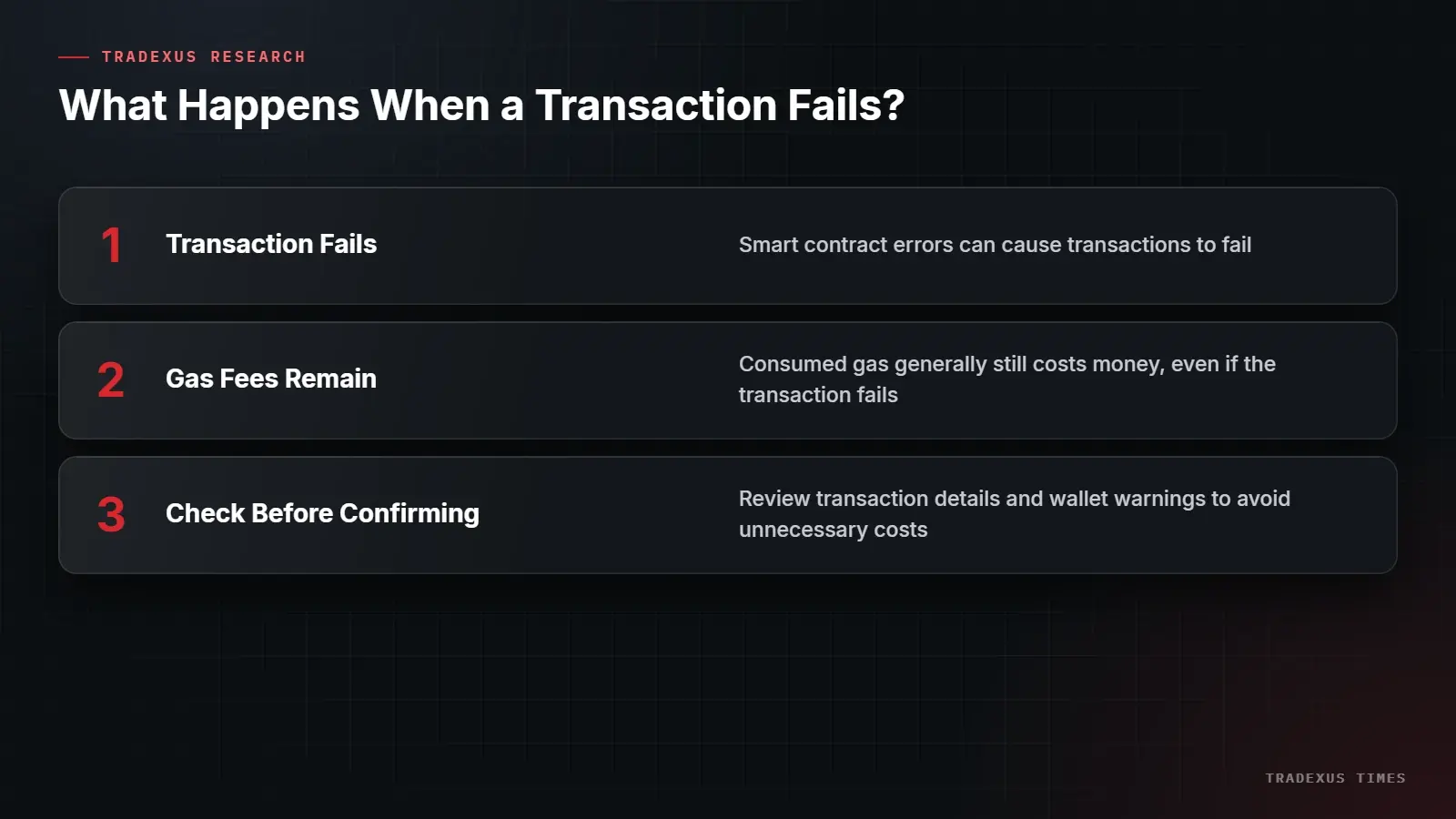
One of the most frustrating experiences for cryptocurrency users is paying a fee for a transaction that ultimately fails. On Ethereum, this can happen because a smart contract encounters an error, a transaction runs out of gas during execution, or a condition required by the application is not satisfied. The key point is that a failed transaction can still consume computational resources. Validators and nodes may have already processed the operation before the blockchain determines that the requested state change cannot be completed. As a result, the network generally does not refund the gas consumed by an executed transaction simply because its intended outcome failed. In many cases, the transaction's state changes are reverted, but the fee remains payable. There is an important distinction, however: a transaction rejected before it is executed because it fails an initial validation requirement may consume no gas on Ethereum. Before interacting with an unfamiliar smart contract, users should check the transaction details, review warnings, and avoid repeatedly submitting transactions without understanding why previous attempts failed.
Are All Cryptocurrency Transaction Fees the Same?
| Feature | Bitcoin (BTC) | Ethereum (ETH) | Solana (SOL) |
|---|---|---|---|
| Fee System | Transaction size (sat/vB) | Gas units + gas price | Base + priority fee |
| Main Purpose | Digital payments | Smart contracts & dApps | Fast transactions & dApps |
| Fee Level | Varies with demand | Varies with demand and complexity | Generally low for basic transfers |
| Fee Currency | BTC | ETH | SOL |
| Who Receives Fees? | Miners | Base fee burned; tip to validator | Part burned; priority fee to validator |
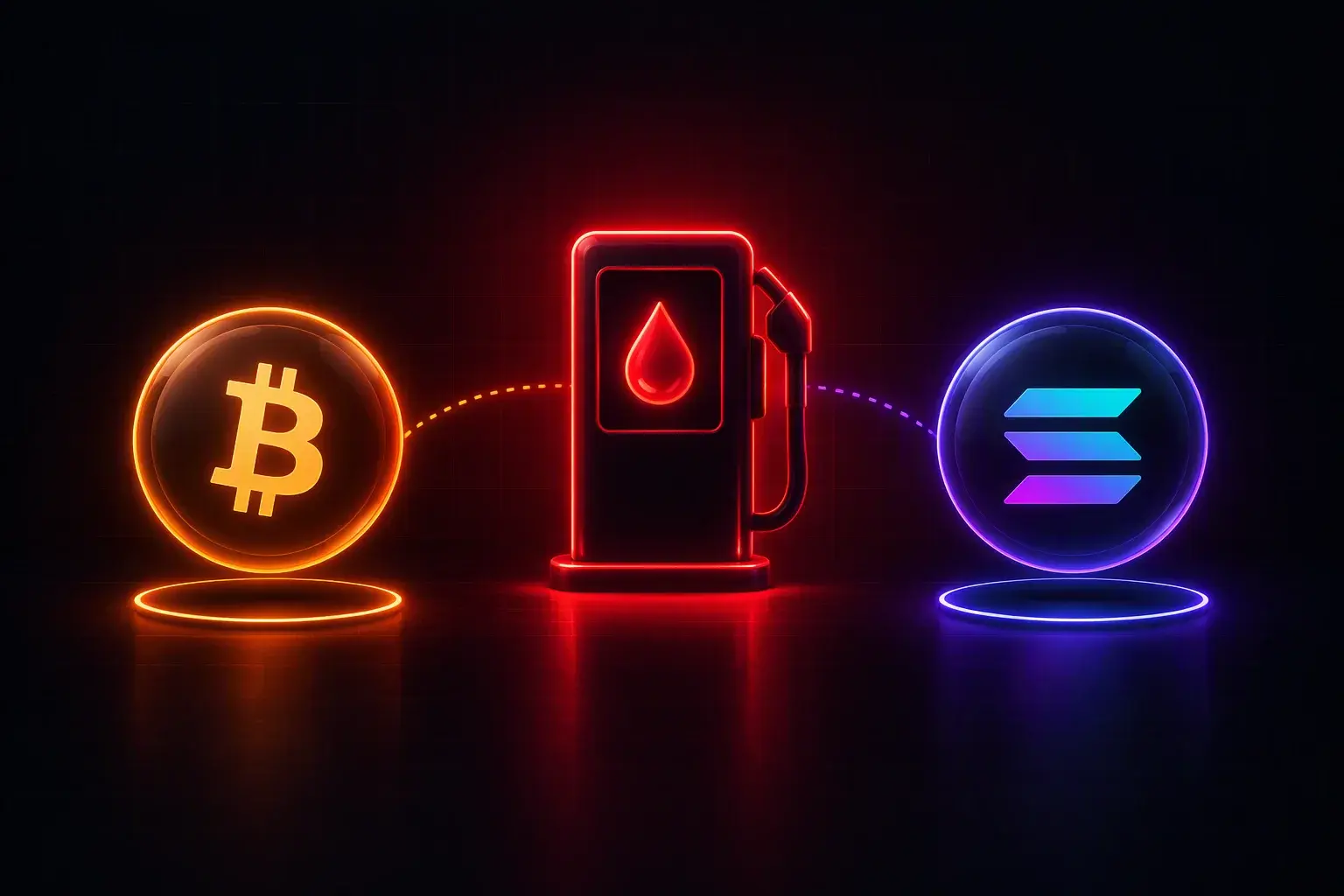
No. Although people often use the term gas fees when discussing cryptocurrency in general, different blockchain networks calculate and distribute transaction fees in different ways. Ethereum uses gas to measure computational work, and its transaction fees are based on gas usage and the applicable gas price. Bitcoin, on the other hand, generally measures transaction fees according to the size of a transaction in virtual bytes and the fee rate offered, commonly expressed in satoshis per virtual byte. Bitcoin transactions compete for limited space in blocks, so a larger transaction or a higher fee rate can affect how much the sender pays and how quickly the transaction is confirmed. Other networks have their own fee mechanisms, resource models, and approaches to transaction processing. Consequently, a transfer on one blockchain may be inexpensive while a seemingly similar transfer on another costs considerably more. Users should also remember that the network matters when transferring tokens: the same token name may be available on multiple networks, but choosing an incompatible network can create serious problems. Always verify the receiving address, supported network, and estimated fee before sending funds.
How Can You Reduce Gas Fees?
Although users cannot eliminate every transaction fee, several practical strategies can help reduce costs. First, check network activity before making a non-urgent transaction. If demand is temporarily high, waiting for a quieter period may result in a lower fee. Second, consider using a suitable Layer 2 network. Layer 2 solutions operate on top of Ethereum and are designed to process transactions more efficiently, often reducing the amount of mainnet capacity required for each user transaction. Some aggregate transactions or use other scaling techniques before submitting data to Ethereum, although their security properties and fee structures differ. Examples include Arbitrum, Optimism, and Base. Third, review the estimated fee in your wallet before approving a transaction. Most wallets provide fee estimates or options that balance cost against confirmation speed. Selecting a lower fee may mean waiting longer, and setting it too low can leave a transaction pending. Finally, be cautious with unfamiliar applications that request repeated transactions. A little preparation can help avoid unnecessary expenses, but never choose a different network or approve a transaction solely because the displayed fee is lower.
Will Cryptocurrency Transactions Ever Be Completely Free?
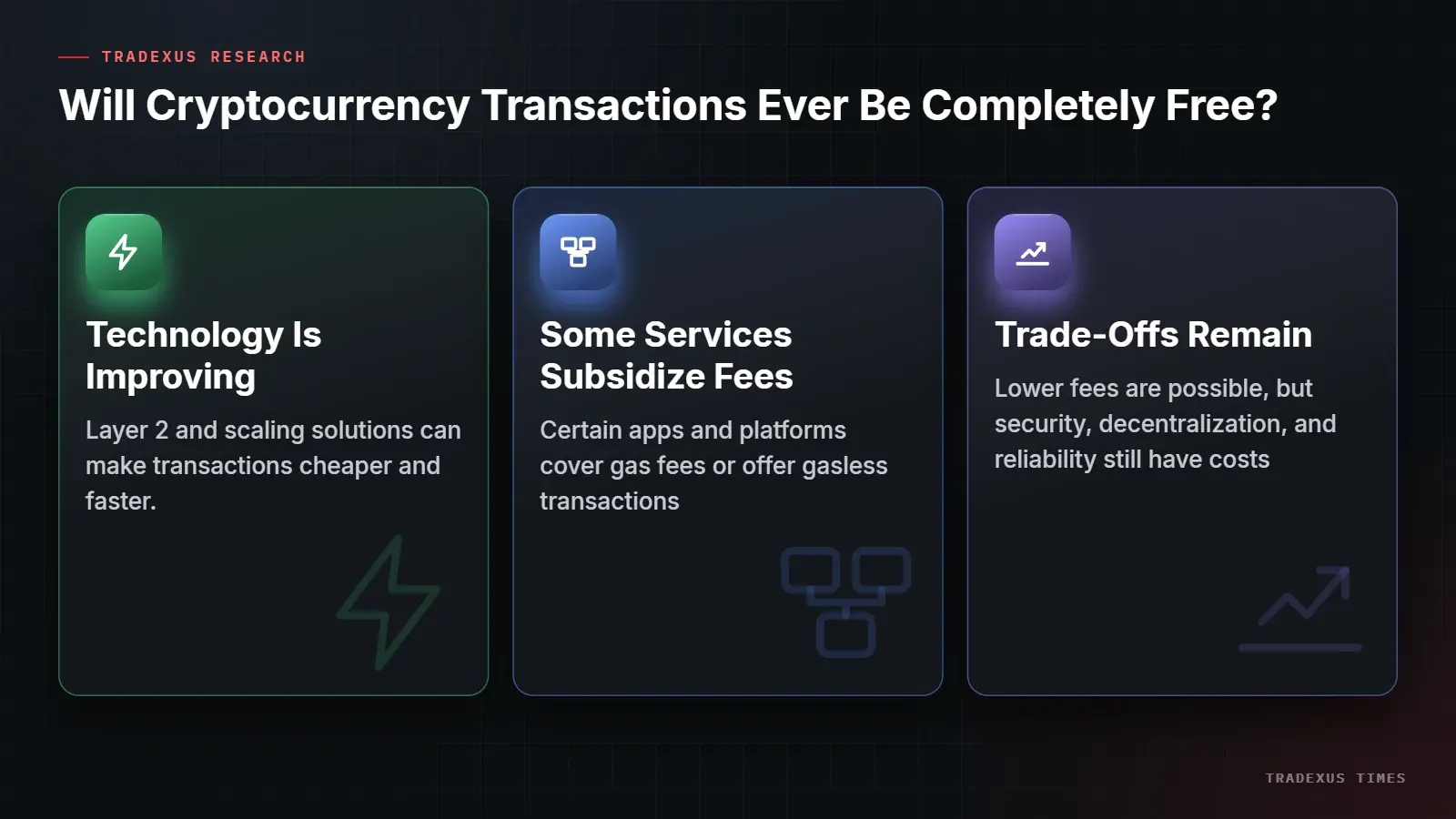
The future of cryptocurrency may bring cheaper, faster, and more convenient transactions, but completely free transactions on every public blockchain are unlikely to be a universal solution. Network infrastructure, computing resources, security, and data availability still have costs, even when users do not pay them directly. Some applications or blockchain services may subsidize fees, sponsor transactions, or offer gasless experiences in which a third party pays on the user's behalf. Certain networks also offer very low transaction costs under particular conditions. However, these arrangements do not necessarily mean that processing the transaction has no economic cost. Layer 2 technology and ongoing improvements to blockchain scalability can make transactions more affordable by using network resources more efficiently. The long-term challenge is to balance low fees with security, decentralization, reliability, and accessibility. A successful blockchain ecosystem must allow ordinary users to transact affordably while maintaining enough safeguards to resist spam and malicious activity. The most useful question, therefore, is not simply whether transactions can be free, but how their costs can be made fair, transparent, and sustainable.
Conclusion: Understanding the Real Cost of Crypto
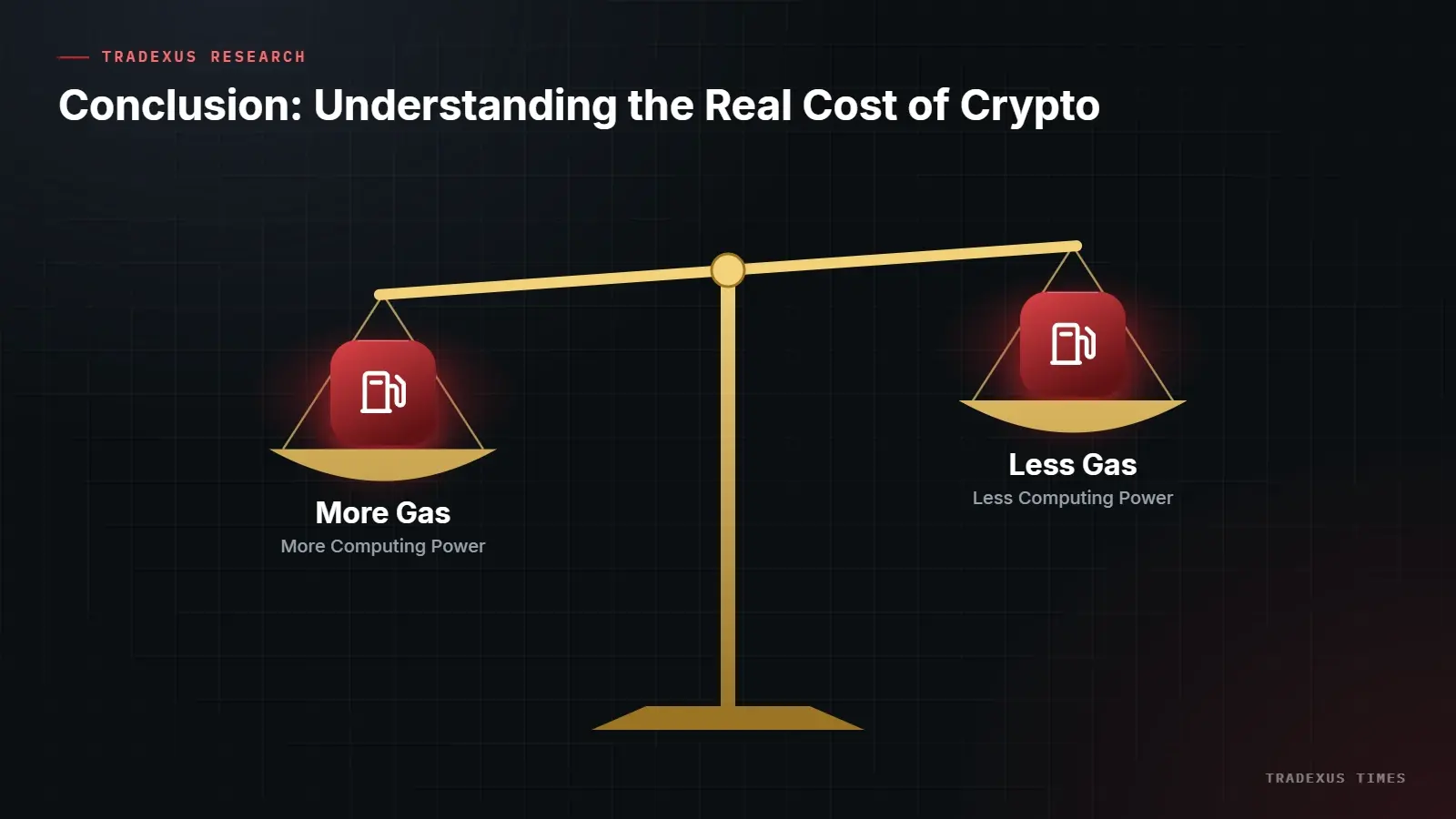
Gas fees are an essential part of how many blockchain networks operate, rather than simply an extra charge imposed by a cryptocurrency wallet. On Ethereum, they compensate for computational work, help allocate limited network capacity, and discourage abusive activity. Their size depends on factors such as the complexity of a transaction, current demand, and the fee offered to encourage inclusion. Understanding these factors helps explain why fees fluctuate, why complicated smart-contract operations often cost more than simple transfers, and why a failed transaction may still incur a charge. It also helps users make better decisions about transaction timing, fee estimates, and Layer 2 alternatives. As blockchain technology develops, improvements in scalability and transaction design may continue to reduce the cost of using decentralized applications. Nevertheless, the fundamental principle remains: digital transactions may not require a traditional bank, but they still require resources to be processed and secured. By understanding how these costs work, cryptocurrency users can navigate blockchain networks more confidently and avoid unnecessary fees.
Sources
- ethereum.org/developers/docs/gas
- ethereum.org/developers/docs/intro-to-ether
- bitcoin.org/fees
- support.metamask.io/more-web3/learn/why-did-i-pay-gas-fees-for-a-failed-transaction
Education only — not financial advice. Figures are as of the dates given in the text and its sources. Our editorial policy · Report an error