
What Is Blockchain and How Does It Work?
An evidence‑based overview of blockchain technology, its components, and its current landscape.

Key takeaways
- Bitcoin is just one application of blockchain. The technology can also support supply chains, digital ownership, and financial services.
- Blockchain can allow people and organizations to share trustworthy records without depending on one central recordkeeper.
- Blockchain is designed to be tamper-resistant, but it is not completely immune to attacks or errors.
- Transparency can increase accountability, although it does not guarantee that information entered into a blockchain is accurate.
- Consensus is what allows a blockchain network to maintain a consistent record without relying on a single administrator.
Blockchain is a digital technology that stores information securely, transparently, and in a way that is very difficult to change or manipulate. In simple terms, blockchain is a digital record book (ledger) that can be shared across many computers instead of being controlled by one person, company, or bank. Blockchain serves as the underlying ledger technology for cryptocurrencies such as Bitcoin and Ethereum.
Blockchain did not suddenly appear with Bitcoin. Its foundations were developed over several decades.
1991 — Cryptographically linked records[1]
Stuart Haber and W. Scott Stornetta described a method for timestamping digital documents so that changes could be detected. Their work helped establish ideas later used in blockchain systems.
2008 — The Bitcoin white paper[2]
An individual or group using the name Satoshi Nakamoto published Bitcoin: A Peer-to-Peer Electronic Cash System. It proposed a way to transfer digital value without requiring a trusted financial institution to maintain the central ledger.
2009 — Bitcoin launches [2]
The Bitcoin network began operating, demonstrating a public blockchain secured through proof of work.
2015 — Ethereum launches[3]
Ethereum expanded the idea by supporting programmable smart contracts, enabling developers to create applications that run according to rules recorded on a blockchain[3].
2020s — Broader experimentation [1]
Blockchain development expanded into decentralized finance, tokenization, stablecoins, identity systems, and infrastructure for financial institutions.
Learn the basics of blockchain technology, consensus, decentralization, and real-world use cases in this short video.
 Watch on our channelwhy this video helps here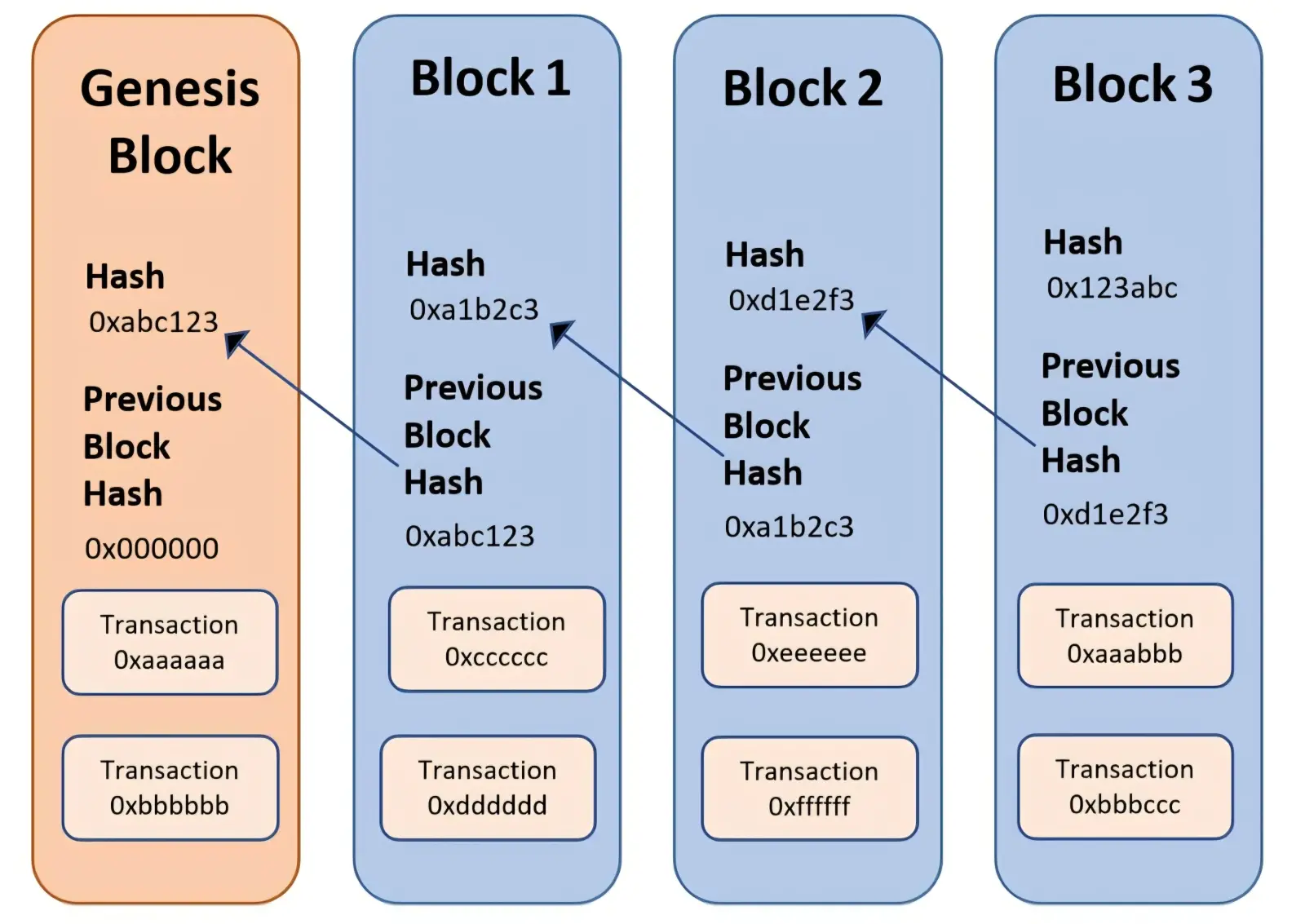
1.Transaction: Someone sends digital money or records information.
2.Verification: Computers on the network check whether the transaction is valid.
3.Block creation: Verified transactions are grouped into a block.
4.Chain connection: The new block is cryptographically linked to previous blocks.
5.Permanent record: The updated blockchain is shared across the network, making retroactive alterations computationally expensive on well-secured public blockchains.
Imagine you want to send $100 to your friend using a blockchain-based payment system.[1]
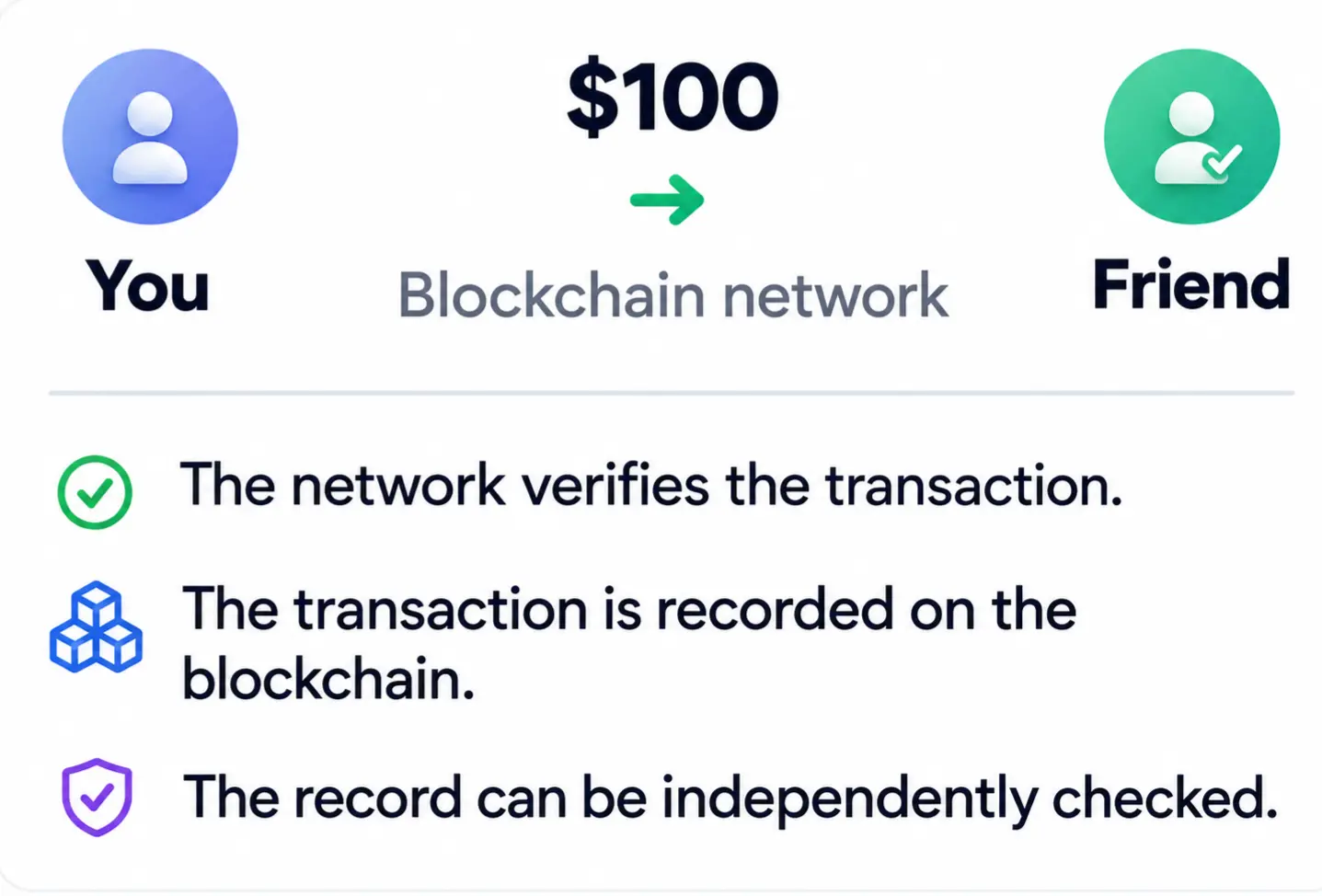
You can transfer value without relying on a traditional bank to maintain the transaction ledger, although fees and other intermediaries may still be involved.
| Feature | Meaning |
|---|---|
| Decentralization | No single authority needs to control the network. |
| Transparency | Transactions on public blockchains can be inspected. |
| Security | Cryptography helps protect records |
| Immutability | Confirmed records are extremely difficult to alter. |
| Traceability | Transaction history can be tracked. |
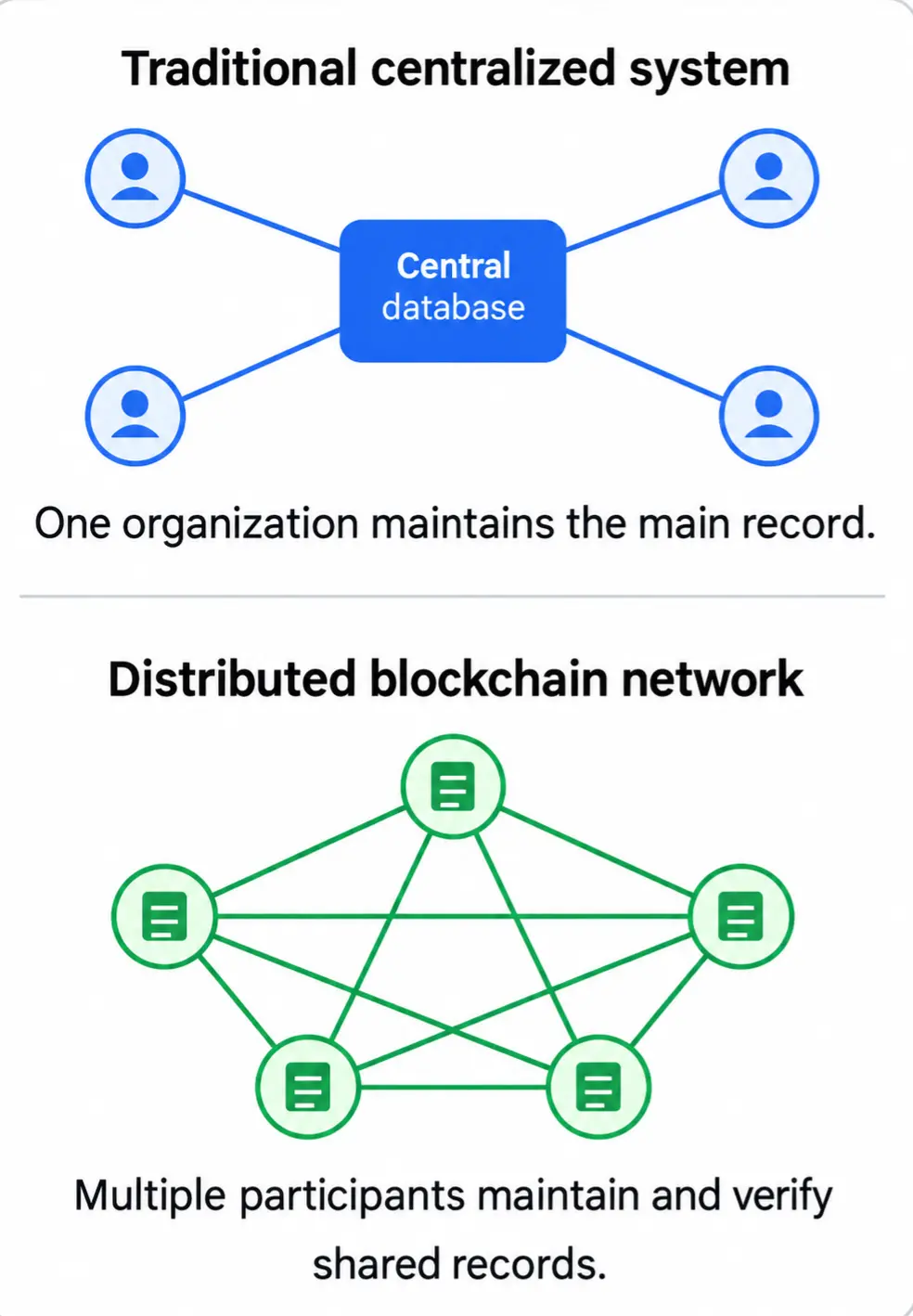
Imagine five banks that need to maintain a shared record of transactions.
Without blockchain, they might use a central database managed by one bank or a trusted third party.
But several questions arise:
Who controls the database?
What happens if the administrator changes a record?
How do the banks know they have the same information?
What happens if the central system fails?
How can participants agree on transactions when they do not fully trust each other?
Blockchain offers one possible solution:
a shared ledger whose updates follow agreed rules.
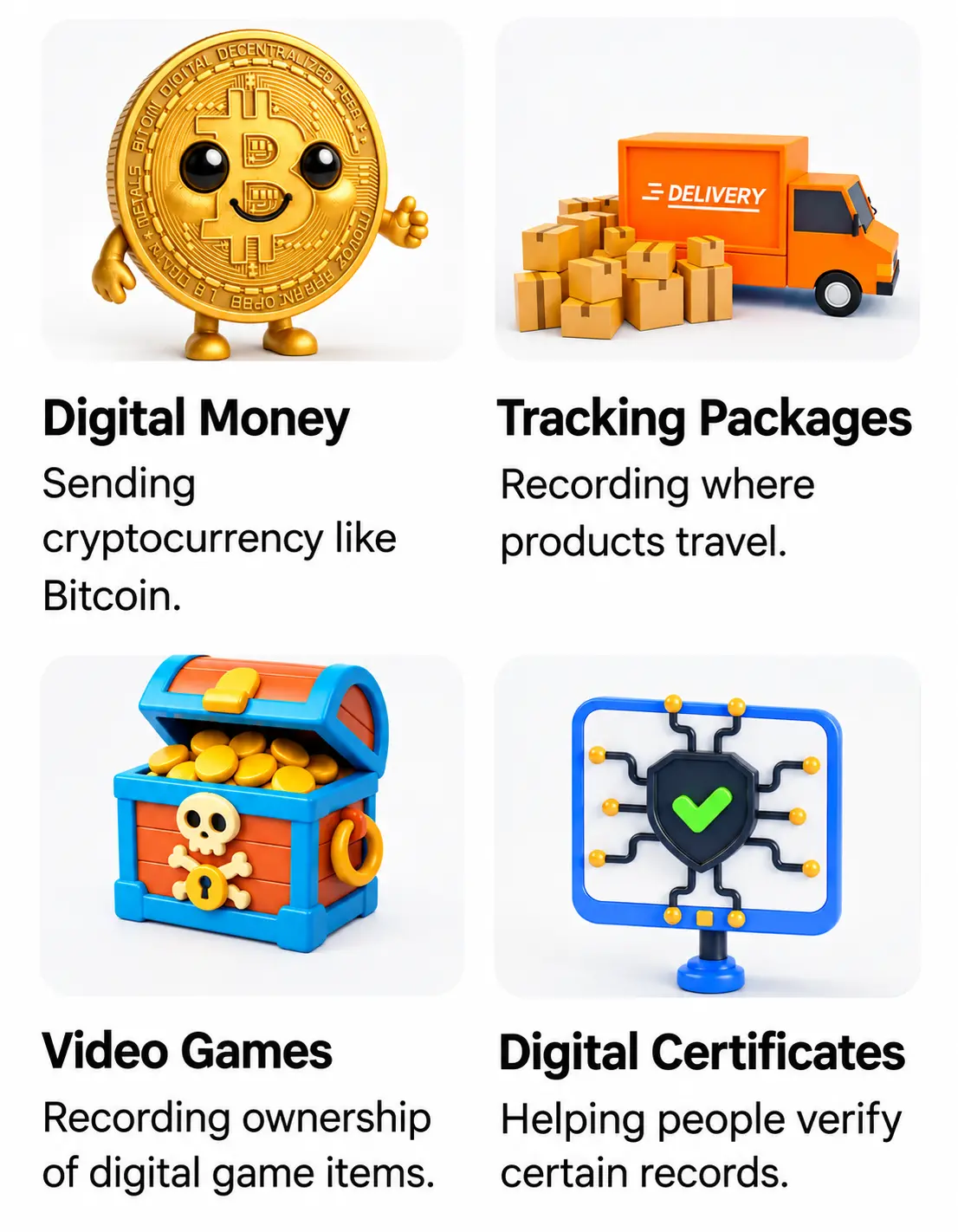
1.Bitcoin and Ethereum use blockchain technology to record transactions and manage digital assets.
2.Supply Chain Management Businesses can use blockchain to track products from manufacturers to customers.
3.Banking and Finance Blockchain can support payments, settlement, and financial transactions.
4.Smart Contracts Programs stored on blockchains can automatically execute agreements when predefined conditions are met.
Three concepts are especially important.
Cryptographic hashing
A hash function transforms input data into a fixed-length output.
For example, SHA-256 produces a 256-bit hash[2].
A secure cryptographic hash function has useful properties:
The same input always produces the same output.
A small input change usually produces a very different hash.
It is computationally impractical to reverse a hash to recover an arbitrary original input.
Finding two different inputs with the same hash should be computationally infeasible.
Think of a normal school notebook. If only the teacher owns it, the teacher controls the records. But imagine everyone in class has a synchronized copy, and special rules protect the entries. That's closer to blockchain. It has three important superpowers:
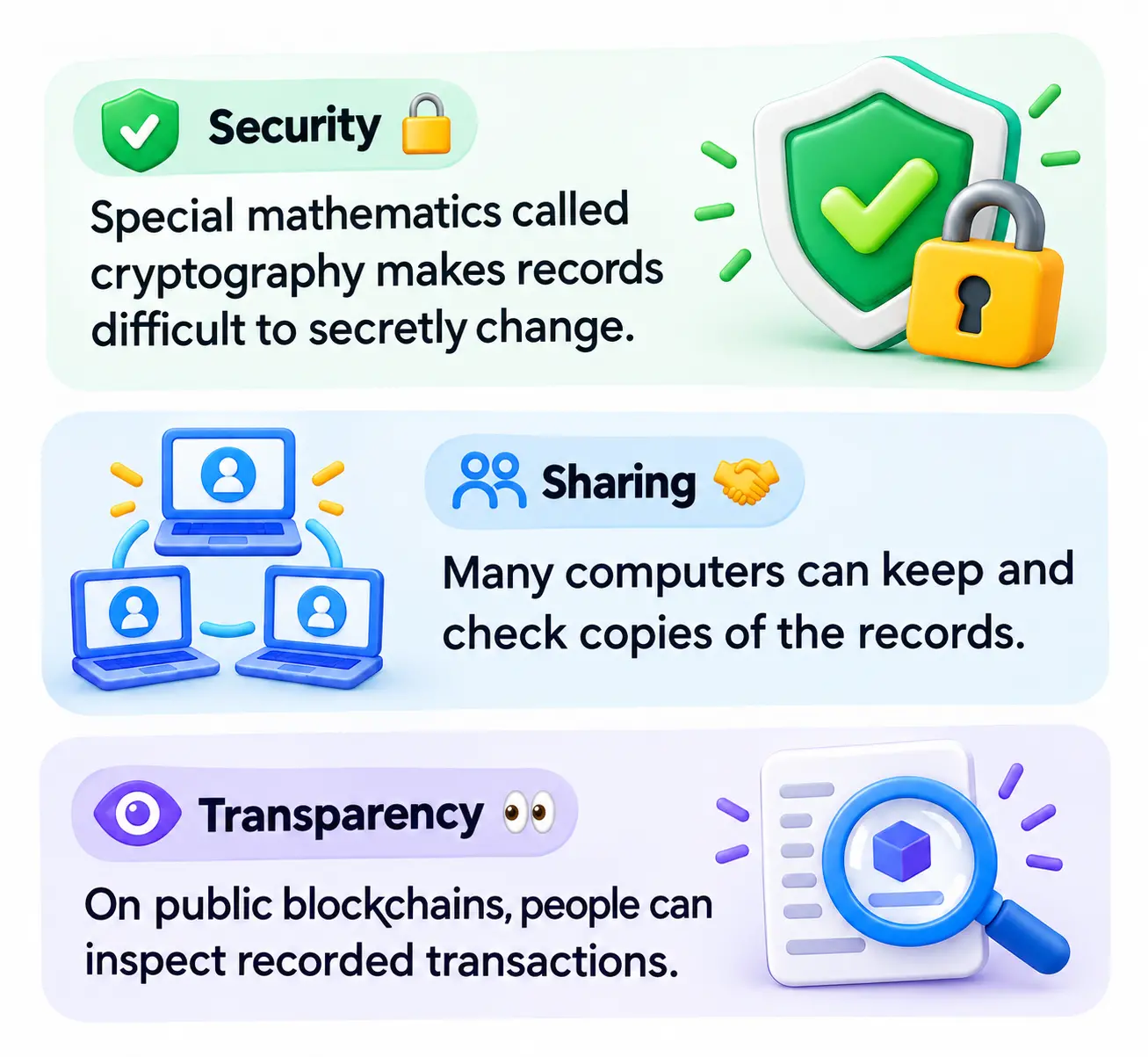
Blockchain is like a shared digital notebook where information is stored in connected blocks, and special rules make cheating very difficult. It isn't magic, and it doesn't stop every scam or mistake. But it is a clever way for computers to agree on information. And that's blockchain!
Sources
- [S1]nvlpubs.nist.gov/nistpubs/ir/2018/NIST.IR.8202.pdf
- [S2]bitcoin.org/bitcoin.pdf
- [S3]blog.ethereum.org/en/2021/05/18/country-power-no-more
- [S4]bis.org/publications/aer-2025/next-generation-monetary-financial-system
Education only — not financial advice. Figures are as of the dates given in the text and its sources. Our editorial policy · Report an error