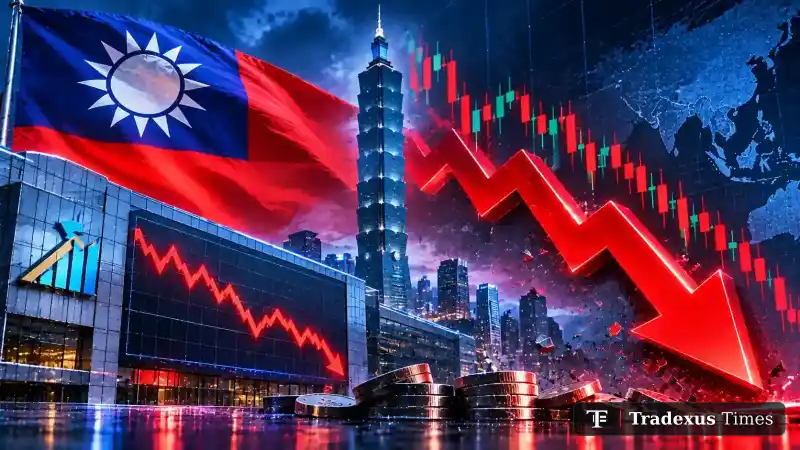
Taiwan's benchmark TAIEX suffered a sharp weekly retreat as mounting pressure on artificial-intelligence stocks triggered heavy selling across the island's semiconductor and technology supply chains. The index was down 17.3% for the week during Friday morning trading, extending a broad market decline that has placed major AI-related companies under significant pressure.
The benchmark fell 6.05% on Friday to 36,102.11 at 11:15 a.m. local time, bringing its cumulative decline since the November 13 close to 17.3%. The figure represents an intraday weekly performance rather than a completed weekly return. Through Thursday's close, the index had already fallen 12.0% from the previous Friday, indicating that much of the selling pressure had developed before the latest session.

The downturn has been particularly significant for Taiwan because of its central position in the global AI hardware ecosystem. Taiwan Semiconductor Manufacturing Co. (TSMC), the world's leading advanced chip manufacturer, and Foxconn, a major producer of AI servers and electronics, are among the companies whose market performance reflects broader expectations for continued investment in artificial intelligence.
TSMC shares had declined 14.9% from their November 13 closing level, while Foxconn's parent company, Hon Hai, had lost 12.9%. Their simultaneous weakness highlights how a reassessment of the AI investment outlook can affect multiple segments of the technology supply chain, including semiconductor manufacturing and server production.
The market decline also presents a notable contrast with the companies' recent business outlooks. TSMC Chairman and Chief Executive C.C. Wei told investors on October 15 that demand remained above available supply, while Foxconn identified AI servers as its most important growth engine on November 12. These assessments point to continued underlying demand for AI infrastructure, even as equity investors reassess the valuations and market expectations attached to the sector.
This distinction is important for understanding the selloff. Weakening share prices do not necessarily indicate an immediate deterioration in semiconductor or AI-server demand. Instead, the divergence suggests that financial markets may be reassessing how much future growth is already reflected in technology valuations. However, if selling pressure persists despite constructive corporate demand assessments, it could indicate a broader reduction in risk appetite toward AI-linked equities.
Regulatory intervention has added another dimension to Friday's trading session. Taiwan's Financial Supervisory Commission introduced tighter short-selling restrictions following earlier market-stabilization measures announced on November 9. Under the new framework, stocks that close at least 3.5% lower cannot be short-sold below their previous closing prices during the following trading session, subject to specified exemptions for market-making and hedging activities.
The regulator also reduced the daily limit on intraday orders involving borrowed shares. The permitted volume has been lowered from 3% to 1% of a security's average daily trading volume over the preceding 30 business days, with specified exemptions.
These measures are designed to constrain certain forms of short-selling activity during periods of severe market weakness. Nevertheless, restrictions on borrowed-share transactions cannot independently reverse a broader reassessment of equity valuations or restore investor confidence. Their effectiveness will depend partly on whether underlying buying demand returns and selling pressure across major technology stocks begins to moderate.
The commission has also encouraged financial institutions to purchase fundamentally sound equities and urged listed companies to consider share buybacks. Such measures could provide additional support to selected stocks, although their impact will depend on the willingness of investors and companies to commit capital while market uncertainty remains elevated.
For Taiwan's equity market, the immediate concern extends beyond the performance of individual semiconductor companies. The TAIEX's concentration in major technology businesses means that changes in sentiment toward the global AI trade can have an outsized effect on the broader benchmark. Continued weakness in TSMC and Foxconn could therefore remain a significant source of downward pressure, even if their underlying business outlooks remain comparatively constructive.
The next important test will be whether the index can stabilize after its steep intraday decline and whether major AI suppliers begin to recover. A sustained improvement in semiconductor and server manufacturers' share prices would suggest that investors are becoming more comfortable with the sector's growth outlook. Conversely, continued selling despite positive demand assessments could reinforce concerns that valuation adjustments and risk reduction are extending beyond individual companies into the wider technology market.