Solana

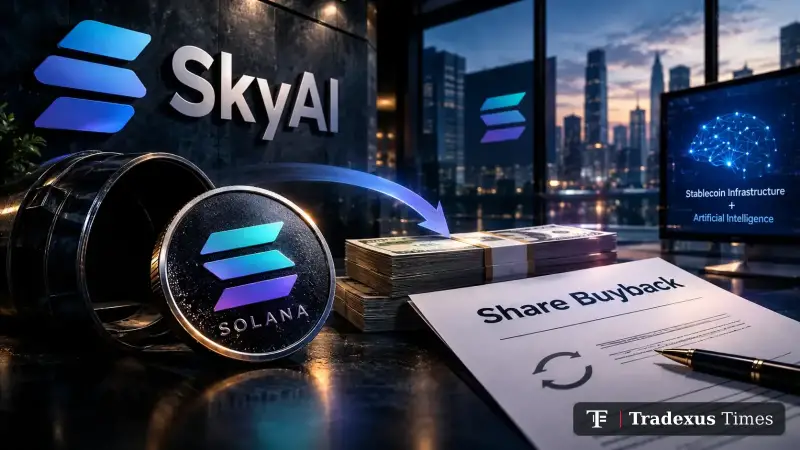
SkyAI, formerly known as Sharps Technology, has sold its entire Solana (SOL) treasury and launched a tender offer to repurchase up to $201.3 million in shares and warrants, marking a reversal of the company’s digital-asset accumulation strategy. According to a filing with the U.S. Securities and Exchange Commission on Monday, the company held approximately $223.8 million in cash as of October 16 following the liquidation of its SOL holdings.
The tender offer allows shareholders and warrant holders to sell their securities directly back to the company at a fixed price. It covers up to 95% of each class of outstanding shares and warrants and will be funded entirely from existing cash reserves. The company has also removed a proposed condition linking the buyback to SOL’s market price, separating the repurchase program from the token’s price fluctuations.
The shift represents a substantial change in SkyAI’s approach to capital allocation. Rather than maintaining direct exposure to Solana as a treasury asset, the company is moving toward a cash-funded repurchase while retaining plans to develop a financial platform combining stablecoin infrastructure on Solana with artificial intelligence.
The distinction is important for assessing the company’s future exposure to the digital-asset market. Selling its SOL holdings eliminates its direct treasury exposure to the token, while the planned platform keeps Solana relevant to its business strategy. The company’s future performance will therefore depend less on the mark-to-market value of a large SOL reserve and more on how it deploys its remaining capital and executes its technology plans.
SkyAI’s treasury strategy began in August 2025, following a private placement that raised more than $400 million. The company acquired more than 2 million SOL the following month, establishing a position worth over $400 million at the time. By the end of 2025, its holdings had reached approximately 2.08 million SOL, with a reported cost basis of $403.1 million, equivalent to roughly $194 per token.
Those holdings subsequently lost substantial value as Solana declined. The company’s SOL position was valued at approximately $250.1 million at the end of 2025, implying around $153 million in unrealized losses. The figures illustrate the balance-sheet risks associated with concentrating corporate treasury capital in a volatile digital asset: even when a company accumulates tokens as a long-term reserve, falling prices can materially reduce the value of its holdings.
The broader experience of publicly traded Solana treasury companies provides additional context. By February 2026, these companies faced more than $1.5 billion in combined unrealized losses as lower token prices pressured the value of their holdings and their share valuations. SkyAI’s decision to liquidate its treasury comes against that backdrop, although the available figures do not establish that the broader sector’s losses alone drove the company’s decision.
SOL has since recovered from approximately $62 in June to around $104 as of Monday. However, that rebound has not prevented SkyAI from abandoning its direct treasury exposure. The move suggests that the company’s capital-allocation priorities have shifted toward repurchasing securities rather than rebuilding its token holdings, though its longer-term commitment to Solana-based infrastructure remains intact.
The proposed $201.3 million tender offer is now a central factor in evaluating the company’s next steps. Because the repurchase is funded by cash on hand, its execution will reduce the company’s cash balance while potentially reducing the number of shares and warrants held outside the company. The final impact on shareholders will depend on participation, the securities accepted for repurchase, and the resulting capital structure.
The scale of the offer is also notable relative to the reported $223.8 million cash balance. The maximum proposed repurchase represents approximately 90% of that amount, although the actual cash expenditure may be lower depending on participation and the terms of the offer. This makes the balance between returning capital to security holders and retaining funding for business development an important consideration.
SkyAI’s stock closed Monday at $2.79, up 5.3% on the day. Shares have gained approximately 65% over the past month but remain down around 41% over the past year. The daily advance and recent monthly recovery indicate that the stock has strengthened over the shorter term, but those price movements alone do not establish how investors have assessed the treasury liquidation or the proposed buyback.
The next developments to watch are the completion and participation levels of the tender offer, the company’s remaining cash position, and progress on its planned stablecoin and artificial-intelligence platform. The key question is whether the transition from a token-heavy treasury to a cash-funded repurchase can improve capital efficiency while preserving sufficient resources for the company’s operating plans.
For the digital-asset treasury sector, SkyAI’s reversal highlights the trade-off between holding a volatile cryptocurrency as a corporate reserve and using capital for direct shareholder returns. Its next phase will test whether a business can retain strategic exposure to blockchain infrastructure without maintaining a large balance-sheet position in the underlying token.