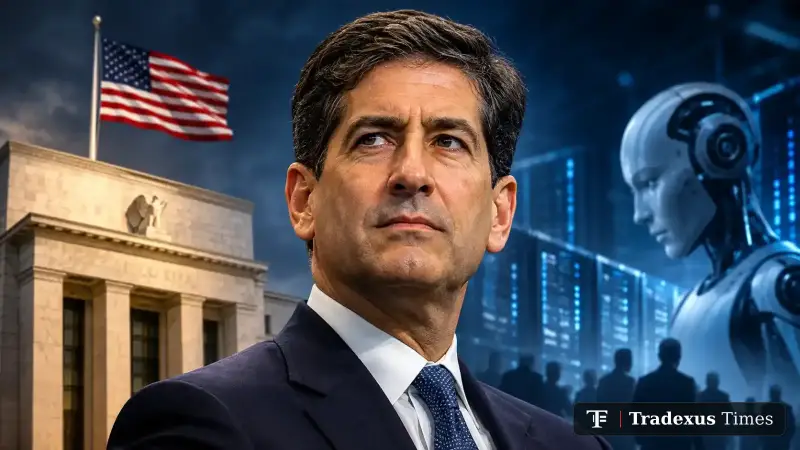
Federal Reserve Chair Kevin Warsh has warned that the rapid development of artificial intelligence and superintelligence could reshape the economy, bringing both significant opportunities for growth and serious risks to employment and financial stability.
Speaking at a Federal Reserve conference on productivity and jobs, Warsh outlined several possible economic outcomes. In a positive scenario, AI could accelerate the creation of new ideas, lift productivity and support stronger long-term growth, with the benefits shared across workers and investors. However, he also cautioned that widespread automation could displace workers faster than labor markets can adapt, pushing unemployment above levels consistent with full employment.

A more negative scenario could emerge if the enormous investments flowing into AI infrastructure fail to generate the returns investors expect. A sharp reassessment of technology valuations could then weaken financial markets, slow economic activity and contribute to a further rise in unemployment.
Warsh presented these possibilities as illustrative scenarios rather than forecasts, emphasizing that the scale, reach and timing of AI's economic impact remain uncertain.The implications extend beyond the labor market. If AI produces a sustained productivity boom, it could change the economy's growth potential and influence inflation dynamics and the Federal Reserve's future monetary policy decisions. Conversely, if technological disruption creates persistent unemployment or a broader economic slowdown, policymakers may face difficult choices in responding to conditions that could be structural rather than temporary.
Warsh also stressed that human judgment and responsibility must remain central to how the technology is developed and deployed. For financial markets, the key question is whether AI's productivity gains will materialize quickly enough to justify current investment expectations without creating severe disruptions across employment and the wider economy.