Amazon’s ambitious data center expansion plans are facing mounting resistance from two fronts: its own employees and local communities concerned about the environmental and economic impact of large-scale facilities. Disputes in Seattle and Ohio have placed billions of dollars in planned infrastructure investment under pressure, adding new challenges to the company’s effort to expand computing capacity for artificial intelligence.
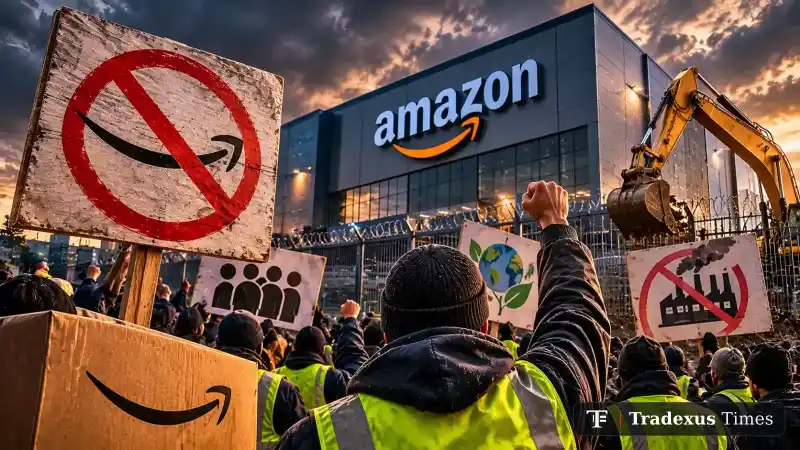
The conflict became public in Seattle on June 3, 2026, when three Amazon software engineers testified before the city council in support of a one-year moratorium on new large-scale data center developments. All three were members of Amazon Employees for Climate Justice (AECJ), an internal advocacy group. Their concerns included rising electricity demand, environmental consequences and the potential economic effects of major facilities on surrounding communities.

Six days later, on June 9, the Seattle City Council approved the one-year moratorium. Amazon subsequently opened internal investigations into the three employees, who faced potential disciplinary action on June 10. The engineers responded with a civil rights complaint alleging retaliation and discrimination linked to their political speech. They argue that their testimony represented protected civic participation rather than workplace misconduct. The complaint adds an employment-related dimension to the wider debate over the company's infrastructure strategy.
Resistance has also expanded in Ohio, where voters approved 21 local ballot measures in November 2026 aimed at restricting data center development. The measures seek to limit the scale of new facilities and regulate their electricity consumption.
Three Amazon projects are affected, representing approximately $17 billion in planned investment and 1.8 gigawatts of proposed capacity. The scale of the exposure is significant relative to Amazon’s previously stated ambition to invest $23 billion in Ohio by 2030. The affected projects account for a substantial portion of that investment target, although the ballot measures do not by themselves establish the final outcome for every development.
Amazon has argued that expanding data center capacity is necessary to meet growing demand for AI services. The company has also highlighted its commitments to renewable energy and community support programs as part of its response to concerns about the environmental and local impact of its projects.
Critics, including employees and outside activists, question whether those commitments adequately address the resource demands of the expansion. Their concerns focus on electricity consumption, sustainability and the balance between increasing computing capacity and using energy efficiently.
The employee campaign predates the latest disputes. In November 2025, AECJ organized an open letter signed by more than 1,000 Amazon employees criticizing the company's approach to AI development and its environmental consequences. Since then, demands have become more specific, including proposals for data centers to generate more renewable energy than they consume, worker-led oversight committees and greater transparency around new developments.
The latest developments create several distinct challenges for Amazon. The Ohio measures introduce uncertainty around projects worth approximately $17 billion, while Seattle's temporary moratorium restricts new large-scale proposals within the city for one year. Separately, the civil rights complaint could bring scrutiny to how the company handles employees who publicly participate in policy debates affecting its business.
The dispute also carries reputational implications. Amazon's defense of its expansion relies partly on its renewable energy and community investment commitments, while employees who work within the company are publicly questioning whether those measures are sufficient. That disagreement may complicate efforts to build support among local residents and policymakers.
The broader issue extends beyond Amazon. As technology companies expand infrastructure to support AI, local governments and communities are increasingly weighing the economic benefits of investment against electricity demand, environmental considerations and local oversight. For Amazon, the ability to advance its expansion plans will depend not only on capital and technology, but also on how it addresses the concerns of communities and employees affected by the buildout.