Market Cap, Volume & Liquidity: How to Evaluate a Crypto Asset
Crypto market cap, volume, and liquidity reveal more than price alone. Learn how to evaluate an asset’s market size, trading activity, liquidity, and hidden risks before making investment decisions.

Key takeaways
- Market Cap measures a crypto asset’s total market value based on its circulating supply and price.
- Trading Volume shows how much of an asset is traded over a specific period and helps gauge market activity.
- Liquidity determines how easily an asset can be bought or sold without significantly affecting its price.
- High Volume ≠ High Liquidity: Strong trading activity does not always guarantee deep order books or low slippage.
- Low Liquidity Increases Risk: Thin order books and wide spreads can make trading more expensive and difficult.
- Evaluate Metrics Together: Market cap, volume, liquidity, and order-book depth provide a more complete picture of an asset.
Market Capitalization: Understanding the Size of a Crypto Asset
Market capitalization, or market cap, is one of the first metrics investors look at when evaluating a cryptocurrency. It represents the total value of all coins currently in circulation. It is calculated by multiplying the circulating supply by the current price of one coin.
A high market cap generally indicates that an asset is more established or widely valued by the market. A low market cap may indicate that the project is relatively small and could have greater room for growth, but it may also carry higher risks, such as price manipulation, weak demand, or limited investor confidence. Market cap alone does not tell you whether a cryptocurrency is cheap or expensive.
 Watch on our channelUnderstanding the Size of a Crypto Asset
Trading Volume: Measuring Market Activity
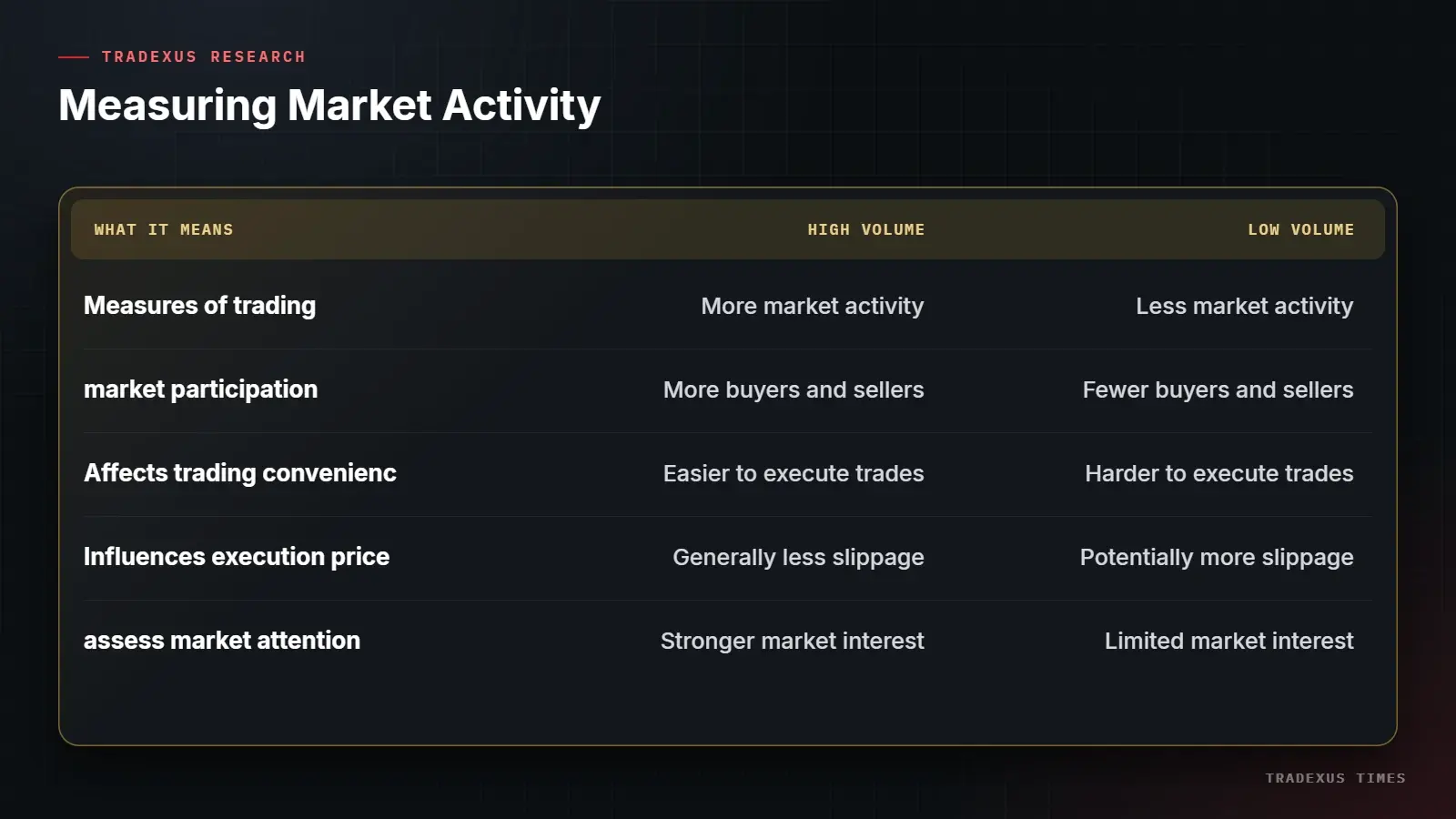
Trading volume measures how much of a cryptocurrency has been traded over a specific period, such as 24 hours. It helps investors understand how active the market is and whether people are currently buying or selling the asset.
High trading volume can suggest strong interest and make it easier to enter or exit positions. However, volume can sometimes be misleading. A sudden increase may be caused by speculation, short-term hype, or artificial trading activity rather than genuine demand. Low trading volume may indicate that interest is fading, making trades more difficult or unpredictable.
Liquidity: Can You Buy or Sell Without Moving the Price?
Liquidity refers to how easily a cryptocurrency can be bought or sold without causing a significant change in its price. It is one of the most important factors when evaluating whether an asset is practical to trade.
A liquid asset usually has many buyers and sellers, a narrow bid-ask spread, and enough orders to handle trades of different sizes. An illiquid asset may appear attractive on a price chart, but selling a large amount could push its price down sharply. This is particularly important for smaller cryptocurrencies, where trading activity may be concentrated on only a few exchanges.
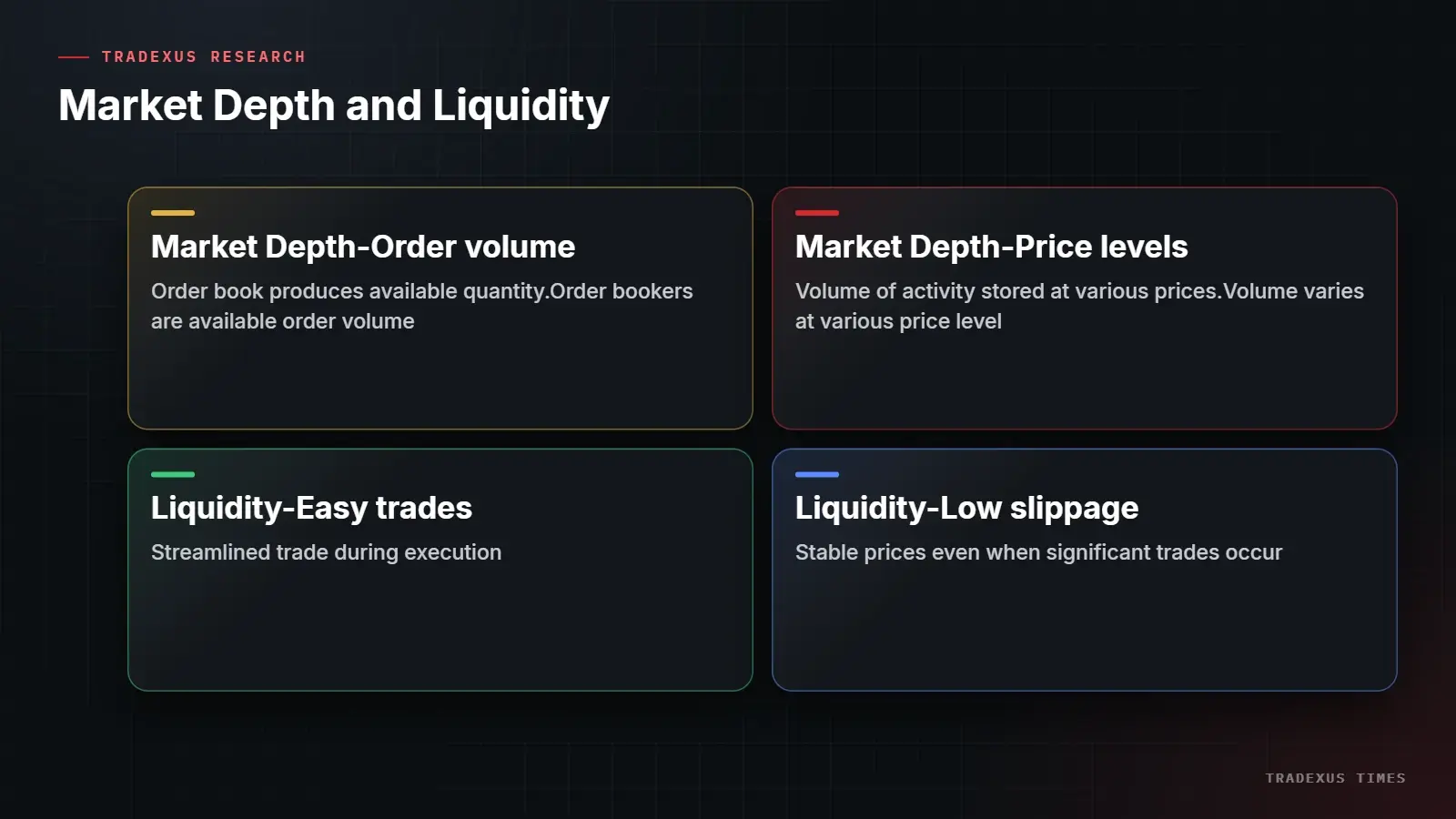
Comparing Market Cap, Volume, and Liquidity
These three metrics are connected, but they measure different aspects of the market. Market cap tells you how large an asset is valued, trading volume shows how active it has been, and liquidity indicates how easily you can trade it.
For example, a token may have a market cap of $500 million and daily volume of $50 million[2], yet still have poor liquidity if most trading happens on a single exchange or if its order book is thin. Another token with a smaller market cap may offer better trading conditions because its buy and sell orders are more evenly distributed.
Investors should avoid judging a crypto asset using one metric alone. A combination of these indicators provides a more realistic picture of its market quality.
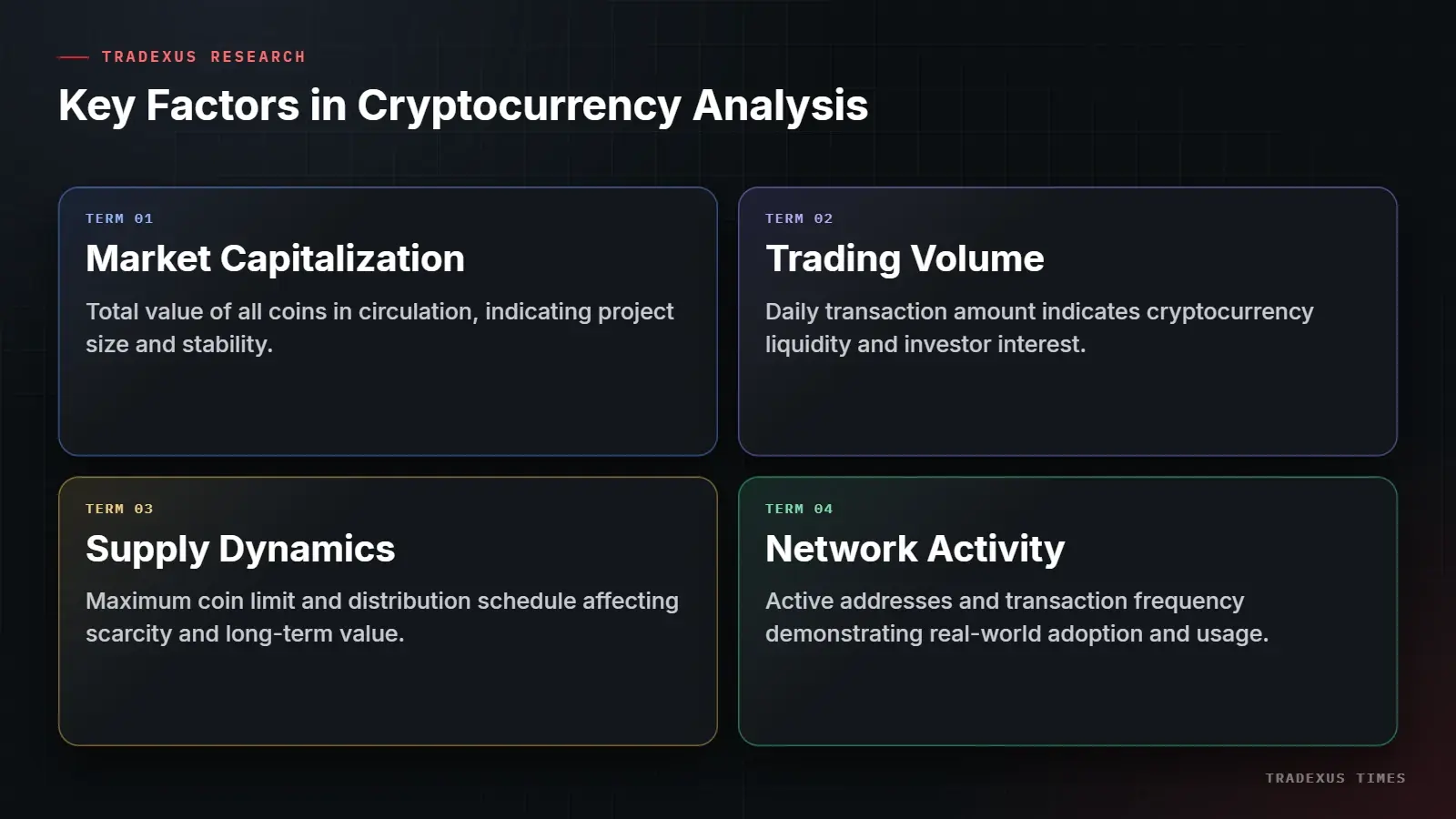
How to Evaluate a Crypto Asset Before Investing
Before investing in a cryptocurrency, examine its market cap, trading volume, and liquidity together. Start by checking whether its market capitalization is reasonable compared with similar projects. Then review its 24-hour trading volume and investigate whether activity is spread across multiple reputable exchanges.
Next, examine the order book. Look at the bid-ask spread and the amount of buying and selling interest close to the current price. If the spread is wide or the order book is shallow, trading may be expensive or difficult. Also, check whether the market remains active during different periods rather than relying on a single volume spike.
A careful evaluation helps investors recognize warning signs before committing money. These metrics cannot predict future prices, but they can help you avoid assets with weak trading conditions or misleading market activity.
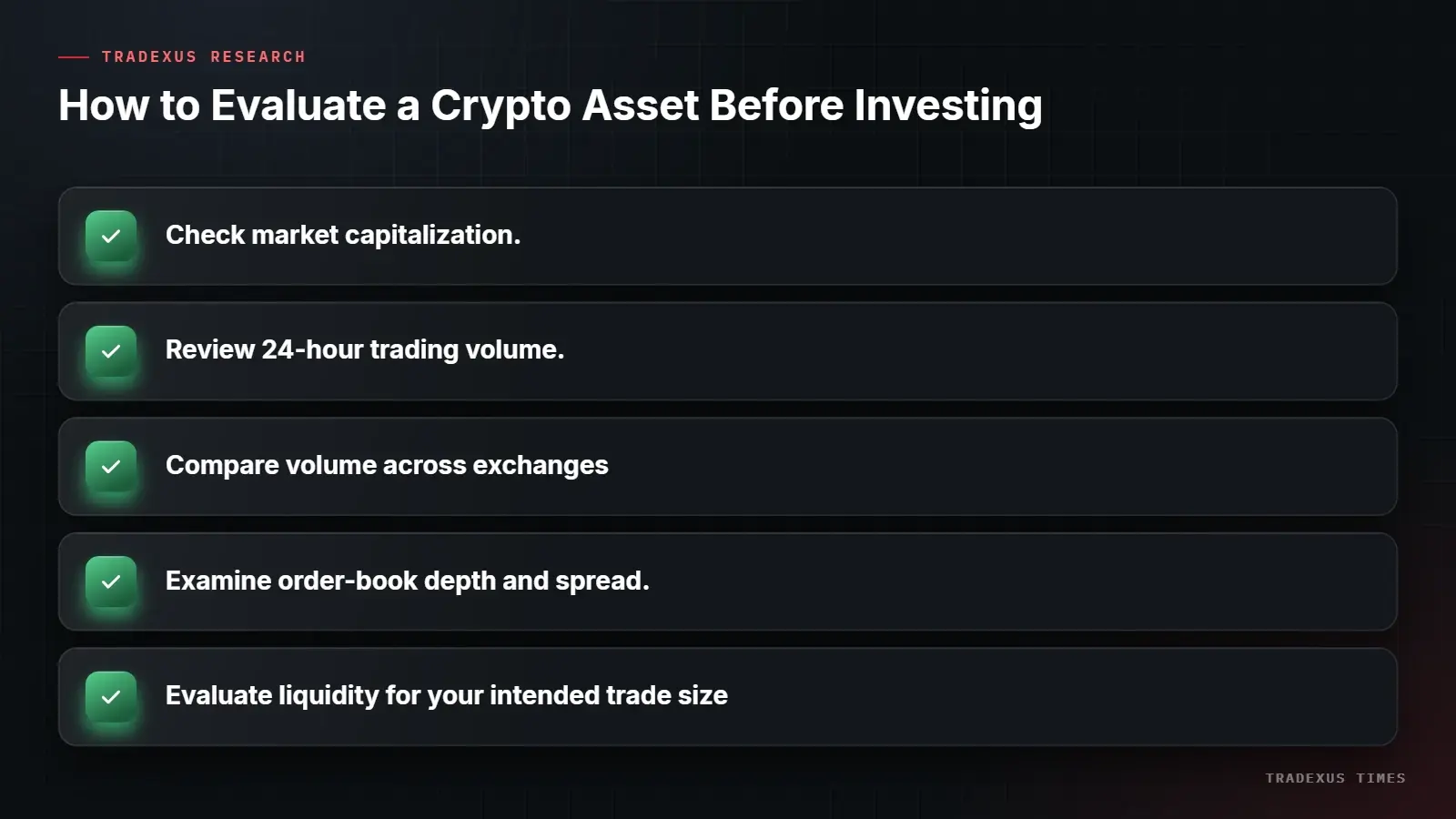
Myth vs. Fact: High Volume Does Not Always Mean High Liquidity
One common mistake is assuming that a cryptocurrency with high trading volume is always easy to buy or sell. In reality, volume records past trading activity, while liquidity reflects the orders currently available in the market. An asset can have impressive volume figures but still experience significant slippage when someone places a large trade. Evaluating both helps investors distinguish between market popularity and genuine trading quality.
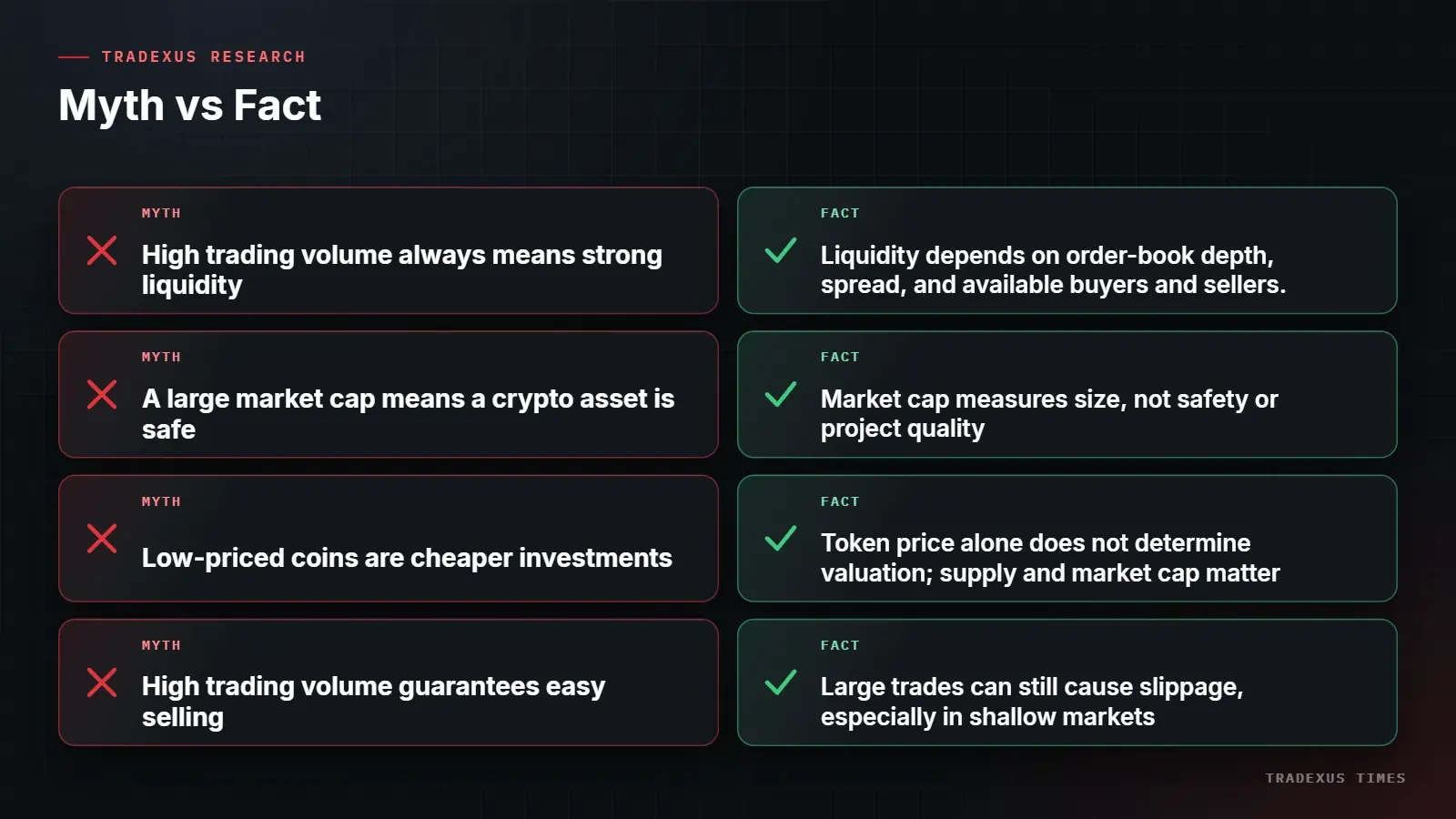
The Red Flags: Signs of Weak Market Quality
| Warning Sign | Why It Matters | Why It Matters |
|---|---|---|
| Extremely low trading volume | Limited market participation | Difficulty selling your assets |
| Very wide bid-ask spread | Large gap between buy and sell prices | Higher trading costs |
| Sudden volume spikes | Activity may be temporary or manipulated | Misleading market signals |
| Shallow order book | Few orders near the current price | High slippage |
| Volume concentrated on one exchange | Trading activity depends on a single platform | Greater exposure to exchange-related disruptions |
Using Tradexus Data to Evaluate Crypto Market Conditions
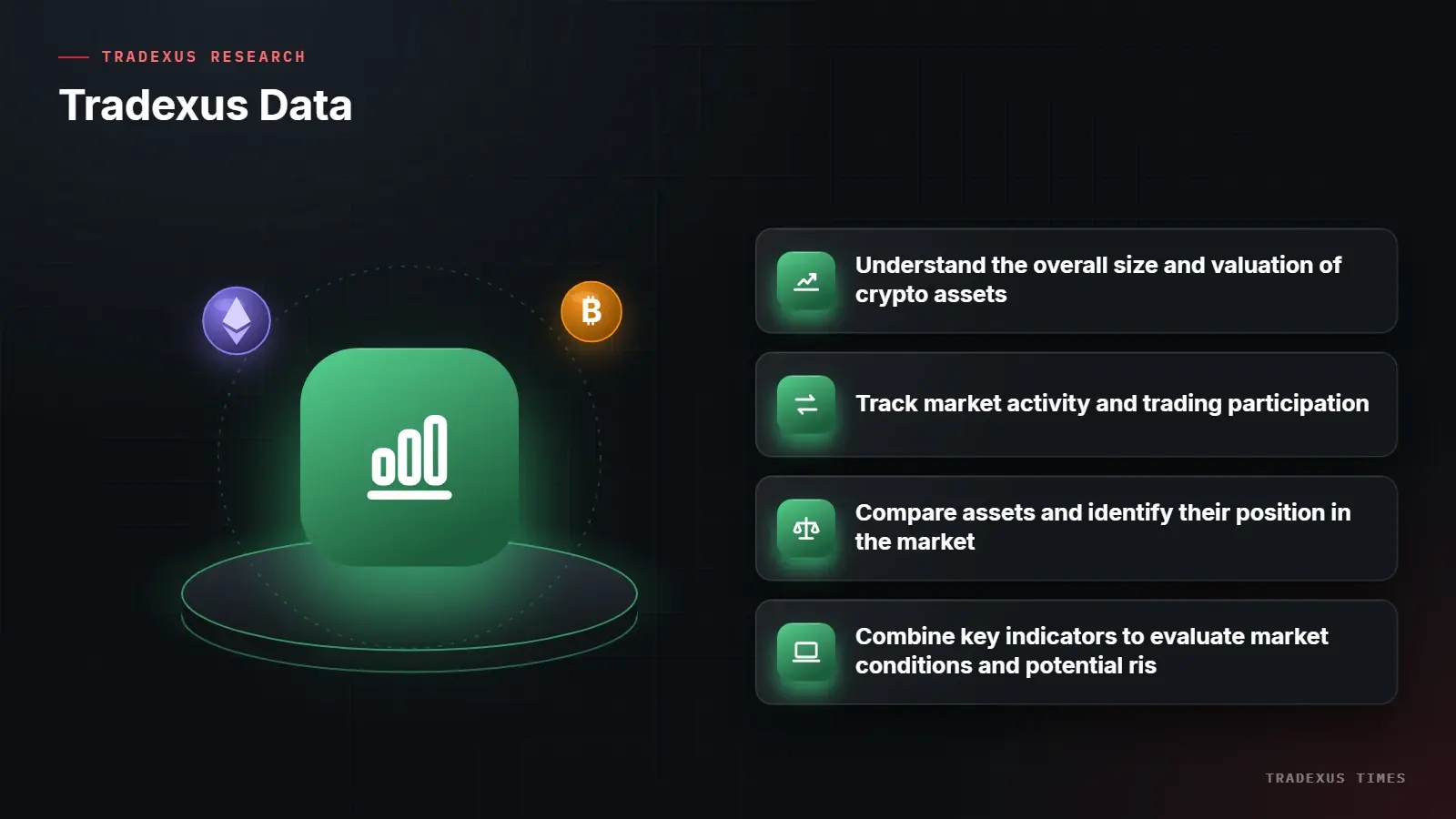
Evaluating a crypto asset becomes easier when market data is organized in one place. Tradexus Data provides access to key market indicators, including market capitalization, trading volume, market rankings, and other crypto-related metrics that can help traders understand market conditions.
By comparing market cap with trading volume, investors can identify whether an asset has significant market participation or relatively limited activity. Combining these metrics with other market indicators can provide a clearer picture of an asset's market position and help users make more informed decisions.
Rather than relying on price movements alone, traders can use data-driven analysis to better understand market behavior, identify potential risks, and evaluate crypto assets more systematically.[1]
Conclusion
Market capitalization, trading volume, and liquidity are three essential metrics for evaluating a crypto asset. Market cap helps investors understand an asset's overall valuation, volume reveals trading activity, and liquidity determines how efficiently trades can be executed without significantly affecting the price.
Understanding these metrics together can help traders identify potential risks, avoid misleading market signals, and make more informed decisions. Using reliable data platforms such as Tradexus Data can also make market analysis more efficient by bringing key indicators together in one place.
In crypto markets, a strong analysis goes beyond price. Understanding market structure, trading activity, and liquidity is what helps turn raw data into meaningful insight.
Sources
Education only — not financial advice. Figures are as of the dates given in the text and its sources. Our editorial policy · Report an error