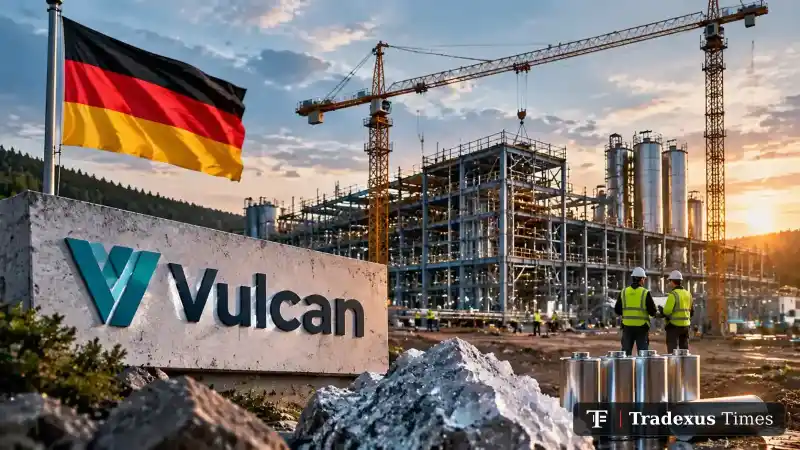
Vulcan Energy Resources has begun civil construction at its commercial lithium extraction plant in Landau, Germany, advancing its flagship Lionheart project as Europe seeks to expand domestic production of critical battery materials.
The company announced on November 16 that construction activities had started at the Upper Rhine Valley site following the completion of preliminary earthworks. The current phase includes foundations, concrete structures, access roads, drainage systems and infrastructure for processing equipment, utilities and storage facilities.

Vulcan said the project remains on schedule and within budget, with the start of civil works completing its major execution milestones planned for 2026. The company will now focus on maintaining construction progress through 2027.
Lionheart is targeting annual production of 24,000 tonnes of battery-grade lithium hydroxide monohydrate, which Vulcan estimates could supply approximately 500,000 electric vehicle batteries. The first phase is also designed to generate 275 gigawatt-hours of renewable electricity and 560 gigawatt-hours of renewable heat annually for local consumers over an estimated 30-year operating life.
The project will use geothermal brine rather than conventional hard-rock mining as its lithium source. Vulcan plans to deploy its proprietary VULSORB direct lithium extraction technology to recover lithium chloride from underground geothermal fluids. The intermediate product will then be processed into battery-grade lithium hydroxide at the company's downstream chemical facility in Frankfurt-Hoechst.
By using geothermal energy from the same brine to power operations, Lionheart is designed to combine lithium production with renewable electricity and heat generation. Vulcan has also secured take-or-pay lithium offtake agreements targeting European battery and electric vehicle customers.
The construction milestone follows a €2.2 billion financing package secured in December 2025, which enabled the company to make a positive final investment decision. The financing arrangements reached financial close in May 2026.
Lionheart carries strategic importance for Europe's efforts to reduce reliance on imported critical minerals and strengthen its domestic battery supply chain. The European Union's Critical Raw Materials Act sets 2030 targets for domestic extraction capacity equivalent to at least 10% of annual strategic raw material consumption and processing capacity equivalent to at least 40%.
Vulcan's first production target remains the second half of 2028, with no changes announced to its production plans or start-up timetable. However, reaching commercial output will depend on the successful completion and commissioning of the integrated lithium extraction, processing and geothermal facilities.