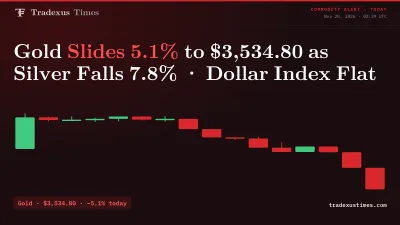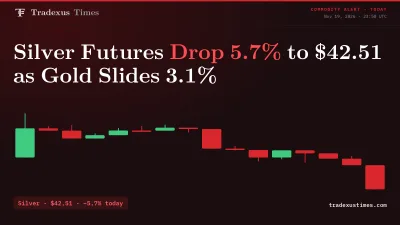

Gold is experiencing an unusual reversal of its traditional safe-haven behavior in 2026, declining alongside US equities rather than attracting investors seeking protection from stock market losses. The precious metal has fallen approximately 18% since the beginning of the year, while its three-month correlation with the S&P 500 has climbed to positive 0.35, indicating a growing tendency for both assets to move in the same direction.
The shift highlights how monetary policy expectations and liquidity pressures can temporarily override gold's traditional defensive characteristics. Although bullion is widely regarded as a store of value during periods of financial uncertainty, its performance remains sensitive to interest rates, real yields and the opportunity cost of holding non-interest-bearing assets.
In this story
2 assets

Rising US Treasury yields have emerged as a significant source of pressure. Higher real yields increase the relative attractiveness of interest-bearing investments, making gold less competitive for investors seeking returns. Unlike government bonds, bullion does not generate periodic income, meaning that expectations of tighter monetary policy can weaken demand even when uncertainty across financial markets remains elevated.
Expectations of another Federal Reserve rate increase are adding to this pressure. If borrowing costs remain elevated or move higher, the opportunity cost of holding gold could increase further. This creates a challenging environment for the precious metal, particularly when rising yields coincide with declining equity valuations.
Liquidity considerations are also contributing to the unusual market relationship. Investors facing losses in equity portfolios may sell other liquid holdings, including gold, to raise cash or meet financial obligations. Under these conditions, an asset traditionally used to diversify portfolio risk can become a source of liquidity rather than a destination for defensive capital.
The positive 0.35 correlation with the S&P 500 reinforces this changing market dynamic. However, correlation does not establish a permanent relationship or prove that gold has lost its safe-haven characteristics. Instead, it indicates that the diversification benefits of holding bullion alongside US equities have become less reliable under the prevailing market conditions.
For financial markets, the interaction between Treasury yields, real interest rates and Federal Reserve expectations will remain central to gold's near-term direction. A moderation in yield pressures could improve the metal's relative attractiveness, while further increases in real yields and continued liquidity-driven selling could prolong its weakness.
The broader implication is that gold's defensive role cannot be evaluated independently of the monetary environment. As long as higher borrowing costs and the need for liquidity dominate investor behavior, traditional safe-haven demand may struggle to offset the pressures weighing on bullion. Whether the positive relationship with equities persists will be an important factor in assessing gold's diversification value in the months ahead.