Ethereum

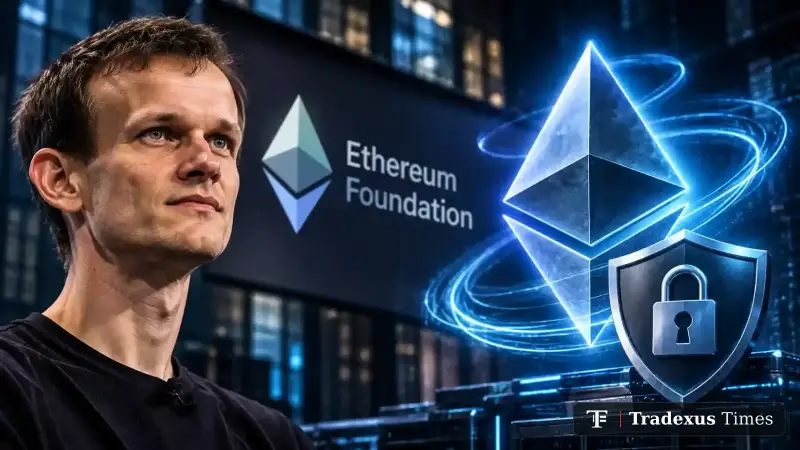
The Foundation is preparing one of the most complex protocol transformations in the network's history, warning that replacing vulnerable cryptographic systems with quantum-resistant alternatives could prove more difficult than the 2022 Merge. The challenge is becoming increasingly urgent as artificial intelligence introduces a potentially nearer threat to existing cryptographic security.
The proposed initiative, described as PQAI, or post-quantum and post-AI, was outlined by Ethereum Foundation contributor Kev Wedderburn on November 23. The initiative reflects growing concerns that Ethereum must strengthen its security architecture before advances in computing and artificial intelligence undermine the cryptographic assumptions supporting the network.
The scale of the challenge extends beyond replacing a single cryptographic algorithm. Ethereum currently relies on Elliptic Curve Digital Signature Algorithm (ECDSA) for user accounts and Boneh-Lynn-Shacham (BLS) signatures for validator operations. Both systems depend on mathematical structures that could become vulnerable to sufficiently powerful quantum computers.
The proposed overhaul involves three major components. Validator signatures would transition toward hash-based cryptography, allowing consensus finality to operate without relying on elliptic-curve signatures. User accounts would also need compatible hash-based signature mechanisms, while data commitments associated with rollup blobs would undergo corresponding changes.
The Foundation has selected hash-based cryptography following more than a year of evaluating potential signature schemes. According to Wedderburn, this approach avoids introducing entirely new security assumptions because Ethereum already relies on the security properties of cryptographic hash functions.
However, implementing the transition across the network presents substantial engineering and compatibility challenges. Wallets, staking pools, multisignature systems and existing smart contracts may require modifications. Infrastructure operators must also account for larger cryptographic signatures, which could increase storage, bandwidth and computational requirements.
The difference in signature size illustrates the technical implications. A conventional elliptic-curve signature occupies approximately 64 bytes, while the ML-DSA-44 post-quantum standard requires 2,420 bytes. Such an increase could affect the efficiency of transaction processing and validator infrastructure, making implementation choices particularly important for maintaining Ethereum's accessibility to independent node operators.
The Foundation is also increasing its security resources to reduce the possibility of introducing vulnerabilities during development. Its protocol security team has doubled in size, while formal verification and broader security reviews are expected to advance alongside protocol engineering. A preliminary consensus-layer development network, known as pq-cl, is already being refined as part of the testing process.
Yet the most consequential aspect of the initiative may be the Foundation's changing assessment of the threat timeline. Wedderburn argues that artificial intelligence has become a more immediate concern than quantum computing hardware itself. Advanced AI systems are increasingly capable of identifying software vulnerabilities at speeds that could exceed the capacity of human security teams to review and address them.
More importantly, AI could potentially accelerate mathematical research and expose weaknesses in existing cryptographic assumptions without requiring the development of a large-scale quantum computer. If sufficiently advanced models discover more efficient approaches to attacking elliptic-curve mathematics, cryptographic systems currently considered secure could face a much shorter protection window.
This concern is consistent with earlier warnings from Ethereum researcher Justin Drake, who discussed the possibility that existing signature schemes could become insecure within months under an extreme scenario. Drake previously suggested December 2028 as a potential target for the transition, while the Foundation's stated deadline remains December 2029. A timeline reassessment is planned for January.
The development is already influencing Ethereum's upgrade priorities. To free engineering resources for post-quantum work, Ethlabs has withdrawn its Quick Slots proposal from the Hegotá upgrade. Developers are also expected to consider removing additional functionality from the planned fork as they prioritize security-related development.
Another concern involves the exposure of public keys. Approximately 42 million ETH, representing 54.6% of ETH on Ethereum's execution layer, is associated with public keys disclosed through previous transactions, according to the figures cited in the source material. This does not indicate an active attack or immediate loss of funds, but it highlights the potential scale of exposure if current cryptographic assumptions were eventually compromised.
At the time covered by the report, ETH was trading at $1,663, down 1.8% over 24 hours. While the immediate price movement does not establish a direct market reaction to the security initiative, the long-term implications could be significant for Ethereum's infrastructure, development priorities and institutional perception of network resilience.
Ultimately, Ethereum's post-quantum transition is no longer simply a precaution against a distant technological possibility. It is becoming a broader security challenge involving cryptography, software vulnerabilities, network compatibility and the accelerating capabilities of AI. The progress of pq-cl, the January timeline review and the Foundation's ability to coordinate a network-wide transition will be important developments to watch as Ethereum prepares for its next major architectural transformation.